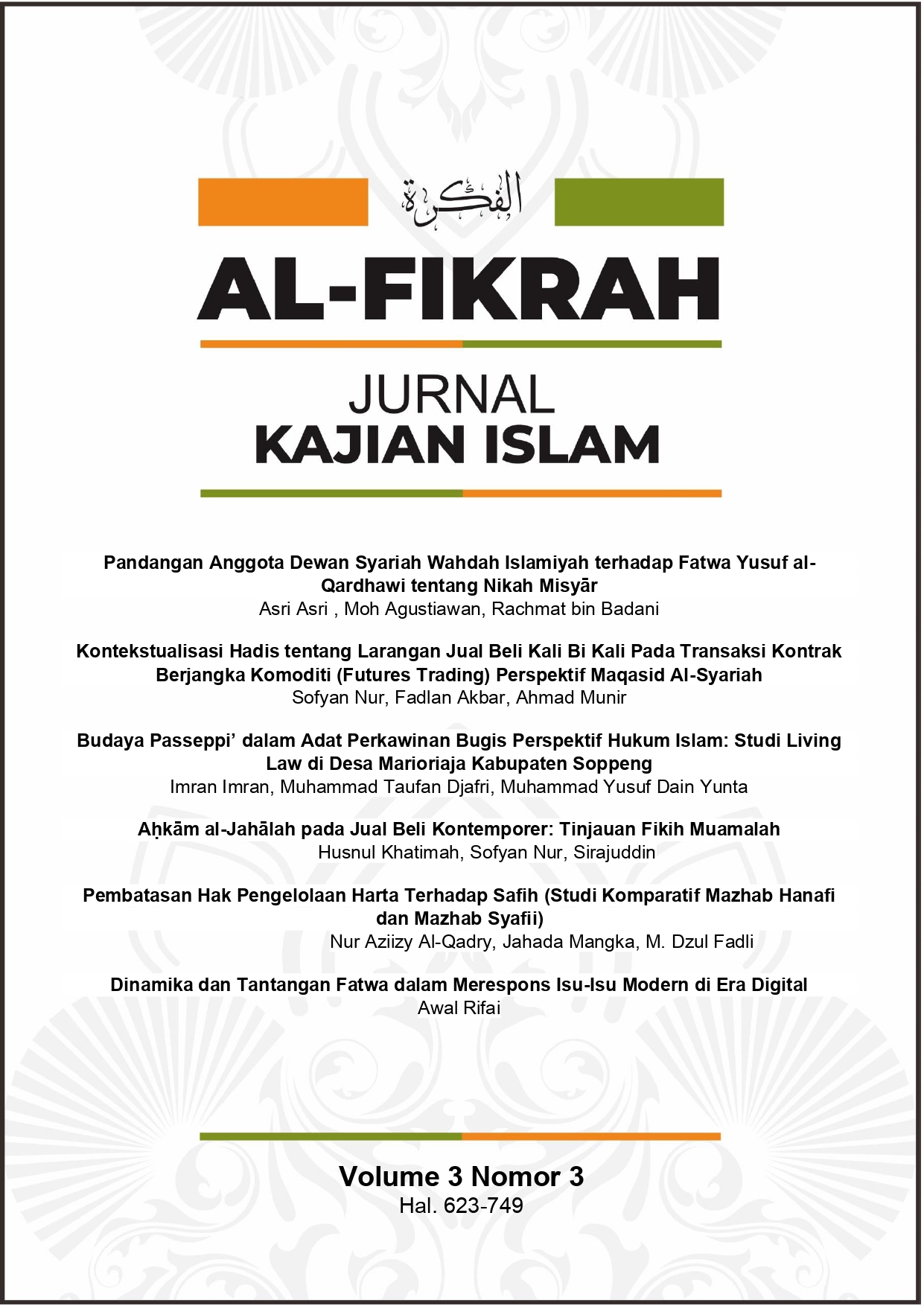
Dinamika dan Tantangan Fatwa dalam Merespons Isu-Isu Modern di Era Digital
The Dynamics of Fatwas in Responding to Modern Issues in the Digital Era
DOI:
https://doi.org/10.36701/fikrah.v3i3.3698Keywords:
Fatwa, Ijtihad, Contemporary Issues, Digital Era, Religious AuthorityAbstract
Fatwas are an important instrument in Islamic law that provide guidance on various issues encountered by Muslim communities. As products of ijtihad, fatwas are dynamic in nature and may change in response to changing circumstances, needs, and developments in human life. Advances in science and technology have not only generated various contemporary issues but have also transformed the ways in which fatwas are produced and disseminated within society. This study aims to analyze the dynamics of fatwas in responding to social changes and various modern issues, as well as to identify the challenges facing fatwas in the digital era, particularly with regard to religious authority and the dissemination of Islamic legal opinions. This study employs a library research method using a normative-conceptual approach. The data were obtained from the Qur’an, Hadith, works of Islamic jurisprudence and legal theory (uṣūl al-fiqh), fatwas issued by religious institutions, and relevant scholarly literature, which were then analyzed descriptively and analytically. The findings indicate that fatwas possess an adaptive capacity to respond to various developments, including issues in bioethics, Islamic economics, digital technology, and artificial intelligence. Such adaptability remains subject to the fundamental principles of Islamic law, the methodology of ijtihad, and the pursuit of public benefit (maṣlaḥah). At the same time, digitalization presents challenges in the form of shifting religious authority, the emergence of instant fatwas, the simplification of complex legal issues, fragmentation of religious understanding, and polarization within society. Therefore, developments in the digital era need to be addressed by strengthening scholarly authority and digital religious literacy, while utilizing technology as a means of disseminating fatwas that are credible, contextual, and firmly grounded in the principles of Islamic law.
Downloads
References
Altsaury, Roychan Abdul Aziz, M. S. Hidayatullah, J. Lutfi, and A. As’ad. “Analisis Fatwa MUI No. 24 Tahun 2017 dalam Menjawab Tantangan Etika dan Transparansi Transaksi Virtual: Studi Kasus pada Platform E-Commerce Shopee dan Tokopedia.” Aiconomia: Jurnal Hukum Ekonomi Syariah 3, no. 2 (2024): 79–91. https://doi.org/10.32939/acm.v3i3.4365.
Asmar, Afidatul, Suf Kasman, and Firdaus Muhammad. “Fatwa Online dan Otoritas Islam: Kajian Dampak Media Baru terhadap Aturan Agama.” Jurnal Riset Mahasiswa Dakwah dan Komunikasi 5, no. 2 (2023): 179–192. https://doi.org/10.24014/jrmdk.v5i3.24487.
Baiquni, Ahmad, A. R. Al Biruni, and Juhardin. “Artificial Intelligence in Islamic Philosophy: A Qur'anic Epistemological Framework for AI Ethics.” Madinah: Jurnal Studi Islam 13, no. 1 (2026): 135–147. https://doi.org/10.58518/madinah.v13i1.4693.
Basri, Rusdaya. “Ibnu Qayyim al-Jawziyyah tentang Pengaruh Perubahan Sosial.” Al-Manahij: Jurnal Kajian Hukum Islam 9, no. 2 (2015). https://doi.org/10.24090/mnh.v9i2.489.
Fikri, Shofil, Risma Rokyul Aini, Bening Mulyowati, and Fawwaz Sobirin Adrebi. “Penggunaan Prinsip al-Jarh wa al-Taʿdil dalam Menyaring Fatwa-Fatwa Digital di Platform Media Sosial.” Tarbawi: Jurnal Pendidikan dan Keagamaan 12, no. 2 (2024): 19–34. https://doi.org/10.62748/tarbawi.v12i2.99.
al-Ghazālī, Abū Ḥāmid Muḥammad ibn Muḥammad. al-Mustaṣfā min ʿIlm al-Uṣūl. 2nd ed. Beirut: Dār al-Kutub al-ʿIlmiyyah, 1993.
Gunawan, Azi. “Algoritma sebagai Mimbar: Analisis Personalisasi Konten Keagamaan pada Media Sosial terhadap Moderasi Beragama.” IKHBAR: Jurnal Ilmu Dakwah dan Komunikasi 1, no. 2 (2026): 45–58. https://doi.org/10.62504/ikhbar.v1i2.12.
Gunawan, M. Indra. “Ijtihad dan Perubahan Sosial pada Masyarakat Kontemporer.” MAQOSID: Jurnal Studi Keislaman dan Hukum Ekonomi Syariah 9, no. 1 (2021): 18–36. https://doi.org/10.37216/maqosid.v9i01.492.
Hasanudin, Fuat. “Ijtihad Maqashidi: Metodologi dan Kontekstualisasi Hukum Islam di Indonesia (Studi Fatwa-Fatwa Majelis Ulama Indonesia).” Al-Mawarid Jurnal Syariah dan Hukum 1, no. 2 (2019): 187–210. https://doi.org/10.20885/almawarid.vol1.iss2.art4.
Hidayatullah, Rahmat. “Otoritas Keagamaan Digital: Pembentukan Otoritas Islam Baru di Ruang Digital.” Ushuluna: Jurnal Ilmu Ushuluddin 10, no. 2 (2024): 1–16. https://doi.org/10.15408/ushuluna.v10i2.42831.
Ibn al-Qayyim al-Jauziyyah, Muḥammad ibn Abī Bakr. Iʿlām al-Muwaqqiʿīn ʿan Rabb al-ʿĀlamīn. Edited by Muḥammad ʿAbd al-Salām Ibrāhīm. 3rd ed. Beirut: Dār al-Kutub al-ʿIlmiyyah, 1991.
Miswanto, Agus. “Problematika Fatwa: Mempertimbangkan Tawaran Metodologi Ijtihad Ulama Kontemporer.” Jurnal Hukum Ekonomi Syariah 4, no. 2 (2021): 137–158. https://doi.org/10.30595/jhes.v4i2.11670.
Nurbaeti, Muammar Bakry, and Abdul Syatar. “Digital Transformation of Fatwa Authorities: Comparative Analysis of MUI, Bahtsul Masail, and Muhammadiyah Tarjih.” Parewa Saraq: Journal of Islamic Law and Fatwa Review 4, no. 2 (2025): 82–100. https://doi.org/10.64016/parewasaraq.v4i2.58.
al-Nūr, Muḥammad Sulaimān. “Qāʿidah Lā Yunkaru Taghayyur al-Aḥkām bi-Taghayyur al-Azmān: Dirāsah Taʾṣīliyyah Taṭbīqiyyah.” Majallah al-Syarīʿah wa al-Dirāsāt al-Islāmiyyah 26, no. 84 (2011): 235–284. https://doi.org/10.34120/jsis.v26i84.1887.
Pelu, Ibnu Elmi A. S. “Kedudukan Fatwa dalam Konstruksi Hukum Islam.” El-Mashlahah: Jurnal Hukum Islam dan Pranata Sosial 9, no. 2 (2019): 1–16. https://doi.org/10.23971/el-maslahah.v9i2.1322.
Ramadhan, Zulhari, Syarifuddin, and A. Hidayat. “Fiqih Kedokteran: Donor Organ, Transplantasi, dan Bayi Tabung (Tinjauan Hukum Islam terhadap Isu Medis Kontemporer).” Jurnal Inspirasi Pembelajaran 7, no. 1 (2026): 45–58.
Rantona, Safutra, A. Firmansyah, and R. Nugraha. “Digitalisasi Komunikasi: Dinamika Teori dan Transformasi di Era Digital.” Jurnal Mimbar Administrasi 1, no. 1 (2024): 1–15. https://doi.org/10.56444/mia.v21i1.2162.
Rizkiandi, R., A. Zamsuri, and A. D. Amri. “Tantangan Etika Teknologi dalam Pemanfaatan Artificial Intelligence: Privasi, Bias, dan Akuntabilitas dalam Pendidikan di Indonesia.” Prosiding SEMASTER: Seminar Nasional Teknologi Informasi & Ilmu Komputer 4, no. 1 (2025): 65–71. https://doi.org/10.31849/r0b2fm79.
Rizkiyah, Lujeng. “Analisis Fatwa MUI No. 13 Tahun 2019 tentang Transplantasi Organ dan Jaringan Tubuh dari Orang Hidup untuk Orang Lain.” Tahkim: Jurnal Hukum dan Syariah 20, no. 1 (2024): 69–84. https://doi.org/10.33477/thk.v20i1.2971.
Sulaiman, Majdi. “Hukum AI Bertindak sebagai Penulis dan Khatib Jumat.” Al-Bashirah: Jurnal Studi Islam 4, no. 2 (2023): 211–230. https://doi.org/10.36701/bashirah.v4i2.1106.
Wahab, Awal Rifai. “Peradilan Islam pada Masa Rasulullah dan Khulafaurasyidin: Studi Komparatif Peradilan Islam Era Klasik.” Bustanul Fuqaha 3, no. 1 (2021): 37–52. https://doi.org/10.36701/bustanul.v3i1.295.
Wiḥdah al-Baḥth al-ʿIlmī bi-Idārat al-Iftāʾ. al-Madhāhib al-Fiqhiyyah al-Arbaʿah: Aʾimmatuhā, Aṭwāruhā, Uṣūluhā, Āthāruhā. 1st ed. Kuwait: Wizārat al-Awqāf wa al-Syuʾūn al-Islāmiyyah, 2015.
Downloads
Published
Issue
Section
License
Copyright (c) 2026 Awal Rifai

This work is licensed under a Creative Commons Attribution-NonCommercial-ShareAlike 4.0 International License.