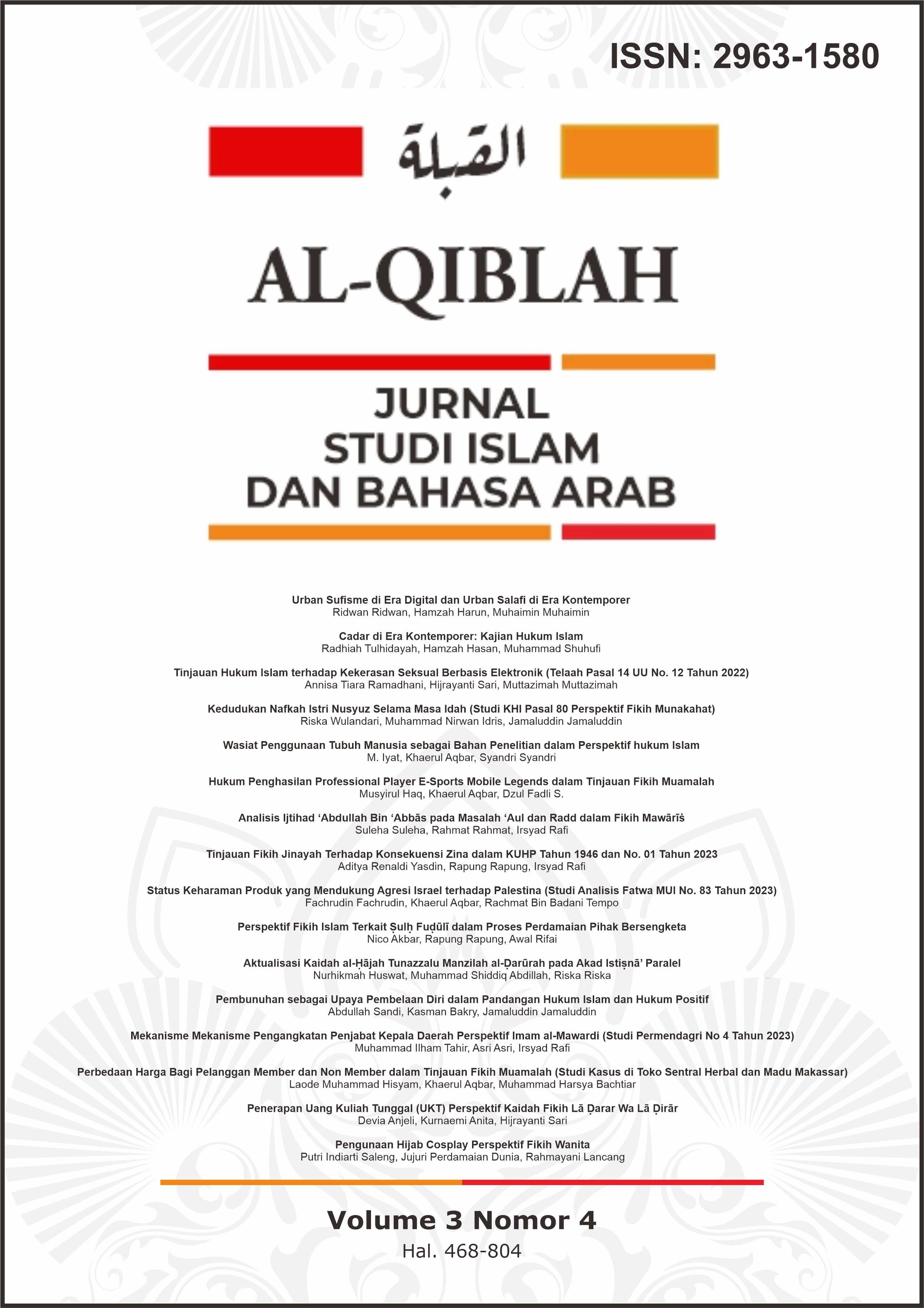
Cadar di Era Kontemporer: Kajian Hukum Islam
The Veil in the Contemporary Era: a Study of Islamic Law
DOI:
https://doi.org/10.36701/qiblah.v3i4.1578Keywords:
cadar, contemporary, Islamic LawAbstract
The purpose of this research is to find out the view of Islamic law on the use of the veil in the contemporary era. This type of research is qualitative research in the form of literature (library research) with the approach used, namely the normative theological approach. The research data is obtained from various sources, such as the Qur'an, hadith, fiqh books and scientific journals. The research results of the discussion of the veil in the contemporary era, namely Islamic law guarantees individual rights to embrace and practice religious teachings, including wearing the veil for Muslim women without discrimination. The veil is a symbol of obedience and Muslim identity. However, it is often associated with discrimination and negative stigma. Veiled women must obey religious rules, maintain good manners, ethics in dressing according to sharia, and respect norms and culture, thus creating relevance between the wisdom and identity of Muslim women in the modern era. This research provides a new contribution in understanding the relevance of the veil in the contemporary era through the lens of Islamic law and its implications for women's rights and obligations. This research is expected to provide a more comprehensive and tolerant understanding of the veil issue for academics, legal practitioners, religious leaders, and society as a whole.
Downloads



 FOCUS AND SCOPE
 EDITORIAL TEAM