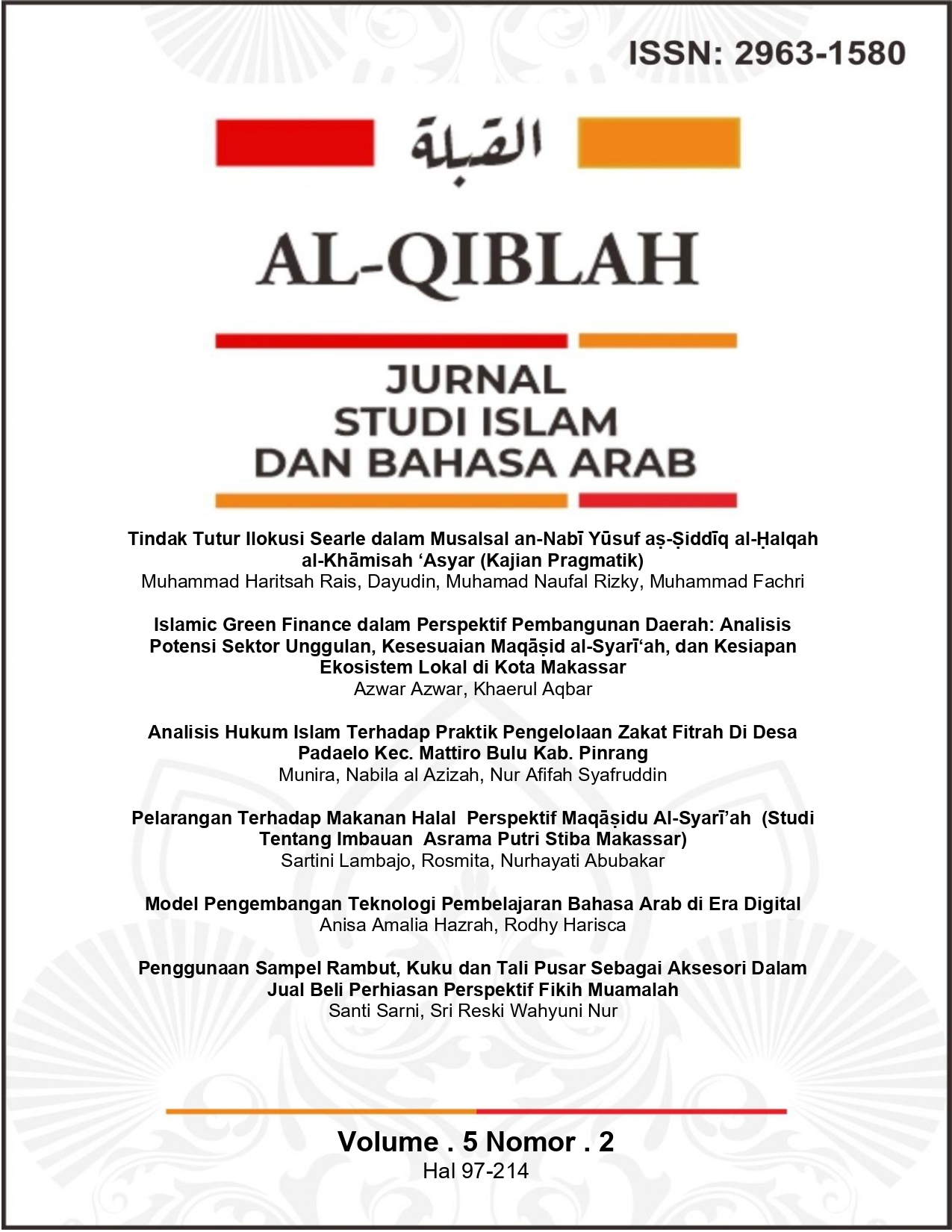
Model Pengembangan Teknologi Pembelajaran Bahasa Arab di Era Digital
A Development Model of Technology for Arabic Language Learning in the Digital Era
DOI:
https://doi.org/10.36701/al-qiblah.v5i2.2752Keywords:
Educational technology, Arabic learning, digital era, development modelAbstract
This study explores the discourse within the field of educational technology with a specific focus on the development of technology-based models for Arabic language learning in the digital era. The purpose of this research is to formulate a relevant and adaptive development model that supports modern learning demands for Arabic learners amid the rapid advancement of digital technologies. Employing a qualitative literature-based approach, this study analyzes theories of educational technology, instructional design models, and various digital implementations in Arabic language learning. Data were analyzed through reduction, classification, and synthesis to produce coherent conceptual patterns. The findings indicate that an effective development model in the digital era must integrate interactive multimedia, flexible online platforms, personalized learning, and strong support for self-directed learning. The contribution of this study lies in presenting a conceptual model that can serve as a reference for educators, researchers, and media developers in designing more innovative and contextual Arabic learning technologies. This study highlights the strategic role of educational technology in improving the quality of Arabic language learning in the digital era.
Downloads
References
Huda, Khoirul, and Nawang Wulandari. “Media Pembelajaran Bahasa Arab Berbasis E-Learning” 1, no. 2 (2022): 191–210. https://doi.org/10.15408/kjar.v1i2.28277.
I. Maita. “‘Pembelajaran Interaktif Bahasa Arab Berbasis Android,.’” Jurnal Pusat Bahasa (UIN Suska Riau), 2023. https://doi.org/http://dx.doi.org/10.24014/rmsi.v4i2.6227.
Lubis, M Syukri Azwar, Endang Fatmawati, Emy Yunita, and Rahma Pratiwi. “UNDERSTANDING CURRICULUM TRANSFORMATION TOWARDS EDUCATIONAL INNOVATION IN THE ERA OF ALL - DIGITAL TECHNOLOGY” 5, no. 2 (2022): 526–42. https://doi.org/https://doi.org/10.31538/nzh.v5i2.2110.
Nesti, Elisabeth Gustina, Trisnawati Bura, and Katharina Woli Namang. “Penerapan Teknologi Digital Dalam Pembelajaran Bahasa Indonesia Di Universitas Muhammadyah Maumere” 2 (2024). https://doi.org/https://doi.org/10.54066/jikma.v2i6.2822.
Nita Zakiah. “Analisis Kritis Efektivitas Penggunaan Media Digital Dalam Pembelajaran Bahasa Arab Di Perguruan Tinggi.” Jurnal Review Pendidikan Dan Pengajaran 8, no. 2 (2025): 6798–6805. https://doi.org/https://doi.org/10.31004/jrpp.v8i2.48838.
Rahmat Iswanto. “Pembelajaran Bahasa Arab Dengan Pemanfaatan Teknologi.” Kaisa: Jurnal Pendidikan Dan Pembelajaran 3, no. 2 (2023): 96–106. https://doi.org/10.56633/kaisa.v3i2.484.
Rizqrabani, Navyll, Anwar Saepudin, Siti Maryam, and Maya Purnama Sari. “Pengembangan Evaluasi Pembelajaran Daring Berbasis Teknologi Untuk Kompetensi Keahlian Multimedia” 06, no. 02 (2023): 1–7. https://doi.org/10.21009/JPI.062.01.
Safitri, Aulia Sofia, Aulia Rahmah Alfattunisa, and Aulia Nur Afifah. “Efektivitas Media Interaktif Berbasis Digital Dalam Pembelajaran Bahasa Arab Untuk Siswa MI” 03, no. 2 (2025): 45–56. https://doi.org/10.55656/wjp.v3i2.355.
Sitompul, Baginda, Pendidikan Agama Kristen, and Era Digital. “Kompetensi Guru Dalam Pembelajaran Di Era Digital” 6 (2022): 13953–60. https://doi.org/https://doi.org/10.31004/jptam.v6i3.4823.
Sopian, Asep, Rinaldi Supriadi, Mia Nurmala, Farhan Fuadi, and Yusuf Ali Tantowi. “Meningkatkan Kompetensi Pedagogis Guru Bahasa Arab DDengan Pendekatan Design Didactic Research ( DDR ): Studi Pengabdian Di SD Teladan , Yogyakarta” 6, no. 1 (2026): 69–78.
Wahyu Setia Ningsih, Zulkipli Jemain. “Evakuasi Kurikulum Digital Dalam Pendidikan Islam,” 2023, 154–58. https://doi.org/10.61116/jp3t.v1i4.384.
Wahyuni, Imelda. “Digital Innovation in Arabic Language Learning Models for Islamic Higher Education” 21 (2024): 137–51. https://doi.org/https://doi.org/10.28918/jupe.v21i2.2279.
Downloads
Published
Issue
Section
License
Copyright (c) 2026 Anisa Amalia Hazrah, Rodhy Harisca

This work is licensed under a Creative Commons Attribution-NonCommercial-ShareAlike 4.0 International License.


 FOCUS AND SCOPE
 EDITORIAL TEAM