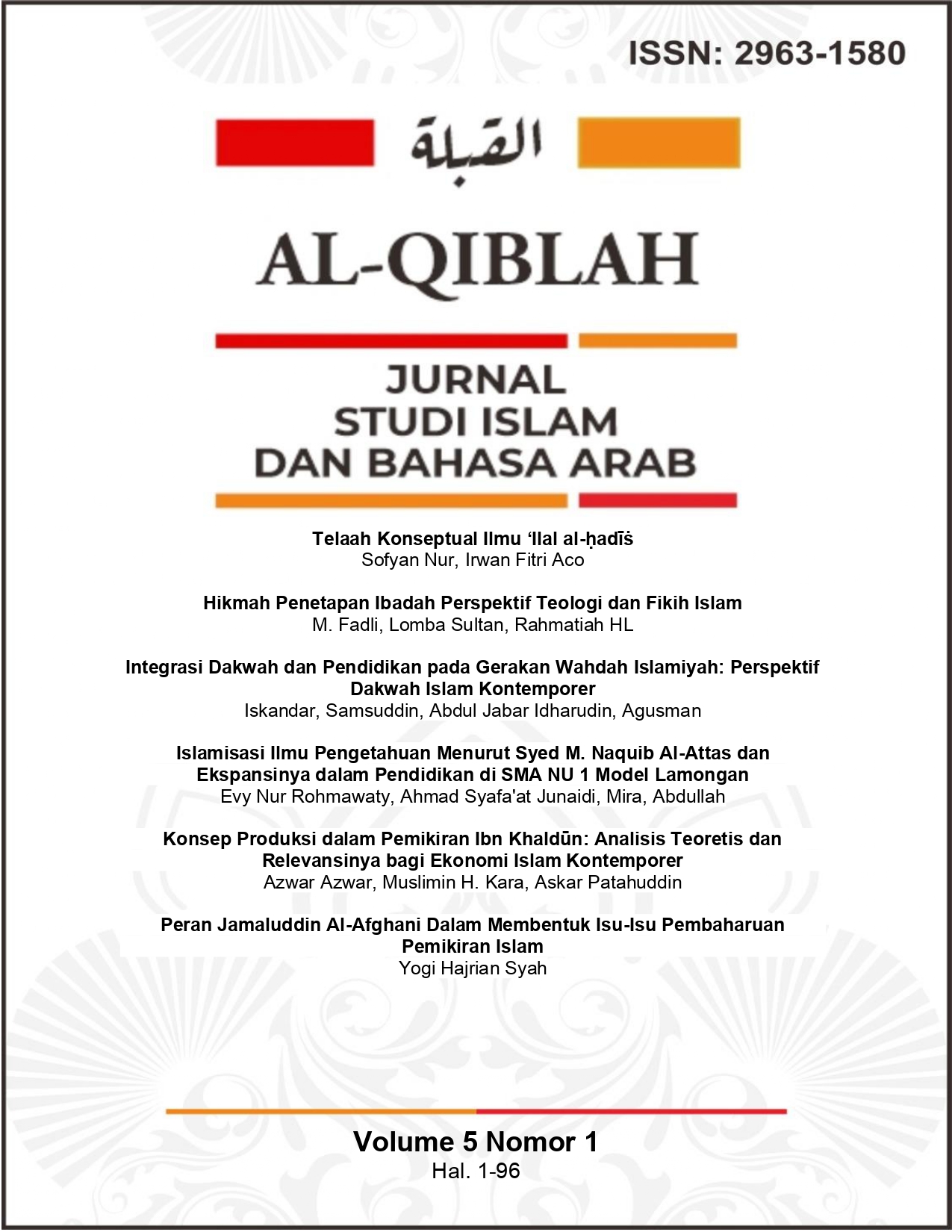
Konsep Produksi dalam Pemikiran Ibn Khaldūn: Analisis Teoretis dan Relevansinya bagi Ekonomi Islam Kontemporer
The Concept of Production in Ibn Khaldūn's Thought: Theoretical Analysis and Its Relevance for Contemporary Islamic Economics
DOI:
https://doi.org/10.36701/al-qiblah.v5i1.2794Keywords:
Ibn Khaldūn, production, Islamic economics, halal industry, ʿumrānAbstract
This study aims to describe the concept of production in Ibn Khaldūn’s thought, analyze its philosophical, normative, and historical foundations, and evaluate its relevance to the development of contemporary Islamic economics, particularly the halal industry. The study employs a qualitative-descriptive approach based on library research, using content analysis of Ibn Khaldūn’s Muqaddimah and related literature to examine the concept of production within the context of the modern economy. The findings indicate that, in Ibn Khaldūn’s perspective, production is an integral part of civilization (‘umrān) and is not merely understood as a technical process, but also as a social activity involving human labor, division of labor, social solidarity (‘asabiyyah), and institutional strengthening. His concept of production is rooted in Sharīʿah values such as justice and maṣlaḥah, and is shaped by historical and political experiences that form a comprehensive view of the relationship between state stability, productive capacity, and societal welfare. Furthermore, the study highlights that Ibn Khaldūn’s thought remains highly relevant to contemporary Islamic economics. Its principles can serve as a foundation for strengthening the halal industry through improving human capital quality, institutional governance, halal certification, access to Islamic finance, and equitable fiscal policies. Therefore, Ibn Khaldūn’s concept of production offers a rich and applicable analytical framework for sustainable Islamic economic development. The implication is that this framework can be used as a conceptual basis for formulating policies and strategies for sustainable and socially oriented halal industry development.
Downloads
References
Al-Khudhairi, Zainab. Filsafat Sejarah Ibn Khaldun, Terj. Edited by Ahmad Rofi’Usmani. Bandung: Pustaka, 1987.
Amri, Ulil. “Analysis Study of Ibnu Khaldun’s Islamic Economic Thought.” Indonesian Journal of Multidisciplinary Sciences (Ijoms) 1, no. 2 (2022): 141–52. https://doi.org/10.59066/ijoms.v1i2.212.
Auliya, Nur Hikmatul, Helmina Andriani, Roushandy Asri Fardani, Jumari Ustiawaty, Evi Fatmi Utami, Dhika Juliana Sukmana, and Ria Rahmatul Istiqomah. Metode Penelitian Kualitatif & Kuantitatif. Makassar: CV. Pustaka Ilmu, 2020. https://www.researchgate.net/publication/340021548_Buku_Metode_Penelitian_Kualitatif_Kuantitatif.
Henry, Khairil. “Konsep Ekonomi Ibnu Khaldun Dan Relevansinya Dengan Teori Ekonomi Modern (Studi Analisis Konsep Ekonomi Dalam Kitab Muqaddimah).” Al-Fikra: Jurnal Ilmiah Keislaman 19, no. 1 (2020).
Huda, Choirul. “Pemikiran Ekonomi Bapak Ekonomi Islam; Ibnu Khaldun.” Economica: Jurnal Ekonomi Islam 4, no. 1 (2013): 103–24.
Ibn Khaldūn, ‘Abd al-Raḥmān. Dīwān Al-Mubtada’ Wa Al-Khabar Fī Tārīkh Al-‘Arab Wa Al-Barbar Wa Man ‘Āṣarahum Min Dhawī Al-Sya’n Al-Akbar. Bairūt: Dār al-Fikr, 1981.
Ibn Khaldūn, Abdurrahman. Muqaddimah Ibn Khaldūn. Edited by Abdullāh Muḥammad Al-Darwīsy. 1st ed. Dimasyq: Dār Ya’rib, 2004. https://archive.org/details/diwan_20170911_2151/مقدمة ابن خلدون - الجزء الاول/page/n3/mode/2up.
Ihwanudin, Nandang, and M Burhanudin. “Relavansi Pemikiran Ekonomi Hamka (1908-1981) Dalam Tafsir Al-Azhar Dengan Ekonomi Islam Di Indonesia.” Eco-Iqtishodi: Jurnal Ilmiah Ekonomi Dan Keuangan Syariah 1, no. 2 (2020): 97–115.
Jaida, Syafitri, Salsabila Balqis, and Rauf Margana. “Pemikiran Ekonomi Pada Masa Ibnu Khaldun.” Pajamkeu 2, no. 3 (2025): 75–84. https://doi.org/10.61132/pajamkeu.v2i3.1262.
Kotimah, Kotimah, and Nurul A’yun. “Konsep Pemikiran Ekonomi Islam Ibnu Khaldun.” IJMA (Indonesian Journal of Management and Accounting) 4, no. 2 (2023): 428–37.
Mafrudlo, Ahmad M, Zuhratul A Mansur, Mustofa Mustofa, and Yadi Janwari. “Economic Development Theory of Ibnu Khaldun: Interrelation Between Justice and Umran Al-Alam.” Share Jurnal Ekonomi Dan Keuangan Islam 13, no. 1 (2024): 43–70. https://doi.org/10.22373/share.v13i1.20552.
Maleha, Nova Yanti. “Studi Pemikiran Ibn Khaldun Tentang Ekonomi Islam.” Ekonomica Sharia: Jurnal Pemikiran Dan Pengembangan Ekonomi Syariah 2, no. 1 (2016): 39–48.
Maulida, Syahdatul, and Aam S Rusydiana. “Mapping the Literature on Ibn Khaldun’s Contribution to Economics.” Ieh 2, no. 1 (2023). https://doi.org/10.58968/ieh.v2i1.264.
Rahmah, Syahidah, Sri Wahyuni, and Nur Yusaerah. “Strengthening The Halal Value Chain Ecosystem in Era Society 5.0.” Al-Mashrafiyah: Jurnal Ekonomi, Keuangan, Dan Perbankan Syariah 7, no. 2 (2023): 1–12. https://doi.org/https://doi.org/10.24252/al-mashrafiyah.v7i2.38490.
Rizkiah, Siti K, and Abdelkader Chachi. “The Relevance of Ibn Khaldun’s Economic Thought in the Contemporary World.” Turkish Journal of Islamic Economics 7, no. 2 (2020): 70–90. https://doi.org/10.26414/a074.
Schreier, Margrit. Qualitative Content Analysis in Practice. Sage publications, 2012.
Ulum, Bahrul. “Kontribusi Ibnu Khaldun Terhadap Perkembangan Ekonomi Islam.” Iqtishodia: Jurnal Ekonomi Syariah 1, no. 2 (2016): 17–32.
Wahyudi, Catur, and Anton Bawono. “Konsep Produksi Dan Uang Menurut Ibnu Kholdun Dan Relevansinya Pada Perekonomian Di Indonesia.” Innovative: Journal Of Social Science Research 4, no. 6 (2024): 5867–80.
Zaini, Ahmad Afan. “Ekonomi Islam Dalam Konsep Ontologi, Epistemologi Dan Aksiologi.” AL-MAQASHID: Journal of Economics and Islamic Business 1, no. 1 (2021): 42–50.
Downloads
Published
Issue
Section
License
Copyright (c) 2026 Azwar Azwar, Muslimin H. Kara

This work is licensed under a Creative Commons Attribution-NonCommercial-ShareAlike 4.0 International License.



 FOCUS AND SCOPE
 EDITORIAL TEAM