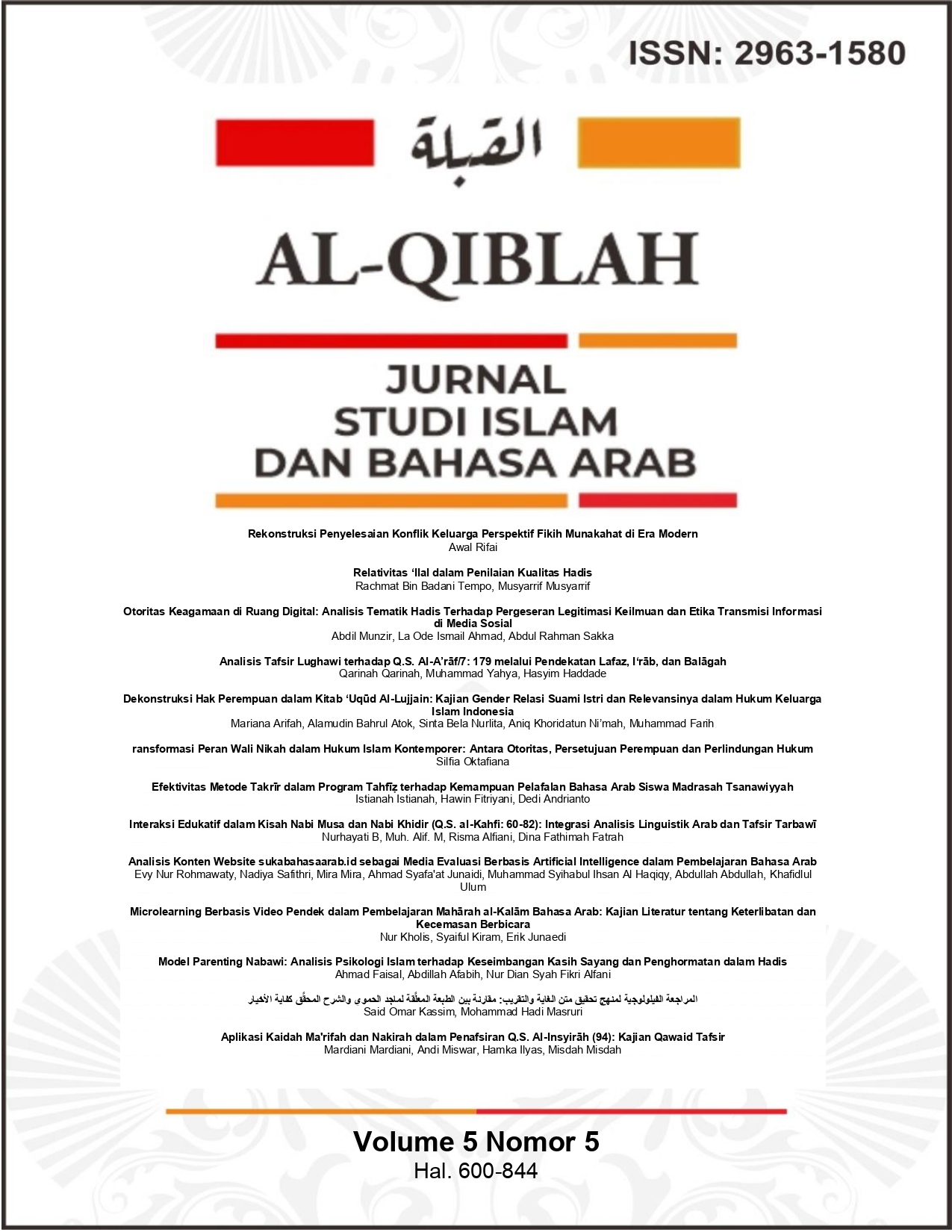
Otoritas Keagamaan di Ruang Digital: Analisis Tematik Hadis Terhadap Pergeseran Legitimasi Keilmuan dan Etika Transmisi Informasi di Media Sosial
Religious Authority in the Digital Space: Hadith Thematic Analysis of the Shift in Academic Legitimacy and Information Transmission Ethics on Social Media
DOI:
https://doi.org/10.36701/qiblah.v5i5.3591Keywords:
Religious Authority, Social Media, Thematic Hadith, Digital Tabayyun, UlamaAbstract
The digital era has fundamentally disrupted the structure of traditional religious authority within contemporary Muslim societies. Public legitimacy has shifted from formal, scholarship-based institutions toward performative figures who adeptly leverage social media. This study aims to critically analyze this socio-religious phenomenon through a thematic hadith approach (maudhu’i). The method employed is descriptive qualitative based on library research. This study evaluates prophetic traditions regarding the gradual loss of religious knowledge, the moral responsibility of information transmission, and the social dangers of pseudo-authority. Primary data were gathered from the Kutubus Sittah literature specifically Sahih al-Bukhari and Sahih Muslim—while secondary data were collected from contemporary academic journals on religion, new media, and cyber-sociology. The results reveal that popularity mechanisms on social media potentially create space for the emergence of religious figures who do not always possess academic legitimacy. Consequently, digital platforms frequently elevate incompetent individuals—conceptually identified in prophetic traditions as "ignorant leaders" (ru’ūsan juhhālan) to issue instant fatwas without a solid foundation in Islamic legal methodology (ushul fikih). This epistemological shift poses a severe risk of triggering widespread theological distortion and social polarization among lay audiences. As a practical solution to this crisis of cyber-authority, this study formulates an operational framework termed "Digital Tabayyun." This framework adapts the critical methodology of classical hadith scholars into the virtual space through four primary filters: source verification (sanad validation), content authentication (matan verification), contextual analysis (asbab al-wurud), and ethical impact assessment (maslahah analysis). The implementation of this framework is expected to safeguard the authenticity of Islamic teachings and curb the flow of misleading religious information on social media.
Downloads
References
Al-Quran al-Karim
Abdillah. “Etika Medsos dan Pedoman Tabayyun.” Gunung Djati Conference Series 24 (2023).
Ahmad, Arifuddin. Metodologi Pemahaman Hadis: Kajian Ilmu Ma'ani al-Hadis. Makassar: Alauddin University Press, 2012.
Al-Asqalani, Ibnu Hajar. Fath al-Bari Sharh Shahih al-Bukhari. Kairo: Dar al-Hadith, 2004.
Al-Baghdadi, Al-Khatib. Al-Kifayah fi 'Ilm al-Riwayah. Hyderabad: Da'irat al-Ma'arif al-Usmaniyyah, 1938.
Al-Bukhari, Muhammad bin Ismail. Sahih al-Bukhari. Beirut: Dar Ibn Katsir, 1993.
Al-Nawawi, Yahya bin Syaraf. Al-Minhaj Sharh Shahih Muslim bin al-Hajjaj (Syarh Shahih Muslim). Beirut: Dar Ihya al-Turath al-'Arabi, 1972.
Amin, Kamaruddin. Menguji Kembali Keakuratan Metode Kritik Hadis. Jakarta: Mizan, 2009.
Aslam, S. “Pergeseran Otoritas Keagamaan Di Era Media Sosial: Tantangan Otentisitas Tafsir Dalam Konten Digital.” ISME 3, no. 2 (2025).
Azra, Azyumardi. Jaringan Ulama Timur Tengah dan Kepulauan Nusantara Abad XVII & XVIII. Jakarta: Kencana, 2013.
Bin Hanbal, Ahmad. Musnad Ahmad bin Hanbal. Beirut: Mu'assasat al-Risalah, 2001.
Fauzi, A. & M. Amin. “Popularitas vs. Otoritas: Analisis Otoritas Keagamaan Pendakwah Media Sosial.” Jurnal Komunikasi dan Dakwah Digital 4, no. 1 (2023).
Hidayatullah, R. “Otoritas Keagamaan Digital: Pembentukan Otoritas Islam Baru di Ruang Digital.” Jurnal Ilmu Ushuluddin 10 (2024).
Indriyani, Putri Isma & Khadiq. “Digital Transformation of Religious Practice in the Islamic World.” Jurnal Dakwah 24 (2023).
Ismail, M. Syuhudi. Hadis Nabi yang Tekstual dan Kontekstual: Telaah Ma'ani al-Hadis tentang Ajaran Islam yang Universal, Temporal, dan Lokal. Jakarta: Bulan Bintang, 1994.
Istiqomah, D. et al. “Tafsir Digital: Antara Adaptasi dan Krisis Otoritas Keagamaan.” Lathaif 4, no. 1 (2025).
Muhibudin, et al. “Transformasi Otoritas Keagamaan di Era Digital: Analisis Sosiologis Terhadap Pergeseran Pola Otoritas Ulama di Media Sosial.” Al-Muqaddimah 1, no. 1 (2025).
Muslim bin al-Hajjaj. Shahih Muslim (Al-Jami' al-Sahih). Kairo: Dar al-Thiba'ah al-'Amirah, 1330 H.
Mustaqim, Abdul. Ilmu Ma'anil Hadits: Paradigma Interkoneksi Berbagai Metode dan Pendekatan dalam Memahami Hadis Nabi. Yogyakarta: Idea Press, 2016.
Rachmadhani, A. “Otoritas Keagamaan di Era Media Baru.” Panangkaran 5, no. 2 (2021).
Rachman, A., T. Saumantri, & T. Hidayatulloh. “Transformation of religious authority in the digital era.” Jurnal Ilmu Dakwah 45, no. 1 (2025).
Rustandi, L. R. “Disrupsi Nilai Keagamaan dalam Dakwah Virtual.” Sangkep 3, no. 1 (2020).
Shofi, I. & Talkah. “Analisis Teori Otoritas Max Weber Dalam Kepemimpinan Multikultural.” Jurnal Kependidikan Islam 11, no. 1 (2021).
Sofiana, N. E. “Relasi Ijtihad NU, Muhammadiyah, Dan MUI.” Al Syakhsiyyah 4, no. 2 (2022).
Downloads
Published
Issue
Section
License
Copyright (c) 2026 Abdil Munzir, La Ode Ismail Ahmad, Abdul Rahman Sakka

This work is licensed under a Creative Commons Attribution-NonCommercial-ShareAlike 4.0 International License.


 FOCUS AND SCOPE
 EDITORIAL TEAM