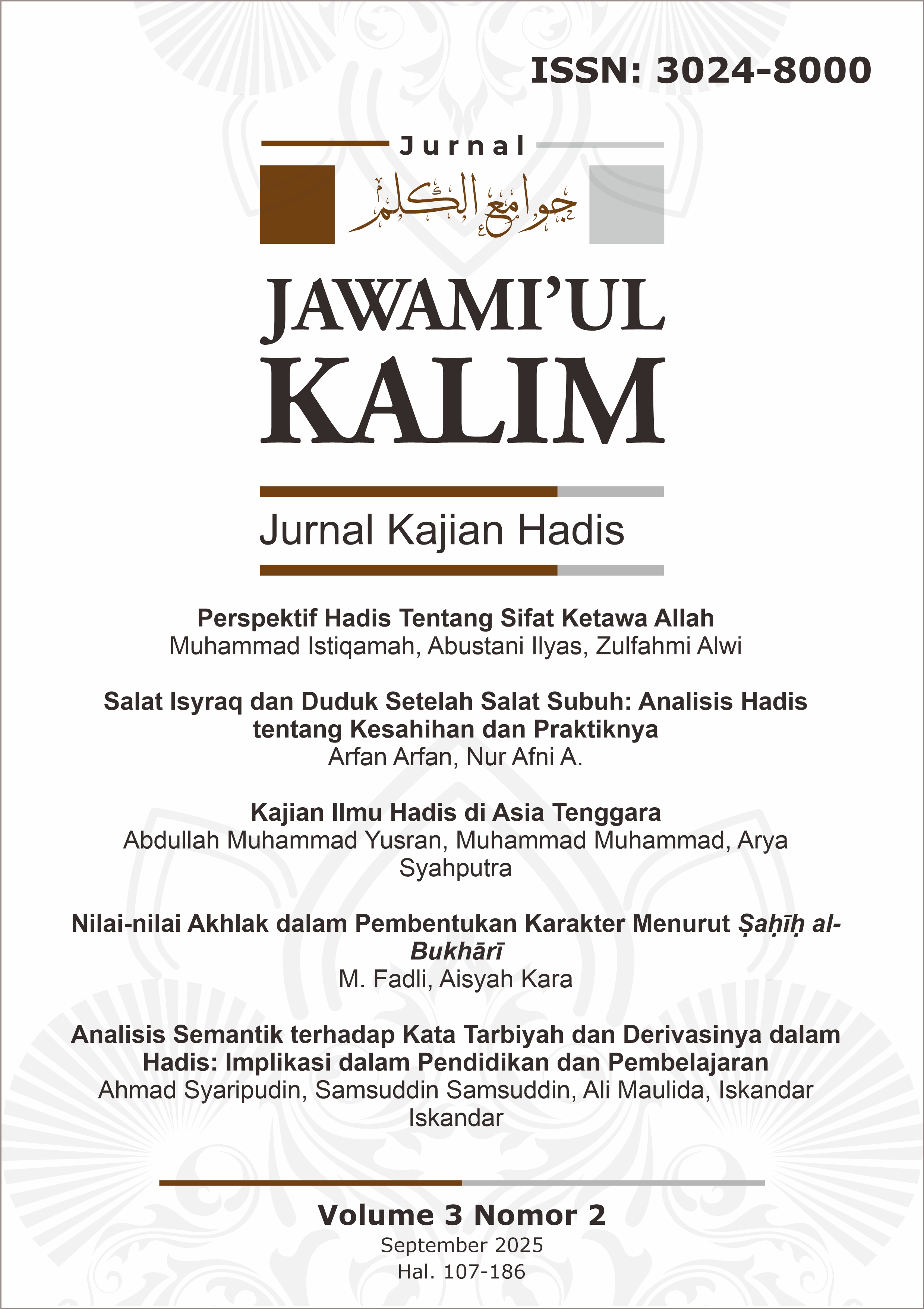
Kajian Ilmu Hadis di Asia Tenggara
The Study of Hadith Scholarship in Southeast Asia
DOI:
https://doi.org/10.36701/59wzre27Keywords:
Hadith studies, Southeast Asia, Islamic scholarship, transmission, modernizationAbstract
This article discusses the development of Hadith studies in Southeast Asia, emphasizing the historical transmission, intellectual networks, and academic transformation of the discipline. The study aims to analyze the condition and progression of Hadith scholarship in the region and to explore the contribution and dedication of Southeast Asian scholars in preserving and advancing the field. Using a qualitative approach through library research, this study examines classical and contemporary literature, including the works of early scholars such as Nuruddin ar-Raniri, Abd ar-Rauf al-Fansuri, and Mahfudz at-Tarmasi, as well as recent institutional developments in Indonesia, Malaysia, and Brunei Darussalam. The findings reveal that Hadith studies in Southeast Asia evolved from traditional oral transmission and pesantren-based education into a more systematic and academic discipline in higher education institutions. Moreover, the integration of modern methodologies—such as hermeneutical, contextual, and digital approaches—demonstrates the adaptability of Hadith studies to current scientific and societal challenges. This research contributes to Islamic studies by providing a comprehensive understanding of the continuity and renewal of Hadith scholarship in the Southeast Asian intellectual landscape.
References
Abdullah, M. Amin. Memaknai Al-Ruju’ ila Al-Qur’an wa al-Sunnah: Dari Qira’ah Taqlidiyyah ke Tarikhiyyah-Maqashidiyyah dalam Kitab Suci dan Para Pembacanya. Yogyakarta: Stelkendo, 2019.
Yusron, Abdullah Muhammad, dan Muhammad Muhammad. “Kajian Interpretasi Hadis Tentang Larangan Bagi Anak-anak untuk Keluar Rumah saat Magrib.” Jawami’ul Kalim: Jurnal Kajian Hadis 1, no. 2 (2023): 147-158.
Abdul Wahid, et al. Perkembangan Terkini Studi Hadis di Indonesia. Medan: UIN Sumatera Utara, 2018.
Amin Abdullah, Muhammad. “Islamic Studies in Higher Education in Indonesia: Challenges, Impact and Prospects for the World Community.” Al-Jami’ah: Journal of Islamic Studies (2017): 426.
Azra, Azyumardi. Jaringan Ulama Timur Tengah dan Kepulauan Nusantara Abad XVII dan XVIII. Bandung: Mizan, 1994.
———. Jaringan Ulama Timur Tengah dan Kepulauan Nusantara Abad XVII dan XVIII. Jakarta: Kencana, 2013.
Dardiri, Helmiati, et al. Sejarah Islam Asia Tenggara. Pekanbaru: Kerjasama ISAIS dan Alaf Baru, 2006.
Fathurahman, Oman. The Roots of the Writing Tradition of Ḥadīth Works in Nusantara: Hidāyāt al-Ḥabīb by Nūr al-Dīn al-Rānīrī. t.t.: t.p., t.th.
Fauzan, Ahmad. “Syekh Mahfudz al-Tarmasi: Muhaddis Nusantara.” Tahdis 9, no. 2 (2018): 119–145.
Hasan Su’udi. “Jaringan Ulama Hadis Indonesia.” Jurnal Penelitian STAIN Pekalongan 5, no. 2 (November 2008): 5.
Ibrahim Syukri. History of the Malay Kingdom of Patani. Translated by C. Bayley and J.N. Miksic. Athena: Center for International Studies, 1985.
Mahmud Yunus. Ilmu Musthalah al-Hadis. Padang: Saadiyah Putra, 1971.
Matheson, Virginia, dan M. B. Hooker. Jawi Literature in Patani. Kuala Lumpur: Oxford University Press, 1974.
Munirah. Metodologi Syaraḥ Hadis Indonesia Awal Abad ke-20. Jakarta: Mutiara Sumber Widya, 1992.
Pimpinan Pusat Muhammadiyah. Himpunan Putusan Tarjih Muhammadiyah 3. Jakarta: Suara Muhammadiyah, 2018.
Saifuddin. “Transmisi Hadis dan Kontribusinya dalam Pembentukan Jaringan Keilmuan dalam Islam.” Ilmu Ushuluddin 8, no. 2 (Juli 2009): 255–285.
Suryadi. Prospek Studi Hadis di Indonesia. Yogyakarta: Dialektika, 2017.
Syuhudi Ismail, M. Metodologi Penelitian Hadis Nabi. Jakarta: Bulan Bintang, 1992.
Wan Shagir Mohd. Abdullah. Wawasan Pemikiran Islam Ulama Asia Tenggara. Kuala Lumpur: Khazanah Fathaniyah, t.th.
Downloads
Published
Issue
Section
License
Copyright (c) 2025 Abdullah Muhammad Yusran, Muhammad Muhammad, Arya Syahputra

This work is licensed under a Creative Commons Attribution-NonCommercial-ShareAlike 4.0 International License.