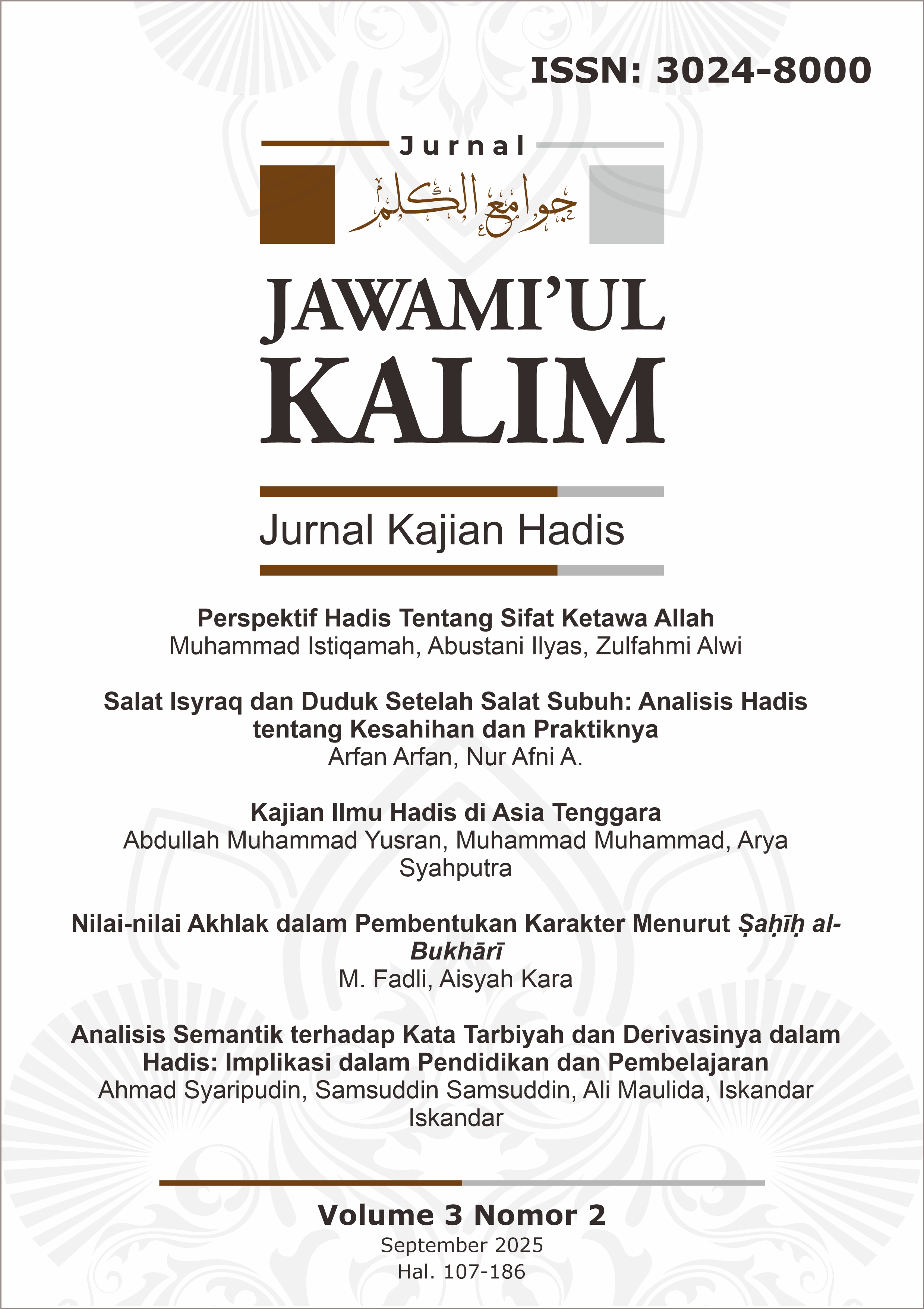
Nilai-nilai Akhlak dalam Pembentukan Karakter Menurut Ṣaḥīḥ al-Bukhārī
Moral Values in Character Formation According to Ṣaḥīḥ al-Bukhārī
DOI:
https://doi.org/10.36701/frabe856Keywords:
Moral Values, Character, Hadith, Islamic Education, Ṣaḥīḥ al-BukhārīAbstract
This study examines the moral values of character formation as reflected in the Prophet’s hadiths within Ṣaḥīḥ al-Bukhārī. It arises from the contemporary crisis of morality and character, emphasizing the need to revitalize prophetic ethics and spiritual values in Islamic education. The aim of this research is to describe the concept of character formation in the Prophet’s traditions, identify key moral values, and analyze their relevance to modern character education. Employing a qualitative method with a thematic (mawḍū‘ī) approach, primary data were collected from Ṣaḥīḥ al-Bukhārī and supported by secondary literature on hadith interpretation and Islamic education. Data were analyzed descriptively and contextually to uncover the relationship between moral values and practical character education. The findings reveal that the hadiths highlight fundamental virtues such as honesty (ṣidq), trustworthiness (amānah), patience (ḥilm), and humility (tawāḍu‘) as the foundation of a noble Muslim personality. These values establish harmony between the human–God relationship (ḥabl min Allāh) and interpersonal ethics (ḥabl min al-nās). Theoretically, this research enriches thematic hadith studies in the discipline of Islamic education; practically, it contributes to developing a hadith-based framework for moral and character education relevant to the challenges of the modern era.
References
Abū Dāwud, Sulaymān ibn al-Ash‘ath. Sunan Abī Dāwud, no. 495. Bayrūt: Dār al-Kutub al-‘Ilmiyyah, 1990.
Al-Bukhārī, Muḥammad ibn Ismā‘īl. Ṣaḥīḥ al-Bukhārī. Bayrūt: Dār Ṭawq al-Najāt, 1422 H.
Al-Nawawī, Yaḥyā ibn Syaraf. Syarḥ Ṣaḥīḥ Muslim, Jilid 2. Bayrūt: Dār al-Ma‘rifah, 1991.
Al-Qaraḍāwī, Yūsuf. Al-Akhlāq al-Islāmiyyah. Al-Qāhirah: Maktabah Wahbah, 2000.
Al-Qur’ān dan Terjemahnya.
Al-Qurṭubī, Muḥammad ibn Aḥmad. Al-Jāmi‘ li Aḥkām al-Qur’ān, Jilid 18. Bayrūt: Dār al-Kutub al-‘Ilmiyyah, 2006.
Al-Tirmiżī, Muḥammad ibn ‘Īsā. Sunan al-Tirmiżī. Bayrūt: Dār al-Kutub al-‘Ilmiyyah, 1998.
Hamka. Tasauf Modern. Jakarta: Republika, 2015.
Ibn Ḥajar al-‘Asqalānī, Aḥmad ibn ʿAlī. Fatḥ al-Bārī, Jilid 10. Bayrūt: Dār al-Ma‘rifah, 1959.
Ibn Rajab al-Ḥanbalī, Zayn al-Dīn ʿAbd al-Raḥmān. Jāmi‘ al-‘Ulūm wa al-Ḥikam. Bayrūt: Dār al-Ma‘rifah, 1997.
Ibn Manẓūr, Muḥammad ibn Mukarram. Lisān al-‘Arab, Jilid 10. Bayrūt: Dār Ṣādir, 1990.
Muslim ibn al-Ḥajjāj. Ṣaḥīḥ Muslim, no. 746. Bayrūt: Dār Iḥyā’ al-Turāth al-‘Arabī, 1991.
Quraish Shihab, M. Wawasan al-Qur’an: Tafsir Maudhu‘i atas Pelbagai Persoalan Umat. Bandung: Mizan, 2007.
Downloads
Published
Issue
Section
License
Copyright (c) 2025 M. Fadli, Aisyah Kara

This work is licensed under a Creative Commons Attribution-NonCommercial-ShareAlike 4.0 International License.