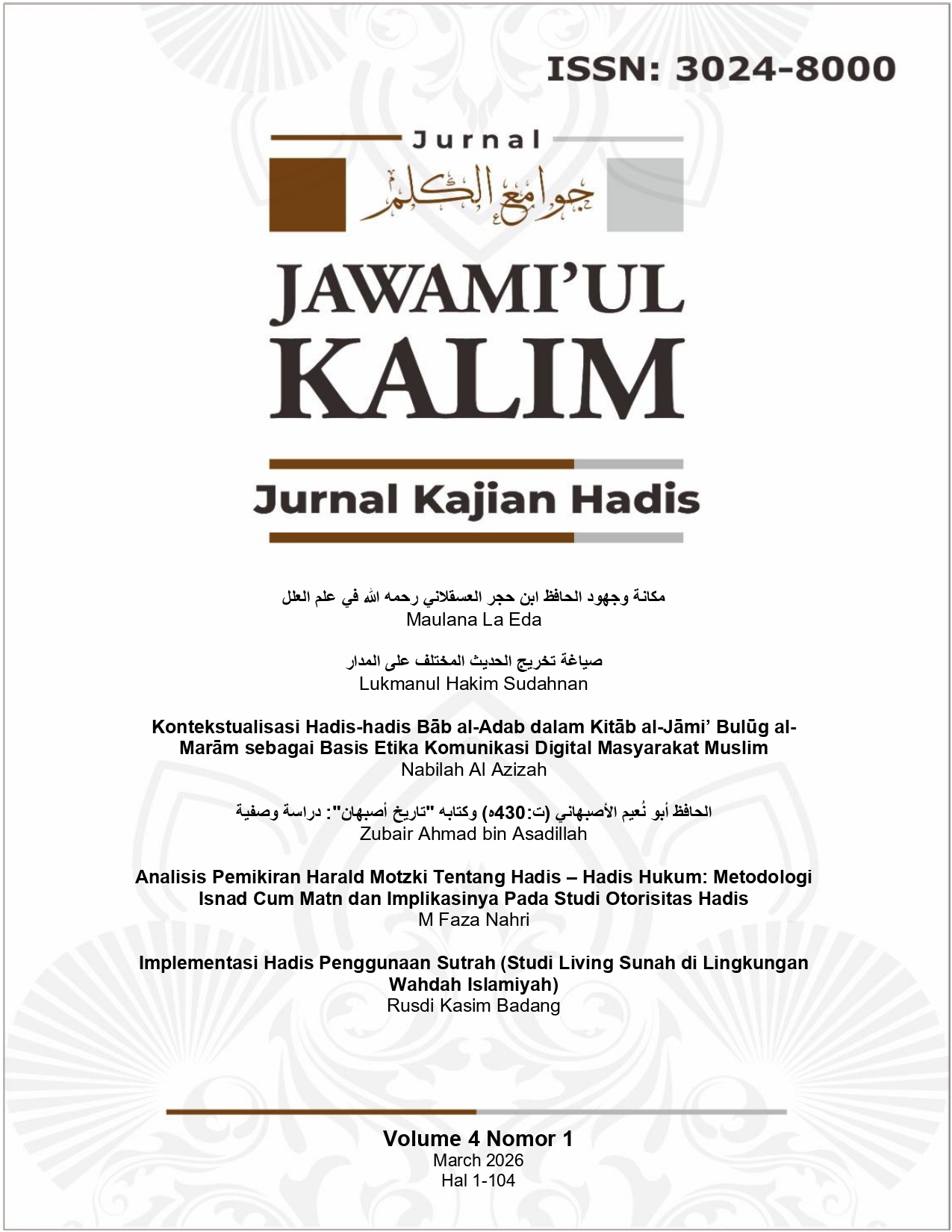
صياغة تخريج الحديث المختلف على المدار
Formulating the different interpretations of hadiths based on the syllabus
DOI:
https://doi.org/10.36701/jawamiulkalim.v4i1.3057Keywords:
Formulation, graduation, different hadith, syllabus.Abstract
This research aims to understand the concept of hadith authentication (takhrij) and its steps, including its formulation according to the established chain of transmission (madhar), as well as the steps for authenticating and formulating variant hadiths according to the established chains of transmission. The research employs an inductive-analytical methodology enriched by practical applications. The findings are as follows: 1- The concept of hadith authentication involves identifying the location of a hadith in its original sources and, when necessary, determining its degree of authenticity. 2- The steps of hadith authentication according to the established chain of transmission involve collecting the various chains of transmission from different sources, identifying the central chain of transmission (madhar) – the narrator at whom the chains converge – determining the type of variation (such as variations between the chain being raised and stopped, or substitution and alteration), counting the number of narrators from each chain of transmission, and authenticating each chain separately as if it were an independent hadith. The steps for formulating the hadith include identifying and stating the central chain of transmission, identifying and explaining the variation and its type, counting the number of narrators from each chain of transmission, and authenticating each chain separately as if it were an independent hadith. 3- The steps for tracing the chain of transmission of a hadith with differing chains of narrators involve gathering the various narrations of the hadith through tracing, updating the chain of transmission of the original hadith (the one closest to the Companion of the Prophet), and identifying the secondary chains of transmission from the original chain. This process also includes determining the type of difference, identifying the number of narrators on the original chain for each version, identifying the secondary chains of transmission from the original chain for each version, and tracing each version separately. The steps for formulating the hadith are the same: updating the chain of transmission of the original hadith (the one closest to the Companion of the Prophet), identifying the secondary chains of transmission from the original chain, determining the type of difference, identifying the number of narrators on the original chain for each version, identifying the secondary chains of transmission from the original chain for each version, and identifying the type of difference within these secondary chains.
References
Abū Dāwūd al-Ṭayālisī. Musnad Abī Dāwūd al-Ṭayālisī. Taḥqīq: Dr. Muḥammad bin ʿAbd al-Muḥsin al-Turkī. Dār Hajr, al-Ṭabʿah al-Ūlā, 1419 H.
Aḥmad bin Ḥanbal. Musnad al-Imām Aḥmad bin Ḥanbal. Taḥqīq: Syuʿayb al-Arnaʾūṭ wa ākharūn. Muʾassasah al-Risālah, Bayrūt, al-Ṭabʿah al-Ṡāniyah, 1420 H.
Al-Bayhaqī, Abū Bakr. Al-Sunan al-Kubrā. Taḥqīq: Dr. ʿAbd Allāh bin ʿAbd al-Muḥsin al-Turkī. Markaz Hajr li al-Buḥūṡ wa al-Dirāsāt al-ʿArabiyyah wa al-Islāmiyyah, Ṭ. 1, 1432 H.
Al-Bayhaqī, Abū Bakr. Syuʿab al-Īmān. Taḥqīq: Dr. ʿAbd al-ʿAlī ʿAbd al-Ḥamīd Ḥāmid. Maktabah al-Rusyd, al-Riyāḍ, al-Ṭabʿah al-Ūlā, 1423 H.
Al-Dāraquṭnī, Abū al-Ḥasan. Sunan al-Dāraquṭnī. Taḥqīq: Syuʿayb al-Arnaʾūṭ wa ākharūn. Muʾassasah al-Risālah, Bayrūt, al-Ṭabʿah al-Ūlā, 1424 H.
Al-Dārimī. Sunan al-Dārimī. Dār Ibn Ḥazm, Bayrūt, 1434 H.
Al-Dawsarī, Dr. Saʿd Fajḥān. Qawāʿid Ṣiyāghah al-Takhrīj. Baḥṡ mansyūr fī al-syabakah.
Al-Fāliḥ, Dr. ʿAbd Allāh bin ʿAbd al-ʿAzīz. Ṣiyāghah al-Takhrīj. Dār al-Maymanah, al-Ṭabʿah al-Ūlā, 1440 H.
Al-Ḥākim, Abū ʿAbd Allāh. Al-Mustadrak ʿalā al-Ṣaḥīḥayn. Iʿtinā bih: Ṣāliḥ al-Laḥḥām. Dār Ibn Ḥazm wa al-Dār al-ʿUṡmāniyyah li al-Nasyr, al-Ṭabʿah al-Ūlā, 1428 H.
Ibn Abī Ḥātim. Al-Jarḥ wa al-Taʿdīl. Dār Iḥyāʾ al-Turāṡ al-ʿArabī, Bayrūt, Ṭ. 1, 1371 H.
Ibn Abī Syaybah. Al-Muṣannaf. Taḥqīq: Muḥammad ʿAwwāmah. Dār Qurṭubah, Bayrūt, al-Ṭabʿah al-Ūlā, 1427 H.
Ibn ʿAsākir. Al-Muʿjam. Taḥqīq: Dr. Wafāʾ Taqī al-Dīn. Dār al-Basyāʾir, Dimasyq, al-Ṭabʿah al-Ūlā, 1421 H.
Ibn Ḥajar al-ʿAsqalānī. Taqrīb al-Tahẕīb. Iʿtinā bih: Ḥassān ʿAbd al-Mannān. Bayt al-Afkār al-Dawliyyah, al-Urdun, al-Ṭabʿah al-Rābiʿah, 2008 M.
Ibn Ḥibbān al-Bustī. Ṣaḥīḥ Ibn Ḥibbān – bi Tartīb Ibn Balabān. Taḥqīq: Syuʿayb al-Arnaʾūṭ. Muʾassasah al-Risālah, Bayrūt, al-Ṭabʿah al-Ṡāniyah, 1414 H.
Ibn Khuzaymah. Ṣaḥīḥ Ibn Khuzaymah. Taḥqīq: Dr. Muḥammad Muṣṭafā al-Aʿẓamī. Al-Maktab al-Islāmī, Bayrūt, al-Ṭabʿah al-Ṡāliṡah, 1424 H.
Ibn Mājah al-Qazwīnī. Sunan Ibn Mājah. Iʿtinā bih: Masyhūr Ḥasan Salmān. Maktabah al-Maʿārif li al-Nasyr, al-Riyāḍ, al-Ṭabʿah al-Ūlā.
Ibn Rajab al-Ḥanbalī. Syarḥ ʿIlal al-Tirmiẕī. Taḥqīq: Dr. Hammām ʿAbd al-Raḥīm Saʿīd. Maktabah al-Manār, al-Urdun, al-Ṭabʿah al-Ūlā, 1407 H.
Ibrāhīm al-Lāḥim, Prof. Dr. ʿArḍ al-Takhrīj, baḥṡ mansyūr fī al-syabakah.
Muḥammad bin ʿAmr al-ʿUqaylī. Al-Ḍuʿafāʾ al-Kabīr. Taḥqīq: ʿAbd al-Muʿṭī Qalʿajī. Dār al-Kutub al-ʿIlmiyyah, Bayrūt, al-Ṭabʿah al-Ūlā, 1404 H.
Al-Syāyiʿ, Dr. ʿAbd al-ʿAzīz bin ʿAbd Allāh. Takhrīj al-Ḥadīṡ. Al-Dār al-Mālikiyyah li al-Ṭibāʿah wa al-Nasyr, al-Ṭabʿah al-Ūlā, 1437 H.
Al-Ṭaḥāwī, Abū Jaʿfar. Syarḥ Maʿānī al-Āṡār. Taḥqīq: Muḥammad Zuhrī al-Najjār wa ākharūn. ʿĀlam al-Kutub, al-Ṭabʿah al-Ūlā, 1414 H.
Al-Tirmiẕī, Abū ʿĪsā. Sunan al-Tirmiẕī. Isyrāf wa murājaʿah: Ṣāliḥ bin ʿAbd al-ʿAzīz Āl al-Syaikh. Dār al-Salām li al-Nasyr, al-Riyāḍ, Ṭ. 1, 1420 H.
Downloads
Published
Issue
Section
License
Copyright (c) 2026 Lukmanul Hakim Sudahnan

This work is licensed under a Creative Commons Attribution-NonCommercial-ShareAlike 4.0 International License.