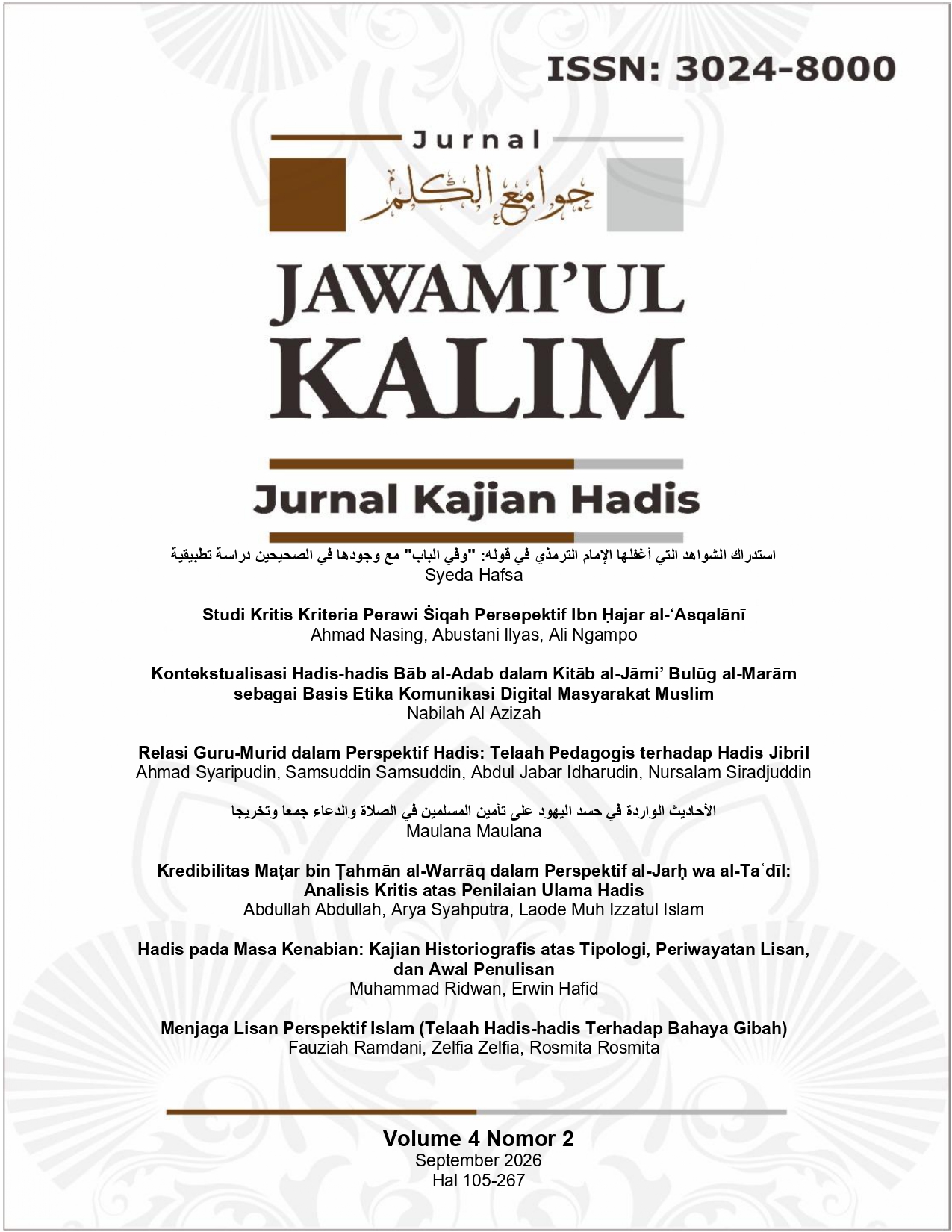
Kontekstualisasi Hadis-hadis Bāb al-Adab dalam Kitāb al-Jāmi’ Bulūg al-Marām sebagai Basis Etika Komunikasi Digital Masyarakat Muslim
Contextualizing the Hadiths of Bāb al-Adab in Bulūg al-Marām as a Foundation for Digital Communication Ethics in Muslim Society
DOI:
https://doi.org/10.36701/jawamiulkalim.v4i2.3633Keywords:
Bāb al-Adab, Bulūg al-Marām, communication ethics, digital communication, hadithAbstract
Digital communication has facilitated human interaction while simultaneously generating ethical problems, including the dissemination of unverified information, impolite language, privacy violations, exclusion in group conversations, and inadequate control of digital expression. Within hadith studies, these challenges provide an opportunity to contextualize prophetic values as a normative foundation for contemporary communication ethics. This study aims to identify the hadiths in Bāb al-Adab of Kitāb al-Jāmi’ in Bulūg al-Marām that are relevant to communication ethics, analyze their meanings and moral principles based on classical hadith commentaries, and formulate their contextualization as a foundation for digital communication ethics in Muslim society. This qualitative study employs library research. Data were collected through documentation and analyzed using content analysis, thematic analysis, and the ma‘ānī al-Ḥadīth approach. The findings reveal that six principal hadiths concerning the rights of fellow Muslims, good character, the prohibition of confidential conversation that excludes a third person, providing space in gatherings, initiating greetings, and group representation in exchanging greetings generate six ethical principles: relational responsibility, moral self-control, empathy and emotional security, participatory inclusiveness, contextual politeness, and collective responsiveness. This study contributes to hadith scholarship by extending the function of hadith from a normative text into an operational framework for digital communication ethics, particularly in maintaining information integrity, politeness, privacy, inclusive participation, and social responsibility.
References
Ala’i Nadjib, Hilmy Firdausy, and Khaerul Umam. “Hadith in Digital Space: An Initial Mapping.” Ilmu Ushuluddin 11, no. 2 (2024): 249–87. https://doi.org/10.15408/iu.v11i2.46250.
Al-‘Asqalānī, Aḥmad ibn ‘Alī ibn Ḥajar. “Bulūg Al-Marām Min Adillat al-Aḥkām.” In Kitāb Al-Jāmi‘. Bāb Al-Adab. n.d.
Al-‘Asqalānī, Ahmad ibn ‘Alī ibn Ḥajar. Fatḥ Al-Bārī Bi Syarḥ Ṣaḥīḥ al-Bukhārī. Juz 11. Beirut: Dār al-Ma‘rifah, 1379.
Al-‘Asqalānī, Ibn ‘Alī ibn Ḥajar. Bulūg Al-Marām Min Adillat al-Aḥkām. Cet VII. Riyāḍ: Dār al-Falaq, 1424.
Al-Bukhārī, Abu Abdillah Muhammad bin Ismail bin Ibrahim bin al-Mughirah bin Bardizbah al-Ju’fi. Ṣaḥīḥ Al-Bukhārī. Juz VIII. Beirūt: Dār Ṭawq al-Najāh, 1422.
Amin, Rajabbul. “Membangun Komunikasi Islam Di Era Digital: Integrasi Qaulan Ma’rufan Dan Qaulan Kariman Dalam Media Sosial.” AT-TABSYIR: Jurnal Komunikasi Penyiaran Islam 12, no. 2 (2025): 169–88. https://doi.org/10.21043/at-tabsyir.v12i2.31008.
Andriani, Faricha. “Perkembangan Etika Komunikasi Islam Dalam Bermedia Sosia.” AT-TABSYIR: Jurnal Komunikasi Penyiaran Islam 6, no. 1 (June 2019): 55. https://doi.org/10.21043/at-tabsyir.v6i1.5586.
Asosiasi Penyelenggara Jasa Internet Indonesia. “Survei Penetrasi Internet Dan Perilaku Penggunaan Internet Indonesia 2025.” Jakarta: APJII, 2025. https://survei.apjii.or.id/.
Avgustis, Iuliia, Samira Ibnelkaïd, and Netta Iivari. “Occupying Another’s Digital Space: Privacy of Smartphone Users as a Situated Practice.” Computer Supported Cooperative Work (CSCW) 33, no. 4 (December 2024): 605–43. https://doi.org/10.1007/s10606-024-09492-z.
Burhanudin, Burhanudin, and Abdul Rahman Rojali. “Membangun Harmoni Kehidupan Dengan Etika Komunikasi Islam.” Dakwah: Jurnal Kajian Dakwah Dan Kemasyarakatan 26, no. 1 (October 2022): 51–69. https://doi.org/10.15408/dakwah.v26i1.28835.
Castells, Manuel. The Rise of the Network Society. 2. ed. with a new preface, [Reprint]. The Information Age / Manuel Castells 1. Malden, Mass: Wiley-Blackwell, 2011.
Konieczna, Agnieszka. “‘Zero Interaction’, Ignoring and Acts of Omission in the School Ecology: Peer Ostracism from the Perspective of Involved Adolescents.” Social Psychology of Education 27, no. 6 (December 2024): 3203–30. https://doi.org/10.1007/s11218-024-09926-y.
Min, Chen, and Fei Shen. “Online Incivility, Argument Quality and Public Expression in China: Exploring the Moderating Role of Education Level and Opinion Congruency.” Telematics and Informatics 82 (August 2023): 102010. https://doi.org/10.1016/j.tele.2023.102010.
Muizza, Muhammad Ahmad Mumtaz, Sholahuddin Al Ayubi, Tazkia Nur Fateha, and Siti Waspiatul Kamilah. “Social Ethics In The Perspective Of Hadith: Relevance And Application In The New Media Era.” Wardah 25, no. 2 (December 2024): 169–85. https://doi.org/10.19109/avmk9302.
Muslim ibn al-Ḥajjāj al-Qusyairī al-Naysābūrī. Ṣaḥīḥ Muslim. Juz 4. Kairo: Dār Iḥyā’ al-Kutub al-‘Arabiyyah–‘Īsā al-Bābī al-Ḥalabī wa Syurakā’uh, 1955.
Al-Nawawī, Yaḥyā ibn Syaraf. Al-Minhāj Syarḥ Ṣaḥīḥ Muslim Ibn al-Ḥajjāj. Cet II. Juz 16. Beirut: Dār Iḥyā’ al-Turāṡ al-‘Arabī, 1392.
Nazaruddin, and Muhammad Alfiansyah. “Etika Komunikasi Islami Di Media Sosial Dalam Perspektif Al-Qur’an Dan Pengaruhnya Terhadap Keutuhan Negara.” Jurnal Peurawi: Media Kajian Komunikasi Islam 4, no. 1 (June 2021): 77–91.
Nurul Hakim. “Hoaxes on Social Media in the Perspective of Hadith.” International Journal of Islamic Studies Issues 1, no. 2 (July 2025): 41–46. https://doi.org/10.59966/y4rbay28.
Saifuddin, Fathan Ghifari, Ahmad Musyafiq, and Nikmah Rochmawati. “Islamic Digital Wisdom: Formulation of Social Media Ethics Based on Hadith to Address the Digital Moral Crisis.” Al-Bukhari : Jurnal Ilmu Hadis 8, no. 2 (December 2025): 145–65. https://doi.org/10.32505/al-bukhari.v8i2.12852.
Al-Ṣan‘ānī, Muḥammad ibn Ismā‘īl. Subul Al-Salām Syarḥ Bulūg al-Marām. Juz 4. Kairo: Dār al-Ḥadīṡ, n.d.
Saputro, Eko Prasetyo Nugroho, Pratiwi Wahyu Widiarti, Wuri Handayani, and Ratna Ekawati. “The Perception of Generation Z on Communication Ethics in Information Dissemination through Social Media.” Journal of Social Studies (JSS) 21, no. 1 (April 2025): 65–74. https://doi.org/10.21831/jss.v21i1.83936.
Al-Sijistānī, Abū Dāwud Sulaymān ibn al-Asy‘aṡ ibn Isḥāq ibn Basyīr ibn Syaddād ibn ‘Amr ibn ‘Imrān al-Azdī. Sunan Abī Dāwud. Juz 4. Beirūt: Al-Maktabah al-‘Aṣriyyah, n.d.
Simangunsong, Zaid Almubarok, and Ferizal Ferizal. “Etika Penggunaan Media Social Dalam Perspektif Hadis Studi Tentang Privasi Dan Tanggung Jawab Social.” Jurnal Budi Pekerti Agama Islam 3, no. 2 (January 2025): 83–94. https://doi.org/10.61132/jbpai.v3i2.1017.
Turkle, Sherry. Alone Together: Why We Expect More from Technology and Less from Each Other. Hachette UK, 2011.
Downloads
Published
Issue
Section
License
Copyright (c) 2026 Nabilah Al Azizah

This work is licensed under a Creative Commons Attribution-NonCommercial-ShareAlike 4.0 International License.