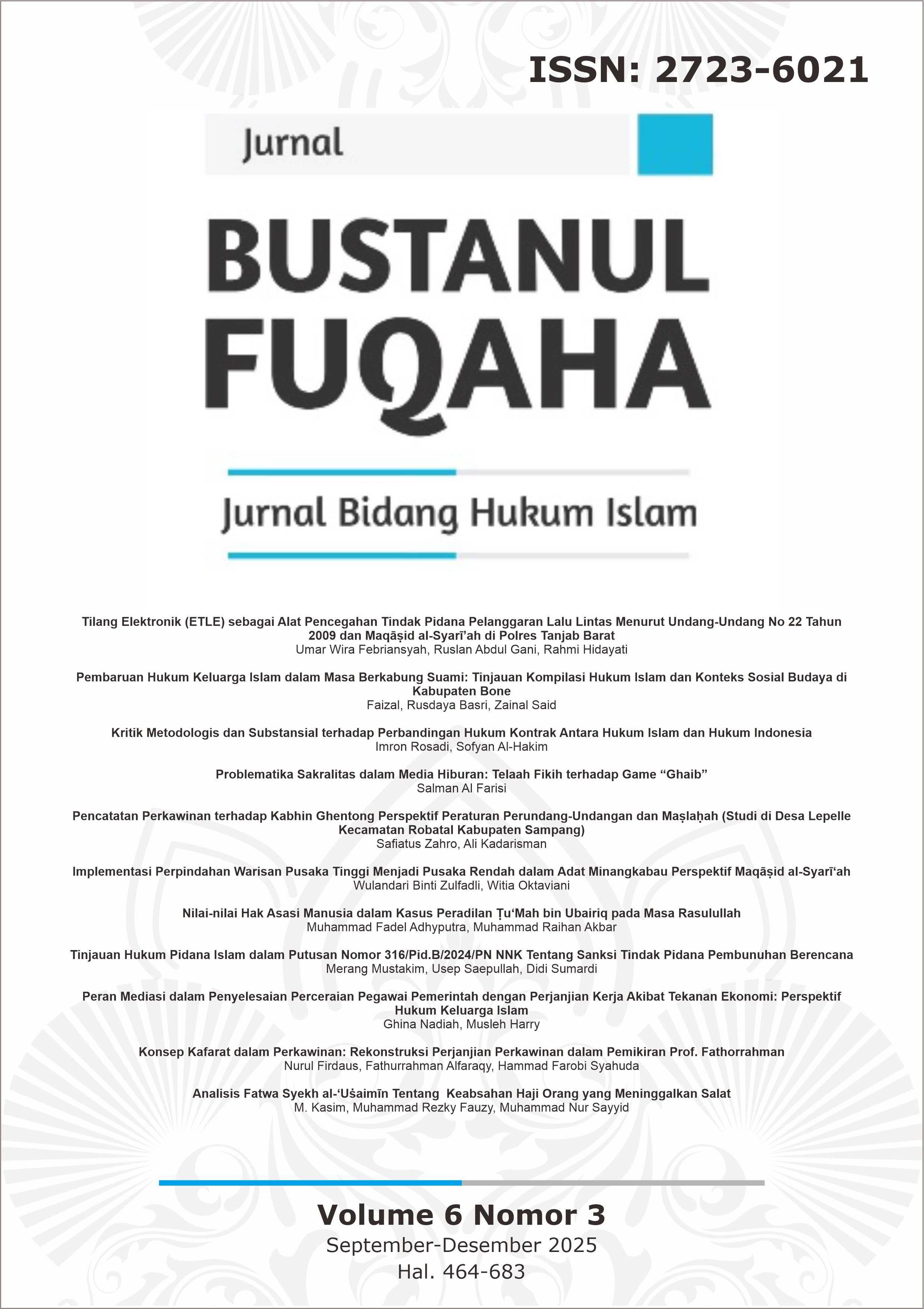
Nilai-nilai Hak Asasi Manusia dalam Kasus Peradilan Ṭu‘Mah bin Ubairiq pada Masa Rasulullah
Human Rights Values in the Case of Ṭu‘Mah Ibn Ubairiq during the Prophetic Era
DOI:
https://doi.org/10.36701/bustanul.v6i3.2692Keywords:
History of Islamic Law, Ṭu‘mah Bin Ubairiq, Human RightsAbstract
Judicial practices in many Muslim countries today still show inequality and unfair treatment, especially towards minority groups and those who are socially and economically disadvantaged. This disparity highlights the need to revisit Islamic history in order to revive the universal values of justice that form the basis of the Islamic legal and judicial systems. This study aims to analyze the case of Ṭu‘mah Bin Ubairiq during the time of the Prophet Muhammad saw. in order to identify reflections of human rights values. This study uses a qualitative method with a historical-normative approach and Mashood A. Baderin's interdependence theoretical framework, which emphasizes the complementary relationship between Sharia and human rights as two normative systems with the same goal of ensuring justice and human dignity. This article analyzes primary sources of Islamic law and uses the UDHR as a comparative framework. The results of the study show that the resolution of the Ṭu‘mah case strongly reflects the fundamental principles of the UDHR, such as equality before the law (Article 7), the right to a fair trial (Article 10), the presumption of innocence (Article 11), and the protection of property rights (Article 17) and honor (Article 12). It can be concluded that despite originating from different sources of legitimacy, this case demonstrates that universal human rights principles have long been internalized in the Islamic judicial tradition based on divine revelation.
Downloads
References
Almahfali, Mohammed, dan Helen Avery. “Human Rights from an Islamic Perspective: A Critical Review of Arabic Peer-Reviewed Articles.” Social Sciences 12, no. 2 (2023).
Al-Qurthubi, Abu Abdillah Muhammad ibn Ahmad al-Anshari. Terjemah Tafsir Al-Qurthubi. Disunting oleh Mukhlis B. Mukti. Diterjemahkan oleh Fathurrahman dan Ahmad Hotib. With Muhammad Ibrahim Al-Hifnawi dan Mahmud Hamid Utsman. Vol. 5. Pustaka Azzam, 2007.
Amaranti, Emira, Fatimah Jihan Ara, dan Fahrur Razi. “The Dynamics of the Social History of Islamic Law from the Classical Period to the Caliphate.” El-Sirry: Jurnal Hukum Islam Dan Sosial 3, no. 1 (2025).
‘Arafa, Mohamed. “Procedural Islamic Criminal Justice in Terms of Human Rights: Beyond the Zero-Sum Game.” Journal of Law in the Middle East 1, no. 1 (2021).
Arifin, Muhammad, dan Mega Ayu Ningtiyas. “Konsep Penelitian Normative (Literair) Dan Empiris (Non Literair) Dalam Ilmu al-Qur’an Dan Tafsir.” Al-Fatih: Jurnal Studi Islam 11, no. 1 (2023).
Awal Rifai Wahab, Asni Asni, dan Muh. Saleh Ridwan. “Peradilan Islam pada Masa Rasulullah dan Khulafaurasyidin: Studi Komparatif Peradilan Islam Era Klasik.” BUSTANUL FUQAHA: Jurnal Bidang Hukum Islam 3, no. 1 (2022).
Baderin, Mashood A. Abdullahi An-Na’im’s Philosophy on Islam and Human Rights. No. 10/2010. SOAS School of Law Legal Studies Research Paper Series. School of Oriental and African Studies (SOAS), University of London, 2010.
Baderin, Mashood A. “Religion and Human Rights: Towars a Better Understanding.” TAFHIM : IKIM Journal of Islam and the Contemporary World 3, no. 1 (2015).
Esmaeili, Hossein. “On A Slow Boat Towards the Rule of Law: The Nature of Law in the Saudi Arabian Legal System.” Arizona Journal of International & Comparative Law 26, no. 1 (2009).
Fraser, Julie. “Exploring Legal Compatibilities and Pursuing Cultural Legitimacy: Islamic Law and the ICC.” Dalam Intersections of Law and Culture at the International Criminal Court, disunting oleh Julie Fraser dan Brianne McGonigle Leyh. Edward Elgar Publishing, 2020.
Haris. “Peradilan Islam.” ‘Aainul Haq: Jurnal Hukum Keluarga Islam 1, no. 2 (2021).
Hasyim, Muh. Fathoni. Tafsir Ayat-Ayat Ahkam Pidana. Kanzum Books, 2020.
Irawan, Bambang, dan Zafran Arifah Amar. “Konsep Keadilan Peradilan Rasulullah Dan Relevansinya Dengan Peradilan Restoratif di Indonesia.” Jurnal El-Thawalib 6, no. 3 (2025).
Johnston, David L. “Islam and Human Rights: A Growing Rapprochement?” The American Journal of Economics and Sociology 74, no. 1 (2015).
Khalid, Nasirullah. “Presumption of Innocence in the Islamic Law.” Addaiyan Journal of Arts, Humanities and Social Sciences 3, no. 1 (2021).
Naili Amalia dan Rahmi Syafitri. “Penafsiran Ayat-Ayat Tentang Korupsi.” Al-Tarbiyah : Jurnal Ilmu Pendidikan Islam 3, no. 3 (2025).
Nasrullah, Muhamad, Ris’an Rusli, dan Abdul Kher. “Mencuri Potong Tangan Dalam Al-Qur’an Surah Al-Maidah Ayat 38 (Studi Komperatif Tafsir An-Nuur Dan Tafsir Al-Azhar).” Risalah: Jurnal Pendidikan dan Studi Islam 11, no. 3 (2025).
Polii, Valentino, dan Dian Julius Polii. “Akses Keadilan bagi Kelompok Rentan: Studi Empiris Mengenai Hambatan Struktural dalam Sistem Peradilan.” Perkara : Jurnal Ilmu Hukum dan Politik 3, no. 1 (2025).
Puji Pangastuti, Berlian. “Contextualizing Justice in Times of Crisis: A Study of QS. Al-Mā’idah 5:38 and Its Application in Criminal Theft Cases.” Jurnal Studi Ilmu-Ilmu Al-Qur’an Dan Hadis 24, no. 1 (2023).
Ritonga, Raja, Desi Asmaret, dan Tamrin Kamal. “Factors Influencing The History of The Growth and Development of Islamic Law From The Era of The Prophet to The Abbasid Period.” El-Ahli: Jurnal Hukum Keluarga Islam 5, no. 2 (2024).
Rohmah, Siti, Moh Anas Kholish, dan Andi Muhammad Galib. “Human Rights and Islamic Law Discourse: The Epistemological Construction of Abul A’la Al-Maududi, Abdullahi Ahmed An-Naim, and Mashood A. Baderin.” Justicia Islamica 19, no. 1 (2022).
Ropei, Ahmad. “Penerapan Restorative Justice Sebagai Alternatif Penyelesaian Masalah Pidana Berdasarkan Hukum Pidana Islam.” AL-KAINAH: Journal of Islamic Studies 1, no. 2 (2022).
Saputera, Abdur Rahman Adi. “Sejarah Peradilan Islam Masa Rasulullah SAW.” JIFLAW: Journal Of Islamic Family Law 1, no. 1 (2022).
Seo, Marwela Remini, Fenetson Pairikas, dan Yakobus Adi Saingo. “Potret Diskriminasi Agama di Indonesia: Studi Kasus Implementasi Nilai Keadilan Sosial bagi Kelompok Minoritas.” Mutiara: Jurnal Penelitian dan Karya Ilmiah 3, no. 1 (2025).
Shihab, M. Quraish. Tafsir Al-Misbah: Pesan, Kesan dan Keserasian Al-Qur’an. Lentera Hati, 2017.
Susandi, Aidil. “Sistem Peradilan Islam dari Masa Nabi SAW sampai Masa Khulafaurrasyidin.” TAQNIN: Jurnal Syariah dan Hukum 4, no. 02 (2022).
Suyuti, Jalaluddin as-. Asbabun Nuzul: Sebab Turunnya Ayat Al-Qur’an. Cet. 1. Disunting oleh Kartina Rosa. Diterjemahkan oleh Abdul Hayyie, dkk. Gema Insani, 2008.
United Nations. The Universal Declaration of Human Rights (UDHR). United Nations General Assembly, 1948.
Yousufi, Obaidulrahman, Muhammad Muhsin Ayubi, dan Shahabuddin Shahab. “The State of the Judiciary in Early Islam.” International Journal of Multicultural and Multireligious Understanding 10, no. 12 (2023).
Downloads
Published
Issue
Section
License
Copyright (c) 2025 Muhammad Fadel Adhyputra, Muhammad Raihan Akbar

This work is licensed under a Creative Commons Attribution-NonCommercial-ShareAlike 4.0 International License.