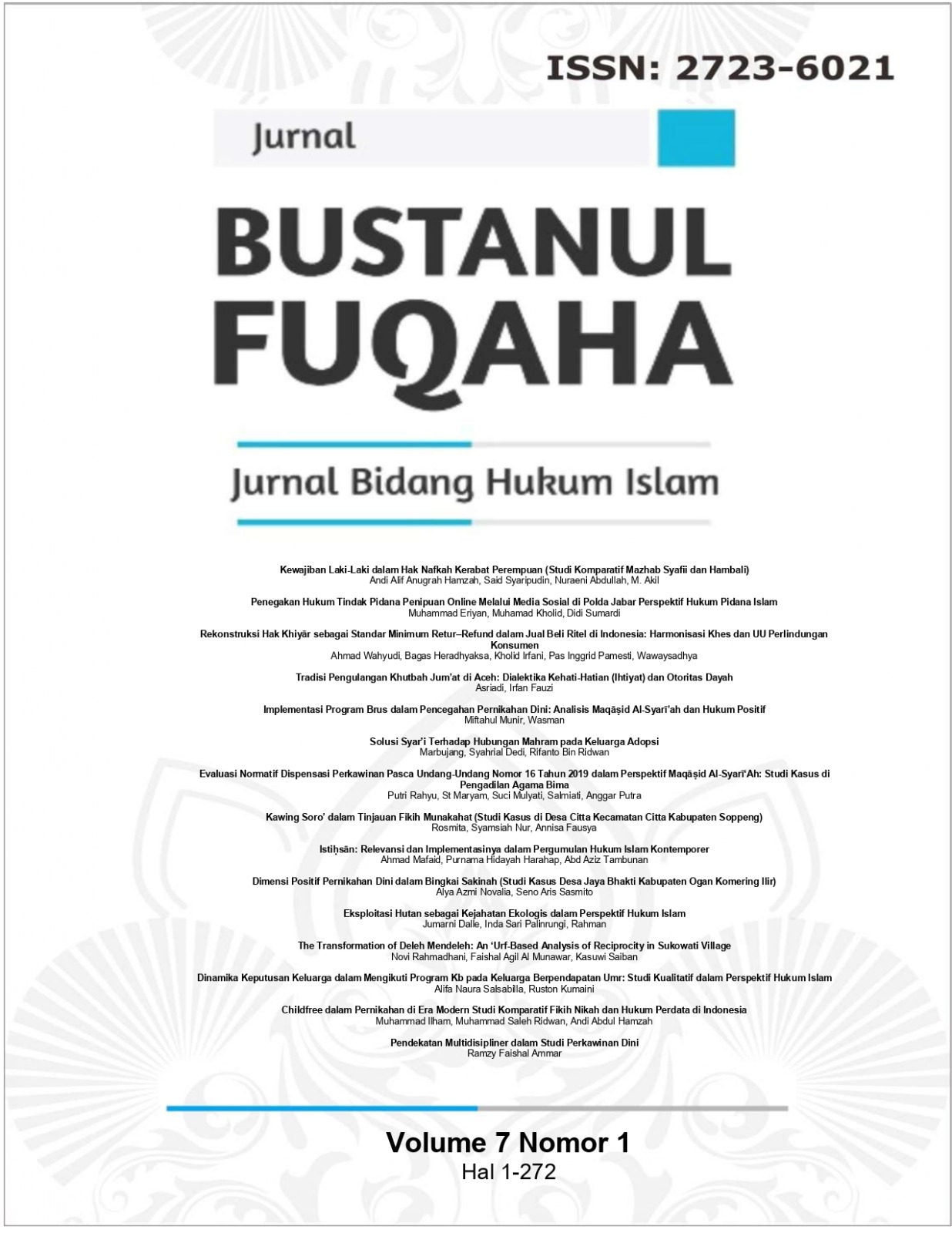
Childfree dalam Pernikahan di Era Modern Studi Komparatif Fikih Nikah dan Hukum Perdata di Indonesia
Childfree in Marriage in the Modern Era: A Comparative Study of Marriage Fiqh and Civil Law in Indonesia
DOI:
https://doi.org/10.36701/bustanul.v7i1.2965Keywords:
Childfree, Marriage, Islamic Law, Civil Law, maqāṣid al- Syarī'ah.Abstract
Childfree in marriage is a contemporary social phenomenon that raises normative debates in the family law system both in the perspective of Islamic law and Indonesian civil law, the decision not to have children is often understood as part of individual freedom and reproductive rights, in other contexts marriage as a legal institution has goals, social functions, and public dimensions that are not fully subject to the private will of the parties. This study aims to analyze and compare the legal status of childfree in marriage, through the formulation of problems regarding: what is the legal status of childfree decisions in marriage jurisprudence according to maqāṣīd al-Syarī’ah, how is the regulation of childfree agreements in family law and what are the meeting points and differences in principles between marriage jurisprudence and civil law related to childfree using normative theological and normative juridical approaches in comparative legal research, analyzed through deductive reasoning and legal syllogism based on maqāṣid shari’ah, prenuptial agreements, and human rights restrictions. The results of this study indicate that, from an Islamic legal perspective, temporary childfree is tolerated as long as it does not negate the right to freedom, while permanent childfree contradicts the purpose of marriage. In Indonesian civil law, prenuptial agreements are not absolute, as they are limited by public order, morality, and the institutional purpose of marriage. The point of agreement between the two lies in the recognition that freedom in marriage is not absolute, but rather limited by social values and institutional goals. The difference is that marital fiqh places offspring as a normative goal that is darūrī, while civil law emphasizes the autonomy of the parties, which is limited by positive law. Thus, reproductive rights in marriage are relational and have normative limits. This research is expected to provide a conceptual contribution in the development of maqāṣid al-Syarī'ah that remains oriented towards the darūrī objectives of sharia. This research is expected to strengthen the integration of Islamic, civil, and human rights law analysis in contemporary marital law studies.
Downloads
References
Buku
Auda, Jasser. Maqasid al-Shariah as Philosophy of Islamic Law: A Systems Approach. Herndon, VA: The International Institute of Islamic Thought, 2008.
Al-Bukhari, Abdullah Muhammad bin Ismail. Shahih al-Bukhari. Juz VII. Beirut: Dār al-Kitāb al-‘Ilmiyyah, 1992.
Al-Ghazālī, Abu Hamid. Ihyā’ ‘Ulūm al-Dīn. Juz II. Jeddah: al-Haramain, n.d.
Al-Ghazālī, Abu Hamid. al-Mustaṣfā min ‘Ilm al-Uṣūl. Vol. 1. Beirut: Dār al-Kutub al-‘Ilmiyyah, 2008.
Al-Sarakhsī, Muhammad ibn Ahmad. al-Mabsūṭ. Vol. 4. Beirut: Dār al-Fikr, 2000.
Al-Syāṭibī. Al-Muwāfaqāt fī Uṣūl al-Aḥkām. Vol. 2. Kuwait: Wizārat al-Auqāf wa al-Syu’ūn al-Islāmiyyah, n.d.
Djamil, Fathurrahman. Hukum Perjanjian Syariah dalam Kompilasi Hukum Perikatan. Jakarta: PT Cipta Adiya Bhakti, 2001.
Ibn ‘Āshūr, Muhammad al-Tahir. Maqāṣid al-Syarī‘ah al-Islāmiyyah. Tunis: al-Muassasah al-Tunisiyyah li al-Nashr, 2001.
Khitab, Hasan Sayyid Hamid. Maqāsid al-Nikāḥ wa Atsarihā Dirāsah Fiqhiyyah Muqāranah. Madinah, 2009.
Mertokusumo, Sudikno. Mengenal Hukum: Suatu Pengantar. Yogyakarta: Liberty, 2007.
Prodjodikoro, Wirjono. Asas-Asas Hukum Perjanjian. Bandung: Sumur Bandung, n.d.
Sayyid Sābiq. Fiqh al-Sunnah. Jakarta: Cakrawala Publishing, n.d.
Setiawan, R. Pokok-Pokok Hukum Perikatan. Bandung: Binacipta, 1979.
Subekti. Hukum Perjanjian. Jakarta: Intermasa, 2005.
Subekti. Kitab Undang-Undang Hukum Perdata. Jakarta: Pradnya Paramita, 2004.
Suaidi. Fiqh Muamalah: Dari Teori ke Problematika Kontemporer. Pamekasan: Duta Media Publishing, 2021.
Tunggono, Victoria. Childfree and Happy. Yogyakarta: EA Books, 2021.
Zuḥaylī, Wahbah al-. Al-Fiqh al-Islāmī wa Adillatuh. Translated by Abdul Hayyie al-Kattani et al. Jakarta: Gema Insani, 2011.
Artikel Jurnal
Agrillo, Christian, and Cristian Nelini. “Childfree by Choice: A Review.” Journal of Cultural Geography 25, no. 3 (2008): 347–363.
Anderson, Michael. “Highly Restricted Fertility: Very Small Families in the British Fertility Decline.” Population Studies: A Journal of Demography 52, no. 2 (1998): 23–32.
Gresnia, Enggel. “Hukum Perjanjian Pranikah dalam Pandangan Hukum Perdata.” Al-Bahts: Jurnal Politik dan Hukum 2, no. 1 (2024): 62–70.
Haspada, Deny. “Analisis Hukum Gugatan Ganti Rugi dalam Kasus Pembatalan Perkawinan.” Jurnal Hukum Mimbar Justitia (2025): 72–87.
McQuillan, Julia, Arthur Greil, et al. “Does the Reason Matter? Variations in Childlessness Concerns Among US Women.” Journal of Marriage and Family 74, no. 5 (2012): 116–175.
Patnani, M. T. “Bahagia Tanpa Anak? Arti Penting Anak bagi Involuntary Childless.” Jurnal Ilmiah Psikologi Terapan 9 (2021): 117–129.
Ramadhan, Javier Nixon Oktorifa, et al. “Penerapan Hifdz an-Nasl terhadap Dinamika Sosial Masyarakat Indonesia.” IHSAN: Jurnal Pendidikan Islam 3, no. 2 (2025).
Siswanti, Elin. “Perjanjian Pra Nikah dalam Perspektif Hukum Islam.” Jurnal Ilmu Hukum (2021): 43–47.
Utami, Lilis Anshoriyah, and Nasri Akib. “Implementasi Lafadz Insya Allah dalam QS. Al-Kahfi Ayat 23–24.” Kajian Living Qur’an (2002).
Skripsi, Tesis, dan Karya Ilmiah
Afrianto. Fenomena Childfree di Indonesia dalam Perspektif Maqāṣid al-Syarī‘ah. Thesis, UIN Alauddin Makassar, 2023.
Amalian, Kisa Permata. Kajian Yuridis Pembatalan Perjanjian Perkawinan Setelah Perkawinan Berlangsung. Undergraduate thesis, Universitas Muhammadiyah Sumatera Utara, 2021.
Ardiansyah, Heskey. Implikasi Putusan Mahkamah Konstitusi No. 105/PUU-XXII/2024. Surabaya: Universitas 17 Agustus 1945, 2022.
Azizah, Alda Ismi. Konsep Childfree Perspektif Pendidikan Keluarga dalam Islam. Ponorogo, 2022.
Peraturan Perundang-Undangan
Indonesia. Undang-Undang Nomor 1 Tahun 1974 tentang Perkawinan. Jakarta: Sekretariat Negara, 1974.
Indonesia. Undang-Undang Nomor 1 Tahun 1974 tentang Perkawinan. Jakarta: Buana Ilmu Populer, 2017.
Indonesia. Kompilasi Hukum Islam.
Sumber Online
Cambridge Dictionary. “Child-Free.” Accessed February 4, 2025.
https://dictionary.cambridge.org/dictionary/english/child-free.
Kementerian Agama Republik Indonesia. Qur’an Kemenag. Accessed February 9–10,2026.https://quran.kemenag.go.id.
Downloads
Published
Issue
Section
License
Copyright (c) 2026 Muhammad Ilham, Muhammad Saleh Ridwan, Andi Abdul Hamzah

This work is licensed under a Creative Commons Attribution-NonCommercial-ShareAlike 4.0 International License.