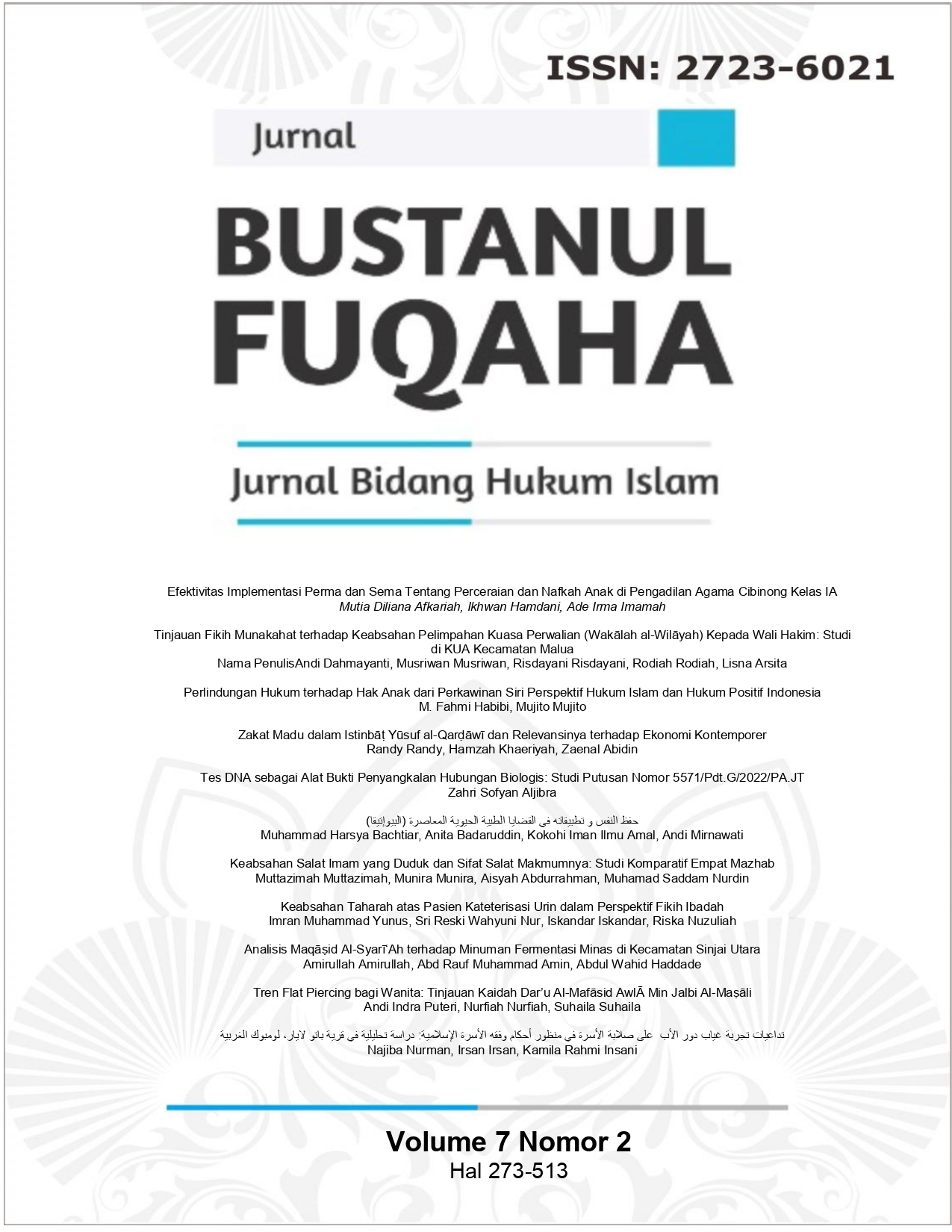
Keabsahan Salat Imam yang Duduk dan Sifat Salat Makmumnya: Studi Komparatif Empat Mazhab
The Validity of Prayer Led By A Seated Imam and The Posture of The Followers: A Comparative Study of The Four Schools of Islamic Law
DOI:
https://doi.org/10.36701/bustanul.v7i2.3004Keywords:
Follower’s prayer behavior, four schools of thought, validity of seated imamAbstract
This study aims to identify the views of the four schools of Islamic law concerning the legal evidence and methods of legal deduction (istinbāṭ) regarding the validity of congregational prayer led by a seated imam and the appropriate posture of the followers. This study employs library research using normative and comparative approaches. Data were drawn from books, classical Islamic jurisprudential works, and other relevant sources. The findings reveal differences of opinion among the four schools. The Hanbali school adopts a middle-ground position: congregational prayer is valid when led by a regular imam who sits due to a valid excuse and is expected to recover, in which case the followers must adopt the imam’s posture. However, if the imam begins the prayer standing and later sits due to an excuse, the followers should remain standing. This position is derived by reconciling several hadiths and āṡār. The Hanafi and al-Shāfi‘ī schools maintain that congregational prayer led by a seated imam remains valid, but the followers must remain standing, whether the imam sits from the beginning or during the prayer. This view is based on the hadith narrated by ‘Ā’ishah (ra.), which is understood to have abrogated the earlier hadith. In contrast, the Māliki school considers such a prayer invalid and requires the imam with a valid excuse to be replaced, based on reports attributed to Jābir al-Ju‘fī and ‘Abd al-Raḥmān ibn Abī Rabī‘ah. In contemporary practice, the use of a chair or wheelchair does not alter the underlying ruling, as the determining criterion is the imam’s ability to perform the essential pillars of the prayer. To avoid disputes, an imam with a permanent disability is advised to appoint a substitute who is able to stand. This study is expected to serve as a reference for the Muslim community, particularly mosque administrators, in developing guidelines for situations in which an imam unexpectedly sits during the prayer.
Downloads
References
Al-Āmidī, Alī ibn Abī ʿAlī ibn Muḥammad. Al-Iḥkām fī Uṣūl al-Aḥkām. Bairut: Dār al-Kutub al-‘Ilmiyyah, 2003.
Al-Badr, ‘Abdul Razzāq bin ‘Abdul Muḥsin al-‘Abbād. Ta’żīm al-Ṣalāh. Cet. I. Riyadh: Dār al-Faḍīlah, 1434.
Al-Bukhāri, Abū ‘Abdillāh Muḥammad bin Ismā’īl al-Bukhāri. Ṣaḥīḥ al-Bukhāri. Juz 1. Cet. V. Damaskus: Dār Ibnu Kaṡīr, 1414.
Al-Buhūti, Manṣūr bin Yūnus bin Idrīs. Syarḥ Muntahā al-Irādāt. Juz 1. Cet. I. Beirut: ‘Ālim al-Kutub, 1414.
Al-Fauzān, Abdullāh bin Ṣāliḥ. Minḥatu al-‘Allām fī Syarḥi Bulūgi al-Marām. Juz 3. Cet. I. Dammam: Dār Ibn al-Jauzi, 1435.
Al-Ghazālī, Muḥammad ibn Muḥammad ibn Muḥammad. Al-Mustaṣfā min ‘Ilm al-Uṣūl. Beirut: Dār al-Kutub al-‘Ilmiyyah, 1993.
Al-Ḥājj Aḥmad, Abū Żarr Ibrāhīm. “Ṣalāt al-Farīḍah ‘alā al-Karāsī: Ṣuwaruhā wa Aḥkāmuhā—Dirāsah Fiqhiyyah.” Majallat Jāmi‘at al-Qur’ān al-Karīm wa al-‘Ulūm al-Islāmiyyah, no. 56 (2022): 483–534.
Ibn Anas, Mālik. Al-Muwaṭṭa’. Beirut: Dār Iḥyā’ al-Turāṡ, 1995.
Ibn Majah, Abū ‘Abdillāh Muḥammad bin Yazīd Al-Quzrūni. Sunan Ibnu Majah. Cet. I. Juz 2. Beirut: Dār Risālah Al-‘alamiyah, 1430.
Ibn Rusyd, Muḥammad bin Ahmad. Bidāyah al-Mujtahid wa Nihāyah al-Mujtahid. Cet. I; Kairo: Dār al-Hadīṣ, 1425.
Ibn ʿAbd al-Barr, Yūsuf. Al-Tamhīd li mā fī al-Muwaṭṭa’ min al-Ma‘ānī wa al-Asānīd. Beirut: Beirut: Dār al-Fikr, 1996.
Ibnu Qudāmah, Abū Muḥammad ‘Abdullāh bin Aḥmad bin Muḥammad. Al-Mugnī li Ibn Qudāmah. Juz 3. Cet. III. Riyadh: Dār ‘Ālam al-Kutub li al-Ṭibā’ah wa al-Nasyri wa al-Tauzī’, 1418.
Al-Jarrāḥ, Fārūq ‘Abd al-Karīm, dan Yūsuf ‘Abdullāh al-Syarīfain. “Al-Maḍāmīn al-Tarbawiyyah fī al-Aḥkām al-Fiqhiyyah al-Muta‘alliqah bi Ṣalāt al-‘Ājiz al-Muq‘ad fī al-Fiqh al-Islāmī.” Majallat al-Jāmi‘ah al-Islāmiyyah li al-Dirāsāt al-Tarbawiyyah wa al-Nafsiyyah 28, no. 6 (2020). https://journals.iugaza.edu.ps/index.php/IUGJEPS/article/view/6825.
Kementerian Agama Republik Indonesia. Mushaf Al-Qur’an & Terjemah. Jakarta: Umm al- Qura, 2017.
Al-Madani, Mālik bin Anas bin ‘Amir al-Aṣbāḥi. Al-Mudawwanah al-Kubrā. Cet. I. Juz 1. Beirut: Dār al-Kutub al-‘Alamiyah, 1415.
Mas‘ūd, Ḥusain Sa‘d al-Dīn. “Aḥkām al-Qiyām fī al-Ṣalāh: Dirāsah Fiqhiyyah Muqāranah.” Journal of Tikrit University for Humanities 29, no. 11, bagian 1 (2022): 1–26. https://doi.org/10.25130/jtuh.29.11.1.2022.01.
Al-Marwazī, Isḥāq bin Manṣūr bin Bahrām Abū Ya’qūb. Masāil Al-Imām Aḥmad wa Isḥāq bin Rāhawayh. Juz 2. Cet. I. Madinah: al-Mamlakah al-‘Arabiyah al-Su’ūdiyah, 1425.
Al-Māwardi, Abū al-Ḥasan ‘Ali bin Muḥammad bin Muḥammad bin Ḥabīb al-Baṣri al-Bagdādi. Al-Ḥāwi al-Kabīr. Juz 2. Cet. I. Beirut: Dār al-Kutub al-‘Ilmiyah, 1419.
Al-Muzanī, Abū Ibrāhīm Ismā’īl bin Yaḥyā. Al-Mukhtaṣar min ‘Ilm al-Syāfi’i. Juz 1. Cet. I. Riyadh: Dār Madārij li al-Nasyr, 1440.
Al-Naisaburi, Abū al-Ḥusain Muslim bin al-Ḥajjāj bin Muslim. Ṣaḥīḥ Muslim. Juz 2. Cet. I. Istanbul: Dār al-Tiba’ah al-Amirah, 1334.
Al-Qarāfī, Aḥmad ibn Idrīs. Al-Furūq. Beirut: Dār al-Ma‘rifah, 1998.
Al-Qurṭubī, Abū ‘Umar Yūsuf bin ‘Abdillāh bin Muḥammad bin ‘Abdi al-Barr bin ‘Āṣim al-Namri. Ikhtilāf Aqwāl Mālik wa Aṣḥābihi. Cet. I. Beirut: Dār al-Garb al-Islāmī, 2003.
Al-Samaraqandi, ‘Ala al-Dīn. Tuḥfatu al-Fuqahā. Juz 1. Cet. II. Beirut: Dār al-Kutub al-‘Ilmiyah, 1414.
Al-Ṣan’āni, Abū Bakr ‘Abdul Razzāq bin Hamām. Al-Muṣannaf. Juz 3. Cet. I. Kairo: Dār al-Ta’ṣīl, 1437.
Al-Sarakhsī, Muḥammad bin Aḥmad bin Abī Sahl. Al-Mabsūṭ. Juz 1. Cet. I. Beirut: Dār al-Ma’rifah, 1993.
Al-Sijistānī, Abū Dāwūd Sulaimān bin al-Asy‘aṡ bin Isḥāq bin Basyīr al-Azdī. Sunan Abī Dāwūd. Juz 1. Cet. I. Beirut: Dār al-‘Aṣriyah, 2008.
Al-Suyūṭī, Jālal al-Dīn. Tadrīb al-Rāwī fī Syarḥ Taqrīb al-Nawawī. Juz 1. Beirut: Dār al-Fikr, 1996.
Al-Syāfi‘ī , Abū ‘Abdullāh Muḥammad bin Idrīs. Al-Umm. Juz 1. Cet. II. Beirut: Dār al-Fikr, 1403.
Al-Syaibānī, Abū ‘Abdillāh Muḥammad bin Al-Ḥasan. Al-Hujjah ‘alā Ahli Madinah. Juz 1. Cet. III. Beirut: ‘Ālim al-Kutub, 1403.
Al-Syaukani, Muhammad bin ‘Ali al-Yamani. Nailu Al-Autar. Cet. I. Kairo: Dar al-Hadis, 1413.
Wahhāb, Muḥammad bin Abdul. Syarḥ Syurūṭ al-Salah wa Arkaniha wa Wājibātihā li Syaikh Muḥammad Bin Abdil Wahhāb. Cet. I. Riyadh: Maktabah al-Mālik Fahd al-Waṭaniyah, 1425.
Al-Zarkashī, Badr al-Dīn. Al-Baḥr al-Muḥīṭ fī Uṣūl al-Fiqh. Kairo: Maṭba‘at al-Sa‘ādah, 1912.
Downloads
Published
Issue
Section
License
Copyright (c) 2026 Muttazimah Muttazimah, Munira Munira, Aisyah Abdurrahman, Muhamad Saddam Nurdin

This work is licensed under a Creative Commons Attribution-NonCommercial-ShareAlike 4.0 International License.