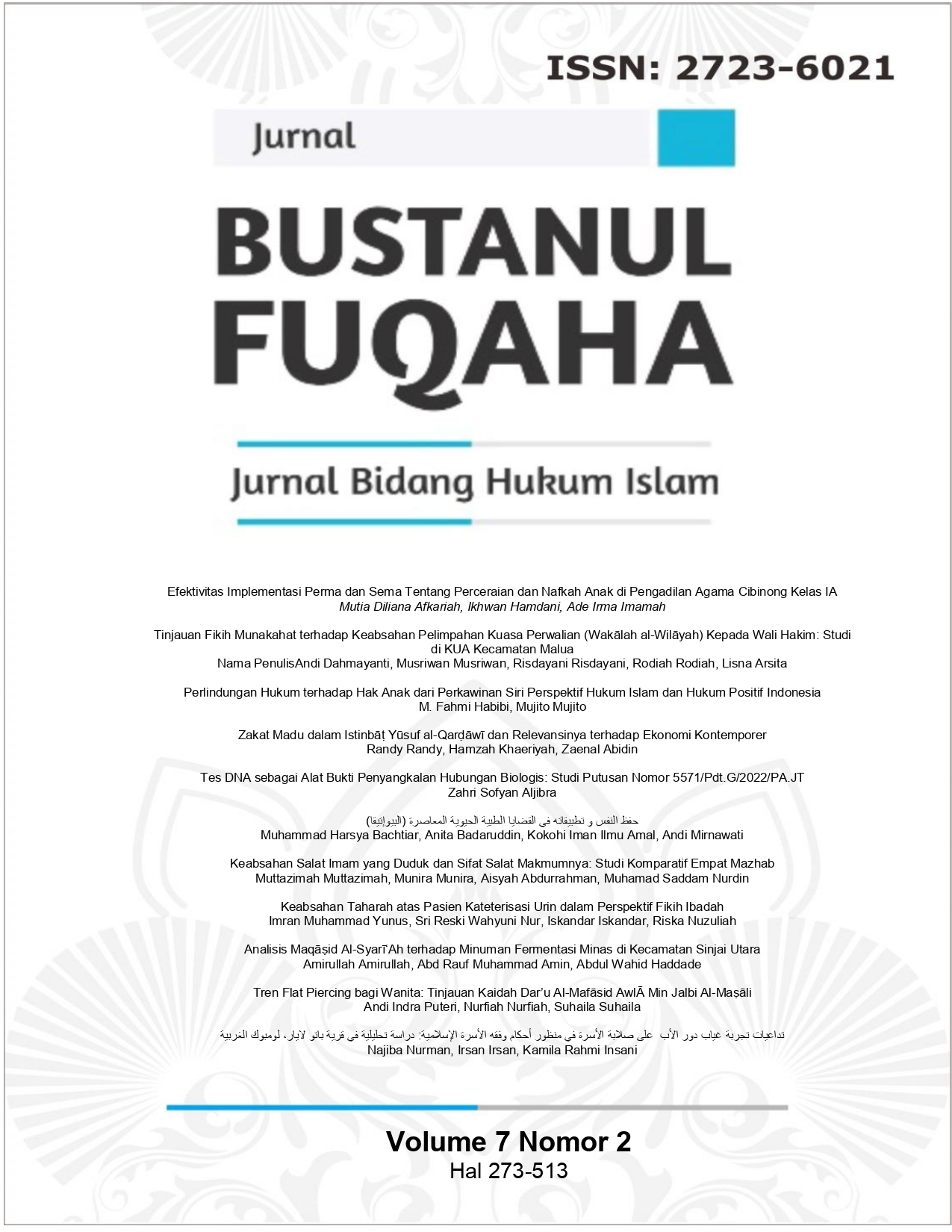
تداعيات تجربة غياب دور الأب على صلابة الأسرة في منظور أحكام وفقه الأسرة الإسلامية: دراسة تحليلية في قرية باتو لايار، لومبوك الغربية
The Implications of Fatherlessness for Family Resilience from the Perspective of Islamic Family Law: An Analytical Study in Batu Layar Village, West Lombok
DOI:
https://doi.org/10.36701/bustanul.v7i2.3603Keywords:
Fatherless , Famiy Resilience, Islamic Family LawAbstract
The increasing prevalence of the fatherless phenomenon, driven by high divorce rates, has the potential to affect family dynamics, particularly after individuals enter marriage. This study aims to analyse the implications of fatherless experiences on emotional development, marital readiness, and family resilience from the perspective of Islamic family law. This research employs a qualitative approach through in-depth interviews with five married informants residing in Batu Layar Village, West Lombok, supported by a literature review. The findings indicate that fatherless experiences affect emotional regulation, communication patterns, and conflict resolution abilities. However, these impacts are not deterministic, as individuals are able to adapt through spousal support, self-awareness, and the internalization of religious values. Within the framework of Islamic family law, this process is related to the internalization of qiwāmah, the fulfilment of spousal rights and obligations, and the strengthening of family resilience from the perspective of maqāṣid al-syarī‘ah. Therefore, fatherless experiences are not only risk factors, but can also be transformed into a source of learning in building adaptive, stable, and harmonious families. This study contributes to the discourse on Islamic family law by emphasizing that family resilience is dynamic and shaped through individuals’ adaptive processes, and enriched by religious guidance, social support, and conscious efforts to reinterpret personal experiences in constructive ways.
Downloads
References
Al Farisi, Maulana Achsan, Junnatun Mukhassonah, Zakia Ilma Mazida, dan Nana Ismiyatun Surifah. “Inner Child Issues akibat Fatherless: Telaah Psikologis dan Hukum Keluarga Islam.” Familierecht: Jurnal Hukum Keluarga dan Ilmu Syari’ah 1 (1), no. 2025 (t.t.): 94–111.
al-Qur’ān al-Karīm, t.t.
Astuti, Desi Widiya Puzi, dan Bashori Bashori. “Fenomena Fatherless Dalam Perspektif Al-Qur’an (Kajian tentang Relasi Ayah dan Anak dalam Kisah Al-Qur’an).” Fathir: Jurnal Studi Islam 2, no. 1 (7 Februari 2025): 70–81. doi:10.71153/fathir.v2i1.180.
Aulia, Adis Prita, Meilanny Budiarti Santoso, dan Nurliana Cipta Apsari. “Persepsi Pernikahan pada Perempuan Dewasa Muda sebagai Implikasi dari Fenomena Fatherless.” Share : Social Work Journal 14, no. 2 (4 Februari 2025): 173–85. doi:10.24198/share.v14i2.60567.
Badan Pusat Statistik. “Jumlah Perceraian Menurut Provinsi dan Faktor Penyebab Perceraian (Perkara).” Diakses 10 Oktober 2025. www.bps.go.id.
Badan Pusat Statistik Nusa. “Jumlah Perceraian Menurut Provinsi dan Faktor Penyebab Perceraian (perkara), 2024.” Badan Pusat Statistik Nusa Tenggara Barat, 14 Februari 2025. https://ntb.bps.go.id.
Bandura, Albert, and Richard H. Waters. Social Learning Theory. Vol. 1. Englewood Cliffs, NJ. Prentice-Hall, 1977.
Berlianti, Rahmanita, dan Dewi Ratno Suminar. “Gambaran Hubungan Romantis Pada Perempuan Dewasa Awal yang Belum Menikah dengan Pengalaman Fatherless Akibat Perceraian,” 2025.
Bocknek, Erika London. “A Family Systems Perspective on Father Absence, Presence, and Engagement.” In Handbook of Fathers and Child Development, 105–20. Cham: Springer International Publishing, 2020.
Bukhari, Abu Abd Allah Muhammad bin Isma‘ill al-. Ṣaḥīḥ al-Bukhārī. Dār Ibn Kaṡīr; Dār al-Yamāmah. Diakses 12 November 2025. https://shamela.ws/book/735.
Cherry, Kendra. “What Is Attachment Theory?” verywellmind.com, 23 Januari 2026. https://www.verywellmind.com/what-is-attachment-theory-2795337.
Creswell, John W, and David J Creswell. Research design: Qualitative, quantitative, and mixed methods approaches. Sage publications, 2017. https://books.google.co.id/books?hl=en&lr=&id=335ZDwAAQBAJ&oi=fnd&pg=PT16&dq=John+W.+Creswell,+Research+Design+&ots=YEySLOtppO&sig=lLh0Sq_dmTaVovQcnKsoHk9RFAc&redir_esc=y#v=onepage&q=John%20W.%20Creswell%2C%20Research%20Design&f=false.
Dār al-Iftā’ al-Miṣriyyah. “al-Qiwāmah.” dar-alifta.org, Mei 2022. https://www.dar-alifta.org/ar/articles/details/8308/القوامة.
Fajriyanti, Aura Putri, Desy Saputri, dan Sujarwo. “Fenomena Fatherless di Indonesia.” The Indonesian Journal of Social Studies 7 (1), no. 2024 (t.t.): 189–94.
Fauzi, Achmad. “Raibnya Figur Ayah.” Kompas.id, Oktober 2025. www.kompas.id.
Hadi, Farisah Hidayatul, Eni Hastuti, dan Dwianti Marthalena. “Dampak fatherless terhadap kecerdasan sosial dan emosional: Penelitian eksploratif terhadap anak perempuan.” ADAPTASI: Jurnal Sosial Humaniora Dan Keagamaan, 2024, 54–66.
Hartatiah, Akhmad Khalimy, and Muh Isra Bil Ali. “Family Communication and Coping Strategies on Soldier Children’s Independence: A Maqasid Al-Shariah Perspective,” t.t.
Hidayah, Nurul, Angraini Ramli, and Fransisca Tassia. “Fatherless Effects On Individual Development; An Analysis Of Psychological Point Of View And Islamic Perspective.” Innovative: Journal Of Social Science Research 3 (2), no. 2023 (t.t.): 754–66.
Hyoscyamina, Darosy Endah. “Peran keluarga dalam membangun karakter anak. Jurnal Psikologi” 10, no. 2 (2011): 144–52. doi:https://doi.org/10.14710/jpu.10.2.144-152.
Ibn Qayyim al-Jawziyyah, Muhammad ibn Abi Bakr ibn Ayyub. Tuḥfat al-Mawdūd bi-Aḥkām al-Mawlūd. 4 ed. al-Riyāḍ; Bayrūt: Dār ʿAṭāʾāt al-ʿIlm; Dār Ibn Ḥazm, 2019. https://shamela.ws/book/229.
Indonesia, Kementerian Agama Republik. Kompilasi Hukum Islam (t.t.).
Indonesia, Republik. Peraturan Pemerintah Nomor 87 Tahun 2014 tentang Perkembangan Kependudukan dan Pembangunan Keluarga, Pub. L. No. 87 (t.t.).
Kahus, Rasyid. al-Qiwāmah fī Ḍau’i al-Qur’ān al-Karīm wa al-Sunnah al-Nabawiyyah. Jam‘iyyah al-Muḥāfaẓah ‘alā al-Qur’ān al-Karīm, 2007. https://quranpedia.net/book/17369.
Markaz al-Fatwa. “Ma‘nā al-Qiwāmah wa Sababuhā.” Islamweb.net, Mei 2023. https://www.islamweb.net/ar/fatwa/475243/معنى-القوامة-وسببها.
Masruroh, Siti, and Mayadina Rohmi Musfiroh. “Marriage Fear in Woman Who Are Fatherless Perspectives of Islamic Law and Family Psychology,” t.t.
Muhlisin, Imam, dan Achmad Umardani. “Ketahanan Keluarga Fatherless Dan Dampaknya Terhadap Kesiapan Anak Perempuan Untuk Menikah” 5 (2025).
Munajjid, Muhammad al-. “Durūs li al-Syaikh Muḥammad al-Munajjid.” al-Maktabah al-Syāmilah, t.t. https://shamela.ws/book/7704/95#p2.
Munjiat, Siti Maryam. “Pengaruh Fatherless terhadapa Karakter Anak dalam Prespektif Islam.” Al-Tarbawi Al-Haditsah : Jurnal Pendidikan Islam 2, no. 1 (1 Juni 2017). doi:10.24235/tarbawi.v2i1.2031.
Novianti, Ria, Ainama Nafisa Putri, Ilga Maria, and Daniel Mplomoka. “Father Absence in Long-Distance Marriage and Early Childhood Self-Confidence in Indonesia: A Qualitative Phenomenological Study Integrating Attachment and Ecological Systems Theory.” Al-Athfal: Jurnal Pendidikan Anak 11, no. 2 (Desember 2025): 303–19. doi:http://dx.doi.org./10.14421/al-athfal.2025.112-04.
Putri Diana dan Agustina. “Gambaran Persepsi Pernikahan pada Perempuan Dewasa Muda dengan Latar Belakang Orang Tua Bercerai dan Fatherless.” Journal of Social and Economics Research 5, no. 2 (24 Desember 2023): 720–31. doi:10.54783/jser.v5i2.181.
Rahman, Maulana Fathur. “Pengaruh Pengalaman Masa Kecil terhadap Perkembangan Kepribadian di Masa Dewasa.” literacy notes, 2 (1), no. 2024 (t.t.).
Romadhona, Awallia, dan Cahniyo Wijaya Chuswanto. “Dampak Fatherless Terhadap Perkembangan Emosional Anak Usia Dini.” As-Sibyan: Jurnal Pendidikan Anak Usia Dini 9 (1), no. 2024 (t.t.): 101–12.
Sa‘dī, Abd al-Rahman bin Nasir al-. Taisīr al-Karīm al-Raḥmān fī Tafsīr Kalām al-Mannān. al-Qāhirah: Dār al-Ḥadīṡ, 2025. https://archive.org/details/tafsir-as-sadi-taisir-karimir-rahman-arab-pustaka-abik/Tafsir-as-Sadi_Taisir-Karimir-Rahman%20-Arab-%28Pustaka%20ABIK%29/.
Jāmi‘ al-Sunnah wa Shurūḥuhā. “Ṣaḥīḥ al-Bukhārī: Kullu Mawlūdin Yūladu ‘alā al-Fiṭrah, fa-Abawāhu Yuhawwidanihi aw Yunaṣṣirānihi aw Yumajjisānihi.” Diakses 3 Agustus 2026. https://hadithportal.com/index.php?show=hadith&h_id=1330&sharh=14&book=33&bab_id=863.
Salamah, al-Sayyid Murad. “Wa-Mur Ahlaka bi al-Ṣalāh wa-Iṣṭabir ‘Alayhā.” Shabakah al-Alūkah. Diakses 4 Agustus 2026. https://www.alukah.net/sharia/0/161731/وأمر-أهلك-بالصلاة-واصطبر-عليها/.
Sudarsanan, Sajeesh, Nayana R. Nakul, and C. Rakesh. “Childhood Trauma and Its Long‐Term Impact on Adult Personality Disorders: A Retrospective and Cohort Study.” Research Journal Of Medical Sciences 19, no. 2 (7 Februari 2025): 380–85. doi:10.36478/makrjms.2025.2.380.385.
Sugiyono, S. Metode Penelitian Kualitatif. bandung: Alfabeta., 2013.
Sundari, Arie Rihardini, dan Febi Herdajani. “Dampak Fatherless terhadap Perkembangan Psikologis Anak,” t.t.
Mausū‘ah al-Aḥādīṡ al-Nabawiyyah. “Syarḥ wa Tarjamah Ḥadīṡ: Murū Aulādakum bi al-Ṣalāh wa Hum Abnā’ Sab‘i Sinīn, wa Iḍribūhum ‘Alaihā wa Hum Abnā’ ‘Asyr, wa Farriqū Bainahum fī al-Maḍāji‘.” Diakses 3 Agustus 2026. https://hadeethenc.com/ar/browse/hadith/5272.
Yapalalin, Sintia, Rosita Wondal, dan Bujuna Al Hadad. “Kajian tentang pola asuh orangtua terhadap perilaku anak usia dini.” Cahaya Paud 3 (1), no. 2021 (t.t.).
Yupi Anesti dan Mirna Nur Alia Abdullah. “Fenomena Fatherless: Penyebab dan Konsekuensi Terhadap Anak dan Keluarga.” WISSEN : Jurnal Ilmu Sosial dan Humaniora 2, no. 2 (21 Mei 2024): 200–206. doi:10.62383/wissen.v2i2.105.
Zuhaili, Wahbah al-. al-Fiqh al-Islāmī wa Adillatuh. 9. Dimasyq: Dār al-Fikr, 2002.
Downloads
Published
Issue
Section
License
Copyright (c) 2026 Najiba Nurman, Irsan Irsan, Kamila Rahmi Insani

This work is licensed under a Creative Commons Attribution-NonCommercial-ShareAlike 4.0 International License.