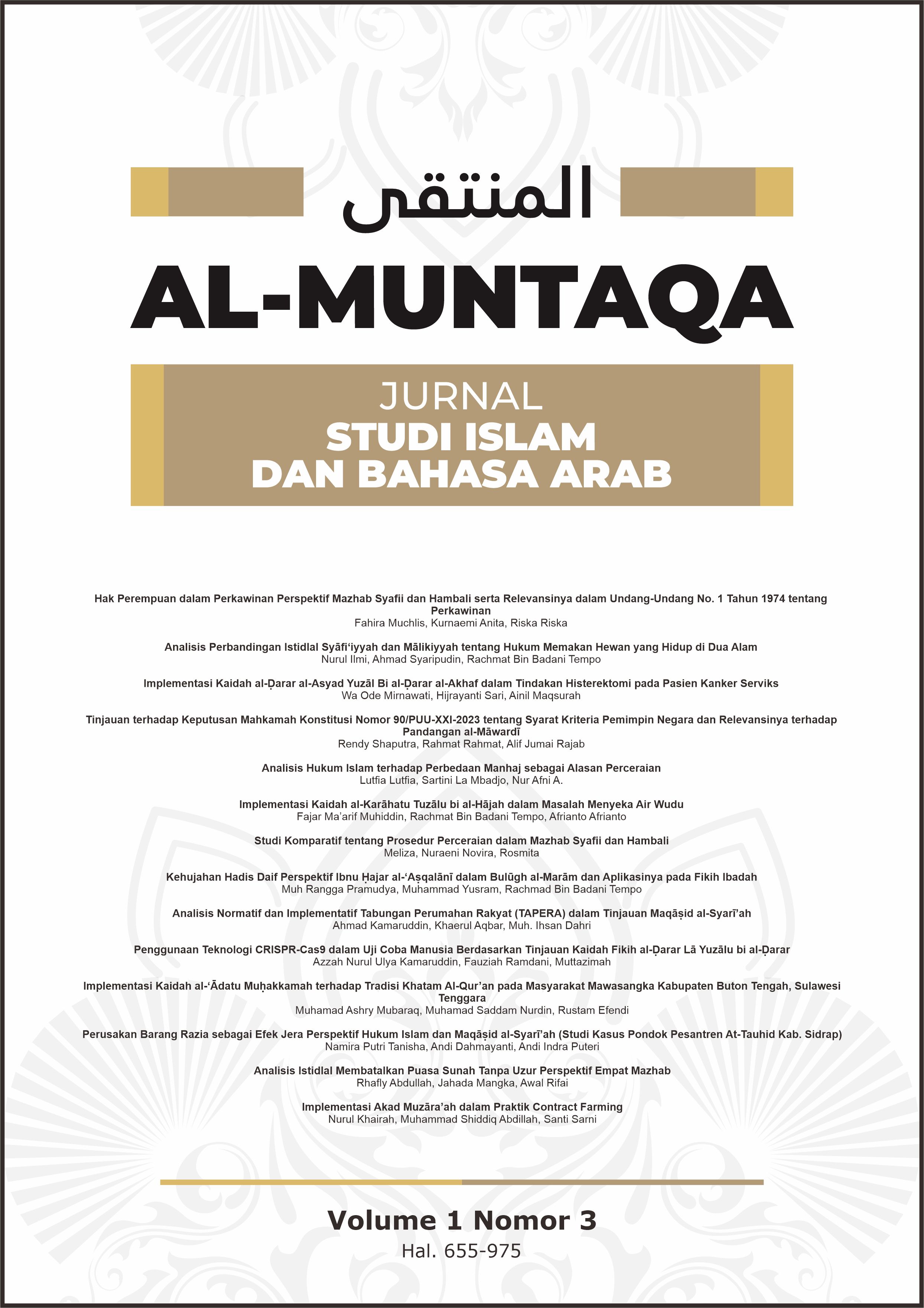
Hak Perempuan Dalam Perkawinan Perspektif Mazhab Syafii Dan Hambali Serta Relevansinya Dalam Undang-Undang No. 1 Tahun 1974 Tentang Perkawinan
Women’s Rights in Marriage: Perspectives of the Syafii And Hambali School of the Thought and Their Relevance in Law No. 1 of 1974 on Marriage
DOI:
https://doi.org/10.36701/muntaqa.v1i3.2546Keywords:
Women’s rights, marriage, perspective, Syafii, Hambali.Abstract
Marriage is a fundamental institution in Islam that regulates the rights and responsibilities between husband and wife in a balanced manner. One of the critical aspects in Islamic family law studies is the fulfillment and protection of women’s rights within marriage. This research aims to explore the perspectives of the Syafii and Hanbali schools of thought regarding women’s rights in marriage and to analyze their relevance to Law No. 1 of 1974 on Marriage in Indonesia. The study focuses on various aspects such as the right to receive a dowry (mahr), financial support (nafaqah), participation in the marriage contract, the right to divorce (khulu’ and fasakh), and property ownership. This komparative research applies a library research method using classical Islamic jurisprudence texts and national legal references. The findings indicate that although there are technical differences between the two schools, both acknowledge and uphold women’s rights in marriage. The relevance to Law No. 1 of 1974 is reflected in the legal recognition of mutual consent between spouses, the wife’s right to file for divorce, and economic protections for women. Therefore, this comparative approach contributes to the reformulation of Islamic family law in Indonesia towards a more just, responsive, and contextual legal system.
Downloads
References
Al-Qur’an dan Terjemahnya
Al-Anshari, Zakaria bin Muhammad. Asna al-Mathālib Syarah Raudh al-Thālib, Beirut: Dār al-Kutub al-Thayyibah, 1422 H
Al-Buhūtī, Mansur bin Yūnus bin īdris. Kasyāf al-Qinā' an Matn al-iqnā, Kairo: Dar al-Kutub al-`Ilmiyyah, 1423 H.
Al-Ghāmidī, Ali Al-Hajjaj. Fikih Wanita (Dalil al-Mar`ah al-Muslimah), terj. Ahmad Syarif,
Solo: Aqwam, 2015.
Al-Haitami, Ibn Hajar. Tuhfatul Muhtāj, Damaskus: Dār al-Fikr, 1985.
Al-Husaini, Abu Bakr bin Muhammad. Kifāyat al-Akhyar Fi Halli Ghayat al-Ikhtishar, Beirut: Muassasah al-Risalah, 2000
Al-Jauziyah, Ibn Qayyim. I’lam al-Muwaqqin, Beirut: Dār al-Kutub al-‘ilmiyyah 1991 M.
Al-Kalwadzani , Mahmud bin Ahmad Abul Khatab. Al-Hidayah 'ala Madzhabi Al-Imam
Ahmad, Kairoh: Muassasah Gharras, 2004
Al-Khin, Mustafa, Mustafa al-Bagha, dan Ali al-Syarbaji. Fiqih Manhaji madzhab Imam Syafii, Damaskus: Dar al-Qalam, 1992.
Al-Nawawi, Yahya bin Syaraf . Al-Majmū’ Syarah al-Muhadzdzab, Beirut: Dār al-Fikr, 1997.
Al-Mawardī, Abu al-Hasan. Al-Hāwi al-Kābir, Beirut: Dār al-Fikr, 1426 H.
Al-Maqdisī, Abdullah bin Qudāmah. Al-Kāfi fi Fiqhi Al-Imam Ahmad, Beirut: al-Maktab al-Islami, 1990.
Al-Qaṭṭān ,Mannā’. Tārīkh al-Tasyrī’ al-Islāmī , Cet. I; Riyād: Maktabah al-Ma’ārif, 1992.
Al-Ramli, Muhammad bin Ahmad Syihabuddin. Nihāyatul Muhtāj, Beirut: Dār al-Fikr, 1985.
Al-Syāfi‘ī, Abū ‘Abdillāh Muḥammad bin Idrīs. Kitāb al-Umm. Cet. I; lebanon: Dār al-Ma'rifah ibn Abī al-Arqam, 1410 H/1990 M.
Al-Syirbīni, Muhammad al-Khatib. Mughni al-Muhtaj, Beirut: Dār al-Fikr, 1426 H.
Abdul, Madjid. pokok-pokok fiqh muamalah dan hukum kebendaan dalam islam. Jakarta: Pustaka al-Kaustar, 2010.
Arifandi, Firman. Hak Kewajiban Suami Istri. Jakarta: Rumah Fiqih Publishing, 2020
Ash-Shiddieqy, Muhamma Hasbi. Pokok-pokok pegangan Imam Mazhab. Cet. I; Semarang: Pustaka Rizki Puta, 1997.
Al-Turki, Abdullah ibn Abd al-Muhsin. Usul Mazhab al-Imam Ahmad, Riyad: Maktabah ar-Riyad al-Hadisah, 1980 M/1400 H.
Azīz, Zaid ad-Dīn ‘Abd al-, Fatḥ al al-Mu’īn, Semarang: Karya Toha Putra, t.t.
Ghazali, Muhammad Bahri. Perbandingan Mazhab. Cet. I; Jakarta: Pedoman Ilmu, 1992
Gusmian, Islah. Khazanaz Tafsir Indonesia, Yogyakarta: LkiS, 2013.
Khalil, Rasyid Hasan. Tarikh Tasyri’ Sejarah Legislasi Hukum Islam, Jakarta: Amzah, 2011.
Mannan, Muhammad Abdul. Islamic Law and Its Implications on Modern Society. kuala lumpur: Dār al-Nashr, 1996
Mansur, Muhammad Laily. Ajaran dan Teladan pada Sufi, Jakarta: PT Raja Grafindo Persada, 1996.
Muslich, DRS. H. Ahmad Wardi. Fiqh Muamalat, Jakarta: Amzah, 2010.
Ramulyo, Mohd.Idris, Hukum Perkawinan Islam: suatu analisis dari UU No 1 / 1974 dan Kompilasi Hukum Islam, Jakarta: Bumi Aksara,1996.
Schacht, Joseph. Pengantar Hukum Islam,terj. Joko Supomo, Bandung: NUANSA, 2010.
Suryadilaga, Muhammad Al-Fatih. Studi Kitab Hadis. Cet. I; Yogyakarta: Teras, 2010.
Syaikh, Farid Ahmad. 60 Biografi Ulama Salaf, Jakarta: Pustaka al-Kautsar, 2006.
Thalib, Sayuti, Hukum Kekeluargaan Indonesia, Jakarta: UI Press, 2009.
Yanggo, Huzaenah Tahido. Pengantar Perbandingan Mazhab, Jakarta: Logos, 1997.
Agha, Khuluq Dhaifallah Muhammad, Mahmoud Ibrahim El Nafad, dan Sutrisno Hadi. “Unravelling the Threads: Bibliometric Exploration of Islamic Family Law Research in Southeast Asia (2004–2024),” Nurani: Jurnal Kajian Syari’ah dan Masyarakat 24, no. 2 (2024): h. 345–59.
Agustina, Arifah Millati. “Contestation between Fiqh and Culture in Indonesia: The Maqāṣid al‑Sharīʿah Paradigm in Dangers of Forced Marriage against Women.” Sawwa: Jurnal Studi Gender 18, no. 2 (2023): h. 147–168.
Aminah,S. “Hak-hak Perempuan dalam Perkawinan dan Implikasinya pada kehidupan keluarga”, Al-hikmah jurnal studi keislaman, h.75-90.
Agustina, Arifah Millati. “Hak Perempuan dalam Perkawinan Perspektif Mazhab Syāfiʿī dan Ḥanbalī.” Assibyan: Jurnal Hukum Keluarga dan Anak, UIN Banten.
Ali, M., Abdul, I., Wasifu, A., dan rekannya. “Impact of Islamic Religion Stereotypes on the Status of Women.” East African Journal of Arts and Social Sciences 14, no. 2 (2019): h. 40–56.
Bardan, Fadhilah. “Marriage Practices from Syafi’iyyah Fiqh Perspective.” Jurnal Al Fikrah 12, no. 2 (2023): h. 219–31
Bariah, Oyoh, dan Ferianto. “Legal Implications of Marriage During the ’Iddah Period: Analytical Study of the Opinions of Fiqh Scholars.” International Journal Ihya’ ’Ulum al-Din 26, no. 1 (2024): 10–22.
Baehaqi, Jaʾfar. “Symbiosis of Mutualism in the Transformation of Islamic Law into National Law in Indonesia.” Walisongo Law Review (Walrev) 3, no. 2 (2021): h. 243–64.
Basuki, Mochammad Doni. “The Relevance of Gender Mainstreaming in Indonesia to Women’s Rights in Marriage: Perspective of Mazhab Syāfiʾī and Ḥanābilah.” Lajīl: Journal of Sharia and Islamic Service, Fakultas Hukum, Universitas Lampung.
Dewi, L.N.K. “Analisis Hak-hak Perempuan dalam Perkawinan studi Perspektif Hukum Islam dan HAM”, jurnal hukum islam dan HAM, h. 45-60.
Fithriani, R. “Hak-hak Perempuan dalam Perkawinan menurut kompilasi hukum islam”. Jurnal Hukum Keluarga Islam, h. 89-105.
Faisar Ananda Arfa. Metodologi Penelitian Hukum Islam. 1st ed. bandung: Cita Pustaka Media Perintis, 2010.
Gul, Ayesha, Shereen Younas Khan, Rukhshandazarar, Soniya Shmas & Muhammad Humayun. “DIVORCE: Causes and Consequences in Islamic Perspective.” PalArch’s Journal of Archaeology of Egypt/Egyptology 18, no. 4 (2021): 6136–6151.
Julianti noor. Metode Penelitian. jakarta: kendana prenanda media grup, 2011.
Kamali, Mohammad Hashim. “Islamic Family Law Reform: Problems and Prospects.” Islam and Civilisational Renewal 3, no. 1 (2011): h. 37–52
Mutaqin, Zezen Zaenal. “Culture, Islamic Feminism, and the Quest for Legal Reform in Indonesia.” Asian Journal of Women’s Studies 24, no. 4 (2018): h. 423–45
Mubarak, Fadhil, dan Januddin. “’Fair’ Status of Marriage Wali According to Shafi'i Mazhab and Hanafi Mazhab.” Al Mashaadir: Jurnal Ilmu Syariah 3, no. 2 (2022): h. 95–112.
Muwahid, Muwahid. “Transformasi Hukum Islam dalam Sistem Hukum Nasional.” Al Manahij: Jurnal Kajian Hukum Islam 6, no. 2 (2012): h. 205–216
Musarrofa, Ita, Husnul Muttaqin, dan Ridha Amaliyah. “The Problems of Islamic Family Law in the Digital Era and Its Relevance to Renewal of the Compilation of Islamic Law.” Jurnal Hukum Islam 22, no. 1 (2024): h. 89–122.
Nazwatul,A. Hak-hak Perempuan dalam Perspektif Hukum Islam, Syariah jurnal ilmu hukum,(2020): h. 224-227.
Nasohah, Zaini. “Dynamics of Islamic Family Law in Facing Current Challenges in Southeast Asia.” Samarah: Jurnal Hukum Keluarga dan Hukum Islam 8, no. 1 (2024): h. 1–19.
Nurafni, Akbarizan, dan Akmal Abdul Munir. “Protection of Women’s Rights in Marriage According to the Compilation of Islamic Law and Its Implementation in Indonesia.” Journal of Law, Politic and Humanities 5, no. 5 (2025): h. 3295–3304
Nirwan Idris, Muhammad, dan Kurnaemi Anita. “Forced Divorce Polemic: Comparative Analysis of the Hanafi and Shafii Schools of Thought.” NUKHBATUL ’ULUM: Jurnal Bidang Kajian Islam 10, no. 1 (2024): h. 1–23.
Rahman, M.T. “Hak dan Kewajiban Suami Istri dalam Perkawinan Perspektif Fiqh Mazhab”, jurnal fiqh dan ushul fiqh, h. 98-113.
Rahmawati, St. “Mainstreaming of Gender Equality in Islamic Family Law: Opportunities and Challenges.” Samarah: Jurnal Hukum Keluarga dan Hukum Islam 4, no. 2 (2020): h. 360–85.
Rajasenan, D., Anas Tharakan, dan Rajeev B. 2022. “Muslim Women Protection of Rights on Marriage Act and Divorce of Muslim Women in Malappuram District.” Journal of Polity and Society 14 (2).
Stilt, Salma Waheedi & Swathi Gandhavadi Griffin. “The Ambitions of Muslim Family Law Reform.” Harvard Journal of Law & Gender 41 (2018): h. 301–42.
Siregar, Erni Sulhati Roudho. “The Development of Islamic Family Law in Indonesia.” El-Sirry: Jurnal Hukum Islam dan Sosial 2, no. 2 (2024): h. 15.
Syandri, Zaiz Zulfikar. “Jasa sebagai Mahar Pernikahan dalam Perspektif Mazhab Syāfiʿī dan Ḥanbalī.” Bustanul Fuqahā: Jurnal Bidang Hukum Islam 3, no. 1 (2022): h. 47–67.
Taufiq, Muhammad, Mohammad Badruddin Amin, Ahmed Salem Ahmed, dan Mohammad Umar Hafiz Mohammad Idrees. “Online Marriage in the Perspective of Fiqh Nawāzil.” Jurnal Hukum Islam 21, no. 1 (2023): h. 29–54.
Umur Sidiq dan Moh. Miftachul Choiri. Metode Penelitian Kualitatif Di Bidang Pendidikan. 1st ed. ponorogo: CV. Nata Karya, 2019.
Uraidi, Ali. “Prinsip Hukum Perkawinan dalam Perspektif Undang Undang Nomor 16 Tahun 2019 atas Perubahan Undang Undang Nomor 1 Tahun 1974 tentang Perkawinan.” Fenomena 19, no. 1 (2022): h. 103-120.
Downloads
Published
Issue
Section
License
Copyright (c) 2025 Fahira Muchlis, Kurnaemi Anita, Riska Riska

This work is licensed under a Creative Commons Attribution-NonCommercial-ShareAlike 4.0 International License.