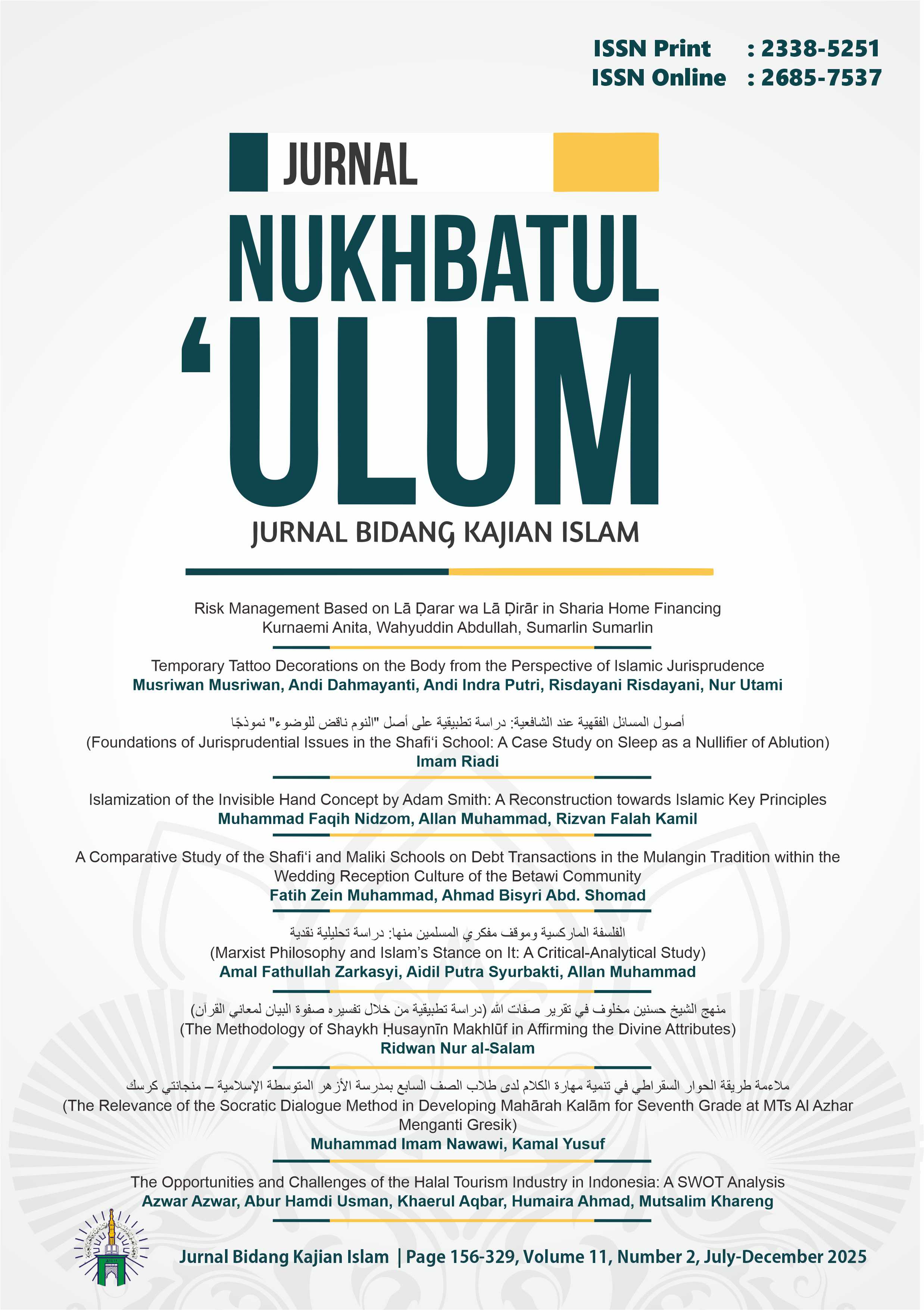
Islamization of the Invinsible Hand Concept by Adam Smith: A Reconstruction towards Islamic Key Principles
DOI:
https://doi.org/10.36701/nukhbah.v11i2.2475Keywords:
Islamization, Islamic Economics, Invisible Hand, Maqasid al-Syariah , Social JusticeAbstract
This study aims to Islamize Adam Smith’s concept of the invisible hand, which has long been regarded as a central pillar of capitalist economic theory. The invisible hand describes a free market mechanism in which individuals pursuing self-interest unintentionally contribute to collective welfare. While this theory emphasizes efficiency, it has been criticized for neglecting morality, justice, and equity. From an Islamic economic perspective, these dimensions are essential, as economic activity must be aligned with values of tawḥīd (monotheism), justice, and social responsibility. The research employs a qualitative approach through literature review and conceptual analysis. The literature review examines Adam Smith’s The Wealth of Nations and The Theory of Moral Sentiments, alongside classical and contemporary Islamic economic writings. Conceptual analysis is then used to assess the compatibility between the invisible hand and Islamic principles, particularly the role of zakat, ḥisbah, and maqāṣid al-Syarīʿah in shaping economic justice and social welfare. The results show that Smith’s invisible hand can be reconstructed by integrating Islamic values, thereby producing a more equitable economic model. While self-interest remains a driving force for efficiency, Islamic principles such as distributive justice through zakat, ethical oversight through ḥisbah, and alignment with maqāṣid al-Syarīʿah ensure that markets also serve moral and social objectives. The implication of this study is twofold: theoretically, it contributes to the enrichment of Islamic economic thought; practically, it offers policymakers an alternative framework for designing economic systems that are not only efficient but also just and welfare-oriented.
Downloads
References
Ahmed, Habib, Mehmet Asutay, and Rodney Wilson. Islamic Banking and Financial Crisis: Reputation, Stability and Risks. UK: Edinburgh University Press, 2014.
Al-Attas, Syed Muhammad Naquib. Islam and Secularism. Kuala Lumpur, Malaysia: International Institute of Islamic Thought and Civilization (ISTAC), 1993.
———. Prolegomena to the Metaphysics of Islam. Kuala Lumpur: International Institute of Islamic Thought and Civilization (ISTAC), 1995.
Al-Faruqi, Ismail Raji. Islamization of Knowledge: General Principles and Workplan. 2nd ed. Herndon, Virginia, U.S.A: International Institute of Islamic Thought, 1981.
Al-Mawdūdī, Abu al-A‘la. Towards Understanding Islam. 2nd ed. Lahore, Pakistan: U.K.I.M Dakwah Centre, 1960.
Al-Quran Al-Karim, n.d.
Arif, Muhammad Nur Rianto Al. Pengantar Ekonomi Syariah. Bandung: Pustaka Setia, 2015.
Arrow, Kenneth Joseph. The Limits of Organization. 1st ed. New York: Norton & Company, n.d.
“Arti Kata Kapital - Kamus Besar Bahasa Indonesia (KBBI) Online,” n.d.
Astutiningsih, Sri Eka, and Citra Mulya Sari. “Empowerment of Agroindustry Groups in an Effort to Accelerate East Java’s Economic Growth.” JIET: Jurnal Ilmu Ekonomi Terapan 2, no. 1 (2017): 1–9. https://doi.org/10.20473/jiet.v2i1.5500.
Asutay, Mehmet. “Conceptualising and Locating the Social Failure of Islamic Finance: Aspirations of Islamic Moral Economy vs. the Realities of Islamic Finance.” Asian and African Area Studies 11, no. 2 (2012): 93–113.
Auda, Jasser. Maqasid Al-Shariah as Philosophy of Islamic Law: A Systems Approach. London: International Institute of Islamic Thought, 2008.
Badrudin, Rudiy. Menggali Filosofi Pemikian Ekonomi Adam Smith. Surabaya: Universitas Airlangga, 2010.
Chapra, Muhammad Umer. Islam and the Economic Challenge. 17th ed. Riyadh, Saudi Arabia: International Islamic Publishing House, 1995.
———. The Islamic Vision of Development in the Light of Maqasid Al-Shariah. Jeddah: Islamic Research and Training Institute, 2008.
Choudhury, Masudul Alam. Islamic Economics and Finance: An Epistemological Inquiry. Bingley: Emerald Group Publishing, 2012.
Fadli, Muhammad Dzul, Siradjuddin, Rahmawati Muin, and Khaerul Aqbar. “Keberlanjutan Usaha Pedagang Warung Tradisional Dengan Menerapkan Etika Bisnis Islam Di Kota Makassar.” Nukhbatul ’Ulum: Jurnal Bidang Kajian Islam 8, no. 1 (2022): 1–15. https://doi.org/https://doi.org/10.36701/nukhbah.v8i1.470.
Fleischacker, Samuel. Adam Smith. London: Routledge, 2021.
Hanley, Ryan Patrick. Adam Smith and the Character of Virtue. Cambridge: Cambridge University Press, 2009.
Hasan, Zainol, and Mahyudi. “Analisis Terhadap Pemikiran Ekonomi Kapitalisme Adam Smith.” Istidlal Jurnal Ekonomi Dan Hukum Islam 4, no. 1 (2020): 24–34. https://doi.org/10.35316/istidlal.v4i1.206.
Ibnu Majah. “Sunan Ibn Majah-Kitab Al-Ruhun-Bab Ajru Al-Ujara.” In Hadith 2443, 16th ed. Vol. 3, n.d.
KAH, Rustam Dahar. “Teori Invisible Hand Adam Smith Dalam Perspektif Ekonomi Islam.” Economica: Jurnal Ekonomi Islam 2, no. 2 (2012): 57–70. https://doi.org/https://doi.org/10.21580/economica.2012.2.2.850.
Kahneman, Daniel. Thinking, Fast and Slow. Canada: Doubleday Canada, 2011.
Kambali, Muhammad. “Kritik Ekonomi Islam Terhadap Mekanisme Distribusi Pendapatan Dalam Sistem Ekonomi Kapitalis.” Ulumuna: Jurnal Studi Keislaman 1, no. 2 (2015): 252–65. https://doi.org/https://ejournal.kopertais4.or.id/madura/index.php/ulumuna/article/view/1626.
Karim, Adiwarman A. Ekonomi Islam: Suatu Kajian Kontemporer. Jakarta: Raja Grafindo Persada, 2021.
Kennedy, Gavin. Adam Smith: A Moral Philosopher and His Political Economy. 2nd ed. London: Palgrave Macmillan, 2013.
———. Adam Smith’s Lost Legacy. New York: Palgrave Macmillan, 2005.
Keraf, Sonny. Pasar Bebas Berkeadilan. Yogyakarta: Kanisius, 1996.
Keynes, John Maynard. The General Theory of Employment, Interest, and Money. US: Global Grey Ebooks, 1936.
Khan, Muhammad Akram. Islamic Economics and Finance : A Glossary. 2nd ed. London and New York: Routledge (Taylor & Francis Group), 2003.
Manis, Jim. An Inquiry into the Nature and Causes of the Wealth of Nations by Adam Smith. Hazleton: The Pennsylvania State University, 2005.
Mannan, Muhammad Abdul. Teori Dan Praktek Ekonomi Islam. Translated by M Nastangin. Yogyakarta: Dana Bakti Wakaf, 1995.
Marx, Karl. Das Capital: A Critique of Political Economy. Edited by Ernest Mandel. Translated by Ben Fowkes. 1st ed. England: Penguin Books, 1990.
Muhalli. “Mekanisme Pasar Dalam Pemikiran Adam Smith.” Fintech: Journal of Islamic Finance 2, no. 1 (2020): 37–61. https://doi.org/https://ejournal.kopertais4.or.id/madura/index.php/fintech/article/view/4635.
Peart, Sandra J., and David M. Levy. The Street Porter and the Philosopher: Conversations on Analytical Egalitarianism. Ann Arbor: The University of Michigan Press, 2008.
Phillipson, Nicholas. Adam Smith: An Enlightened Life. London: Penguin Books, 2010.
Piketty, Thomas. Capital In The Twenty-First Century. Translated by Arthur Goldhammer. Vol. 2. Cambridge: Harvard University Press, 2014.
Rothschild, Emma. Economic Sentiments: Adam Smith, Condorcet, and the Enlightenment. Cambridge: Harvard University Press, 2019.
Samuelson, Paul A., and William D. Nordhaus. Economics. 9th ed. New York: McGraw-Hill/Irwin, 2009.
Schumpeter, Joseph A. Capitalism, Socialism and Democracy. Edited by Richard Swedberg. London and New York: Routledge, 2003.
Sen, Amartya. The Idea of Justice. Cambridge, Massachusetts: Harvard University Press, 2009.
Sitorus, Ilhamsyah. “Pemikiran Adam Smith Tentang Pasar Bebas Perspektif Ekonomi Islam.” Institut Agama Islam Negeri, 2017.
Smith, Adam. The Theory of Moral Sentiments. Edited by Amartya Sen and Ryan Patrick Hanley. London: Penguin Classics, n.d.
———. The Wealth of Nations - An Inquiry Into the Nature and Causes of the Wealth of Nations. Edited by R. H. Campbell, A. S. Skinner, and W. B. Tood. 1st ed. UK: Oxford University Press, 1976.
Stiglitz, Joseph E. People, Power, and Profits: Progressive Capitalism for an Age of Discontent. New York and London: W.W.Norton, 2019.
Stonier, Alfred W., and Douglass C. Hague. Teori Ekonomi. Jakarta: Ghalia Indonesia, 1984.
Sukirno, Sadono. Mikro Ekonomi: Teori Pengantar. 3rd ed. Jakarta: Raja Grafindo Persada, 2008.
Thaler, Richard H. Richard H. Thaler: Misbehaving: The Making of Behavioral Economics. New York and London: W.W.Norton, 2015.
Wijaya, Cuk Ananta. “Filsafat Ekonomi Adam Smith.” Jurnal Filsafat 19, no. 1 (2009): 1–22. https://doi.org/https://doi.org/10.22146/jf.3447.
———. “Filsafat Ekonomi Adam Smith.” Jurnal Filsafat 19, no. 1 (2009). https://doi.org/https://doi.org/10.22146/jf.3447.
Winardi. Sejarah Perkembangan Ilmu Ekonomi. Bandung: Tarsito, 1974.
Zulianna, Eka, and Prima Dwi Priyatno. “Optimalisasi Pendistribusian ZIS Dalam Pengentasan Kemiskinan Berdasarkan Perspektif Maqashid Syariah Di Baznas Kota Bogor.” Nukhbatul ’Ulum: Jurnal Bidang Kajian Islam 8, no. 2 (2022): 146–57. https://doi.org/10.24014/jhi.v19i2.8060.2.
Downloads
Published
Issue
Section
License
Copyright (c) 2025 Muhammad Faqih Nidzom, Allan Muhammad, Rizvan Falah Kamil

This work is licensed under a Creative Commons Attribution-NonCommercial-ShareAlike 4.0 International License.