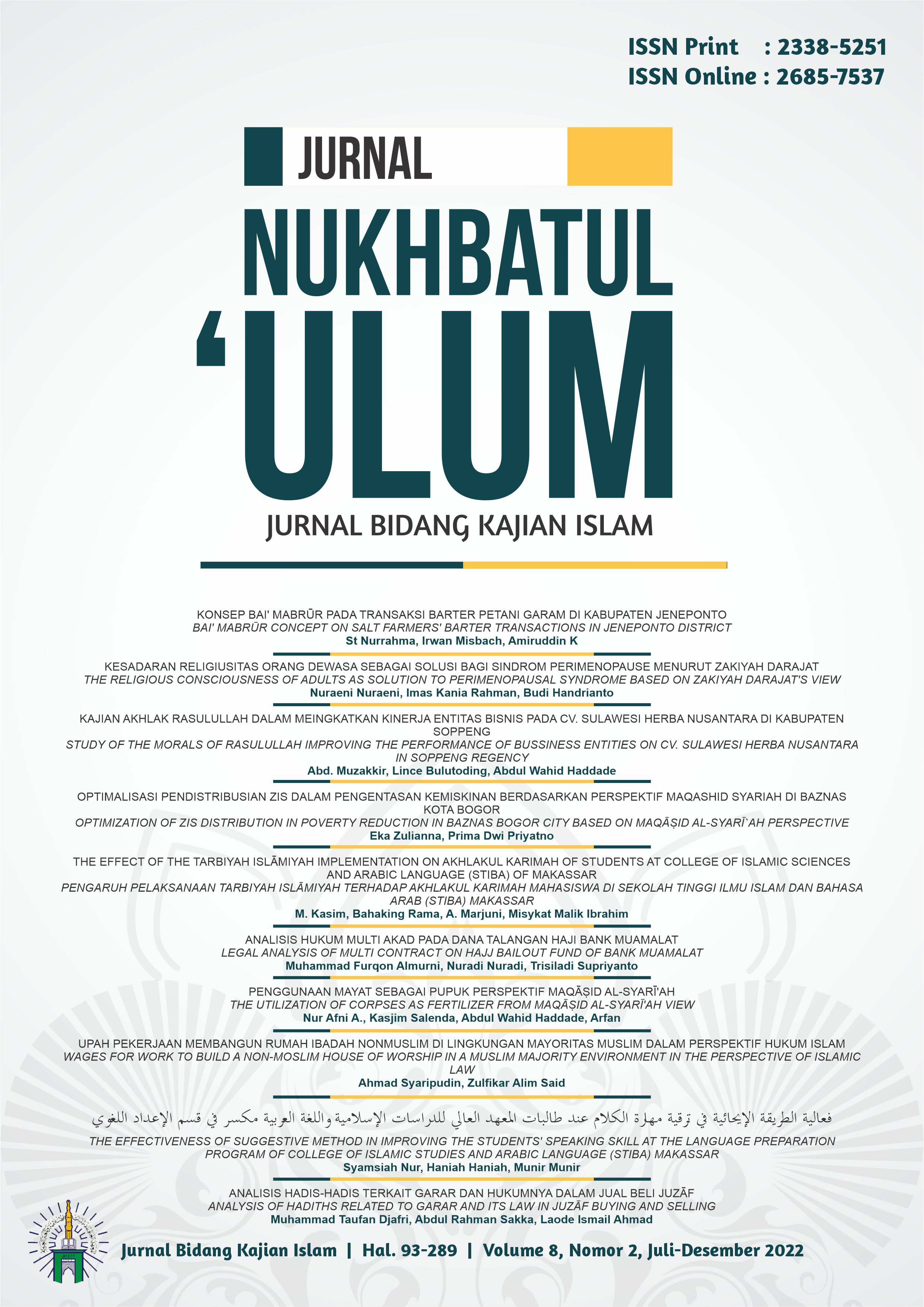
Penggunaan Mayat sebagai Pupuk Perspektif Maqāṣid al-Syarī’ah
The Utilization of Corpses as Fertilizer from Maqāṣid al-Syarī'ah View
DOI:
https://doi.org/10.36701/nukhbah.v8i2.568Keywords:
corpse, fertilizer, maqāṣid al-Syarī‘ahAbstract
This study examined the usage of human remains as fertilizer from the standpoint of maqāṣid al-syarī’ah. This study combined library research (library research) with a normative theology (shar'i) and a philosophical approach. The key data sources included the verses of the Qur'an, the hadith of the prophet, and the theories of maqāṣid al-syarī’ah, as well as information on the usage of corpses as fertilizer and the corresponding laws and government regulations. Literatures that serve as interpretations of passages, hadiths, scientific works that investigate maqāṣid al-syarī’ah theories, research outcomes, scientific journal articles, print and internet media were the secondary data sources. Deductive, inductive, comparative, and descriptive approaches were used to analyze the data. According to the findings of this study, the usage of human remains as fertilizer is contrary to maqāṣid al-syarī’ah. Because the objective of this activity was the efficiency of property and land for burial of corpses, as well as soil fertility for environmental sustainability, which was included in the maslahat al-taḥsīniyyah level, whereas turning corpses into fertilizer violates the ḥifẓ al-nafs and ḥifẓ al-’arḍ aspects of maslahat al-ḍarūriyyah. Destruction of al-ḍarūriyyah objects cannot achieve the objective at the al-taḥsīniyyah level, hence the conduct was forbidden.
Penelitian ini membahas tentang penggunaan mayat sebagai pupuk perspektif maqāṣid al-syarī‘ah. Penelitian ini termasuk library research (penelitian pustaka) dengan pendekatan teologis normatif (pendekatan syar’i) dan pendekatan filosofis. Data-data yang merupakan bahan primer adalah ayat-ayat al-Quran, hadis nabi, dan teori-teori maqāṣid al-syarī’ah serta informasi penggunaan mayat sebagai pupuk dan undang-undang dan peraturan pemerintah yang berkaitan dengan itu. Adapun sumber data sekunder yaitu literatur-literatur yang berfungsi sebagai interpretasi ayat, hadis, karya-karya ilmiah yang mengkaji tentang teori-teori maqāṣid al-syarī’ah, hasil-hasil penelitian, artikel jurnal ilmiah, media cetak dan online. Data-data dianalisis dengan metode deduktif, induktif, komparatif, dan deskriptif analisis. Hasil penelitian ini menunjukkan bahwa penggunaan mayat sebagai pupuk tidak sesuai dengan maqāṣid al-syarī‘ah. Sebab, tujuan aktivitas ini adalah efiensi harta dan lahan untuk penguburan jenazah, serta kesuburan tanah untuk kelestarian lingkungan yang masuk pada tingkatan maslahat al-taḥsīniyyah, sedangkan mengubah mayat menjadi pupuk melanggar aspek ḥifẓ al-nafs dan ḥifẓ al-’arḍ pada tingkatan maslahat al-ḍarūriyyah. Oleh karena itu, perbuatan tersebut tidak boleh dilakukan mengingat bahwa tujuan pada tingkatan taḥsīniyyah tidak boleh dicapai dengan merusak hal-hal yang bersifat ḍarūriyyah.
Downloads