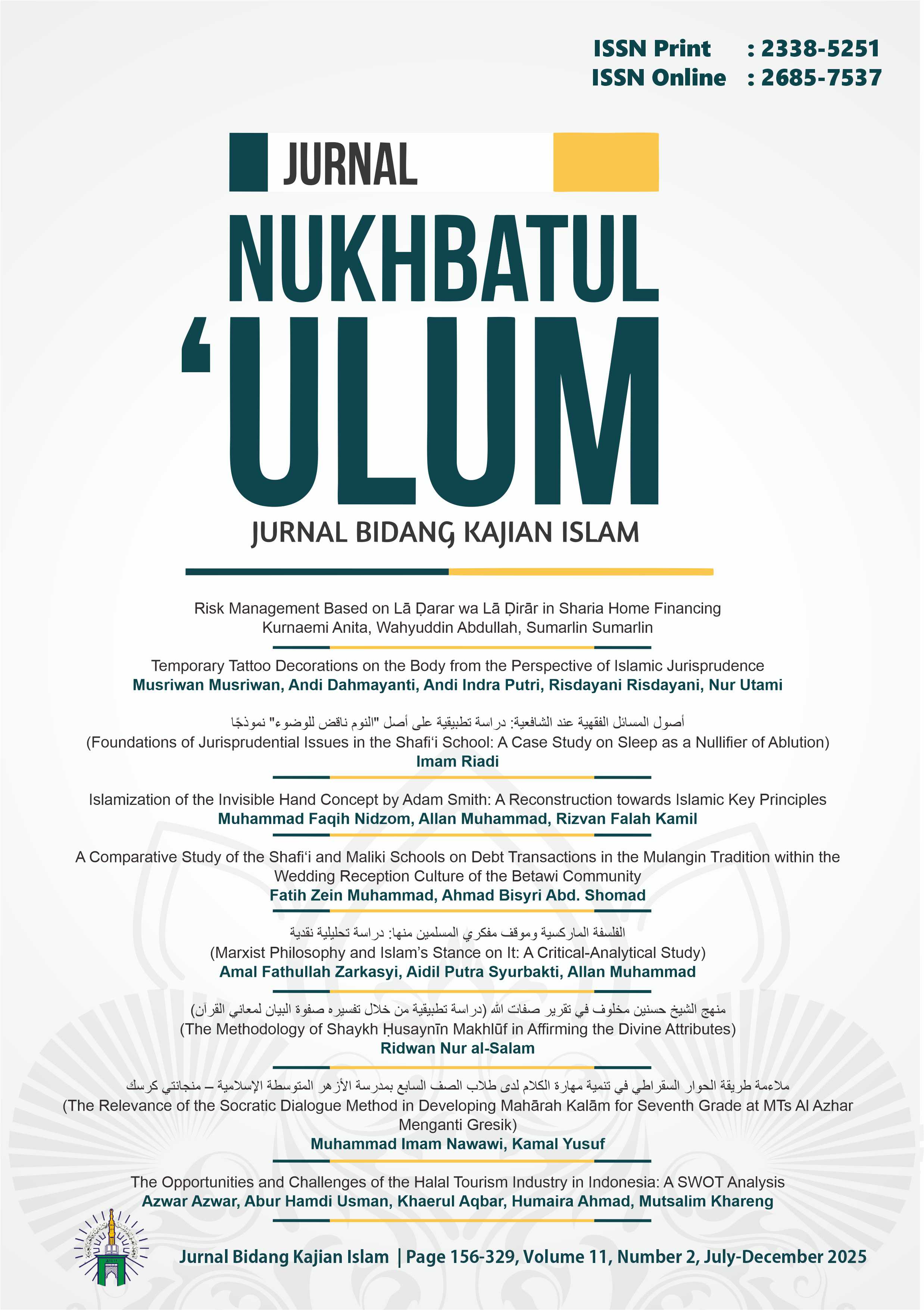
The Opportunities and Challenges of Halal Tourism Industry in Indonesia: A SWOT Analysis
DOI:
https://doi.org/10.36701/nukhbah.v11i2.2809Keywords:
halal, tourism, industry, SWOT, IndonesiaAbstract
The rapid global growth of the tourism industry has positioned halal tourism as one of the most promising sectors in Muslim-majority countries. Indonesia, with its large Muslim population and rich natural and cultural diversity, holds significant potential to become a leading destination in the halal tourism market. This study aims to examine the opportunities and challenges faced by Indonesia’s halal tourism industry and to formulate strategic recommendations for its development. Employing a descriptive qualitative method with a phenomenological approach and SWOT analysis, this study explores internal and external factors influencing the industry. The findings reveal that Indonesia’s strengths lie in the growing Muslim population, increasing awareness of the halal lifestyle, and government support through institutional coordination. Meanwhile, the main challenges include relatively low-quality infrastructure compared to competitors, limited technological integration, and the absence of specific financial and legal frameworks for halal tourism. The study recommends a growth strategy through horizontal integration, emphasizing digital branding and social media promotion, as well as the urgency of establishing a national law on halal tourism. The novelty of this research lies in its comprehensive positioning of Indonesia’s halal tourism industry using SWOT analysis to bridge the gap between potential and policy direction, offering strategic insight for policymakers and industry stakeholders.
Downloads
References
Abd.ghafur. “Etika Bisnis Dalam Perpektif Islam.” Iqtishodiyah: Jurnal Ekonomi Dan Bisnis Islam, no. 2 (2018): 1–21.
Abdullah, Fatihah Norazami, Azyyati Anuar, Rosliza Md Zani, and Yong Azrina Ali Akbar. “Halal Tourism: An Integrative Review of Concepts, Challenges, and Future Directions.” Journal of Emerging Economies and Islamic Research 13, no. 2 (June 1, 2025): 4486. https://doi.org/10.24191/jeeir.v13i2.4486.
Addina, F N, and I Santoso. “Concept of Halal Food Development to Support Halal Tourism: A Review.” In IOP Conference Series: Earth and Environmental Science, 475:12053. IOP Publishing, 2020.
Adinugraha, Hendri Hermawan, Ismail Fahmi Arrauf Nasution, Faisal Faisal, Maraimbang Daulay, Ikhwanuddin Harahap, T Wildan, Muhamad Takhim, Agus Riyadi, and Agus Purwanto. “Halal Tourism in Indonesia: An Indonesian Council of Ulama National Sharia Board Fatwa Perspective.” The Journal of Asian Finance, Economics and Business 8, no. 3 (2021): 665–73.
al-Raisūnī, Aḥmad. Naẓariyyah Al-Maqāṣid ’Inda Al-Imām Al-Syāṭibī. Virginia: Ma’had ’Ālī li al-Fikr al-Islāmī, 1995.
Azam, Md Siddique E, Betania Kartika Muflih, and M Ashraf Al Haq. “Intersection between Modern Technologies and Halal Tourism: Exploring the Role of Digital Innovation in Enhancing Muslim Travellers’ Experience.” The Journal of Muamalat and Islamic Finance Research, 2024, 16–31.
Azwar, Azwar, and Jumadil Saputra. “The Role of the Digital Economy in the Development of the Halal Industry and the Sharia Economy in Indonesia: SWOT Analysis.” JURNAL INDO-ISLAMIKA 13, no. 1 (2023): 34–49. https://doi.org/https://doi.org/10.15408/jii.v13i1.32029.
Bappenas. Masterplan Ekonomi Syariah Indonesia 2019-2024 Hasil Kajian Analisis Ekonomi Syariah Di Indonesia. Edited by Deputi Bidang Ekonomi. 1st ed. Jakarta: Kementerian Perencanaan Pembangunan Nasional/ Badan Perencanaan Pembangunan Nasional, 2018. https://kneks.go.id/storage/upload/1573459280-Masterplan Eksyar_Preview.pdf.
Battour, Mohamed, Fatemeh Hakimian, Mohd Ismail, and Erhan Boğan. “The Perception of Non-Muslim Tourists towards Halal Tourism: Evidence from Turkey and Malaysia.” Journal of Islamic Marketing, 2018.
Boğan, Erhan. “Halal Tourism: The Practices of Halal Hotels in Alanya, Turkey.” Journal of Tourism and Gastronomy Studies 8, no. 1 (2020): 29–42.
Carboni, Michele, Carlo Perelli, and Giovanni Sistu. “Is Islamic Tourism a Viable Option for Tunisian Tourism? Insights from Djerba.” Tourism Management Perspectives 11 (2014): 1–9.
CrescentRating. “The 10th Edition of the Mastercard-CrescentRating Global Muslim Travel Index (GMTI) in 2025,” 2025. https://www.crescentrating.com/reports/global-muslim-travel-index-2025.html.
Creswell, John W, and J David Creswell. Research Design Qualitative, Quantitative, and Mixed Methods Approaches. 5th ed. New York, NY: SAGE Publications, Inc, 2017. http://www.ceil-conicet.gov.ar/wp-content/uploads/2015/10/Creswell-Cap-10.pdf.
Dawes, J D K, and Elizabeth R Landers. “The Effect of a Collaborative Classroom on Clinical Judgment Development in Nursing Students.” Journal of Nursing Education 64, no. 6 (2025): 365–71. https://doi.org/10.3928/01484834-20250130-03.
Dukcapil (Direktorat Jenderal Kependudukan dan Pencatatan Sipil Kementerian Dalam Negeri). “Data Kependudukan,” 2022. https://dukcapil.kemendagri.go.id/.
El-Gohary, Hatem. “Halal Tourism, Is It Really Halal?” Tourism Management Perspectives 19 (2016): 124–30.
Furqani, Hafas, and Abdelghani Echchabi. “Who Is Homo Islamicus? A Qurʾānic Perspective on the Economic Agent in Islamic Economics.” ISRA International Journal of Islamic Finance 14, no. 2 (2022): 206–20.
Gandhi, Ravi P, Charru Hasti, and Mahim Sagar. “A Grounded Exploration of Regulatory Dynamics and Competitive Forces in the Indian Telecom Network Industry.” Competition and Regulation in Network Industries 25, no. 2–3 (2024): 84–109. https://doi.org/10.1177/17835917241276006.
Gerlitz, Laima, Christopher Meyer, and Gunnar Prause. “Marketing and Branding Strategy for the South Baltic Sea Region: Reinforcing Regional Innovation in SMEs through Cross-Border Collaboration Models in the Age of Transformation.” Entrepreneurship and Sustainability Issues, no. 4 (2021): 467.
Hariani, Dina, and Mohd Hafiz Hanafiah. “The Competitiveness, Challenges and Opportunities to Accommodate the Halal Tourism Market: A Sharia -Law Tourism Destination Perspectives.” Journal of Islamic Marketing 15, no. 3 (February 19, 2024): 919–42. https://doi.org/10.1108/JIMA-05-2023-0147.
Ibn ‘Āsyūr, Muhammad al-Ṭāhir. Maqāṣid al-Syarī‘ah Al-Islāmiyyah. Urdun: Dār al-Nafāis, 2001.
Ifediora, Osita, and Justina Nzekwe. “Organization’s Stability and Productivity: The Role of SWOT Analysis an Acronym for Strength, Weakness, Opportunities and Threat.” International Journal of Innovative and Applied Research 2 (October 1, 2014): 23–32. https://www.researchgate.net/publication/292747707_Organization’s_stability_and_productivity_the_role_of_SWOT_analysis_an_acronym_for_strength_weakness_opportunities_and_threat.
Johan, Nur Syairah Jalilah, and Wan Farahiyah Izni W Abd Rahman. “Halal Tourism: Legal Factor Attracting Tourists To Malaysia.” Akademika 95, no. 1 (2025): 496–512.
Khairuldin, WMKFW, WNIWN Anas, Mustaffami Imas, A B Hassan, Abdul Hanis Embong, Nurul Haq Zahidah Lukman, and MAIM Yusuf. “Philosophy and Ethics in Halal Tourism: A Conceptual Analysis.” International Journal of Religion 5, no. 11 (2024): 486–93. https://pdfs.semanticscholar.org/2150/01bf0b7e9dee93b76088fd56dac58d49de07.pdf.
Khoiri, Nispul, and Muhammad Habibi Siregar. “Exploring Halal Tourism: The Role of Islamic Jurisprudence (Usul Fiqh) and Religious Moderation in Enhancing the Tourism Sector of Indonesia.” Pakistan Journal of Life & Social Sciences 22, no. 1 (2024).
Lestari, Yuliani Dwi, Faridatus Saidah, and Aghnia Nadhira Aliya Putri. “Effect of Destination Competitiveness Attributes on Tourists’ Intention to Visit Halal Tourism Destination in Indonesia.” Journal of Islamic Marketing, 2022.
Noy, Sue, Rebecca Patrick, Teresa Capetola, Claire Henderson‐Wilson, Jian W Chin, and Anthony D LaMontagne. “Minding Environment, Minding Workers: Environmental Workers’ Mental Health and Wellbeing.” Global Health Promotion 29, no. 4 (2022): 8–17. https://doi.org/10.1177/17579759221081881.
Pasarela, Husni, Andri Soemitra, and Zuhrinal M Nawawi. “Halal Tourism Development Strategy in Indonesia.” Konfrontasi: Jurnal Kultural, Ekonomi Dan Perubahan Sosial 9, no. 1 (2022): 14–26.
Prajasari, Anniza Citra. “How to Promote Halal Tourism through the Stakeholders? Case of Halal Tourism Market in Indonesia.” Jurnal Ilmiah Ekonomi Islam 8, no. 1 (2022).
Pratiwi, Ni Putu Lusiana, and Made Sudiarta. “Alternative Marketing Strategies For Low Season Period At Courtyard By Marriott Bali Seminyak Resort.” Journal of Applied Sciences in Travel and Hospitality 2, no. 2 (2019): 109–19. https://doi.org/https://dx.doi.org/10.31940/jasth.v2i2.1424.
Preko, Alexander, Iddrisu Mohammed, and Leeford Edem Kojo Ameyibor. “Muslim Tourist Religiosity, Perceived Values, Satisfaction, and Loyalty.” Tourism Review International 24, no. 2–3 (2020): 109–25.
Rangkuti, Freddy. Analisis SWOT Teknik Membedah Kasus Bisnis. Gramedia Pustaka Utama, 1998.
Rating, Crescent. “Global Muslim Travel Index 2018,” 2018. https://www.crescentrating.com/reports/mastercard-crescentrating-global-muslim-travel-index-gmti-2018.html.
Salaam Gateway. “State of the Global Islamic Economy (SGIE) 2024/25 Report,” 2025. https://salaamgateway.com/specialcoverage/SGIE24.
Sehnem, Simone, Deivsson S Bispo, Jacinto O João, Maria Aparecida Lima de Souza, Oscar Bertoglio, Rogério Ciotti, and Simone M Deon. “Upscaling Circular Economy in Foodtechs Businesses in Emergent Countries: Towards Sustainable Development Through Natural Resource Based View.” Sustainable Development 30, no. 5 (2022): 1200–1221. https://doi.org/10.1002/sd.2311.
Shi, Beiqi, Jinlin Zhao, and Po-Ju Chen. “Exploring Urban Tourism Crowding in Shanghai via Crowdsourcing Geospatial Data.” Current Issues in Tourism 20, no. 11 (2017): 1186–1209.
Suban, Syed Ahamed, Kumar Madhan, and Shameem Shagirbasha. “A Bibliometric Analysis of Halal and Islamic Tourism.” International Hospitality Review, 2021.
UNWTO (United Nations World Tourism Organization). “Tourism: An Economic and Social Phenomenon,” 2020. https://www.unwto.org/why-tourism.
Vargas-Sanchez, Alfonso, Dina Hariani, and Ani Wijayanti. “Perceptions of Halal Tourism in Indonesia: Mental Constructs and Level of Support.” International Journal of Religious Tourism and Pilgrimage 8, no. 4 (2020): 5.
World Travel & Tourism Council (WTTC). “Travel & Tourism Economic Impact Research (EIR),” 2025. https://wttc.org/research/economic-impact.
———. “WTTC’s 2025 Economic Impact Research (EIR).” United Kingdom, 2025. https://researchhub.wttc.org/product/indonesia-economic-impact-report.
Zhao, Jinlin. The Hospitality and Tourism Industry in China: New Growth, Trends, and Developments. CRC Press, 2018.
Downloads
Published
Issue
Section
License
Copyright (c) 2025 Azwar Azwar, Abur Hamdi Usman, Khaerul Aqbar, Humaira Ahmad, Mutsalim Khareng

This work is licensed under a Creative Commons Attribution-NonCommercial-ShareAlike 4.0 International License.