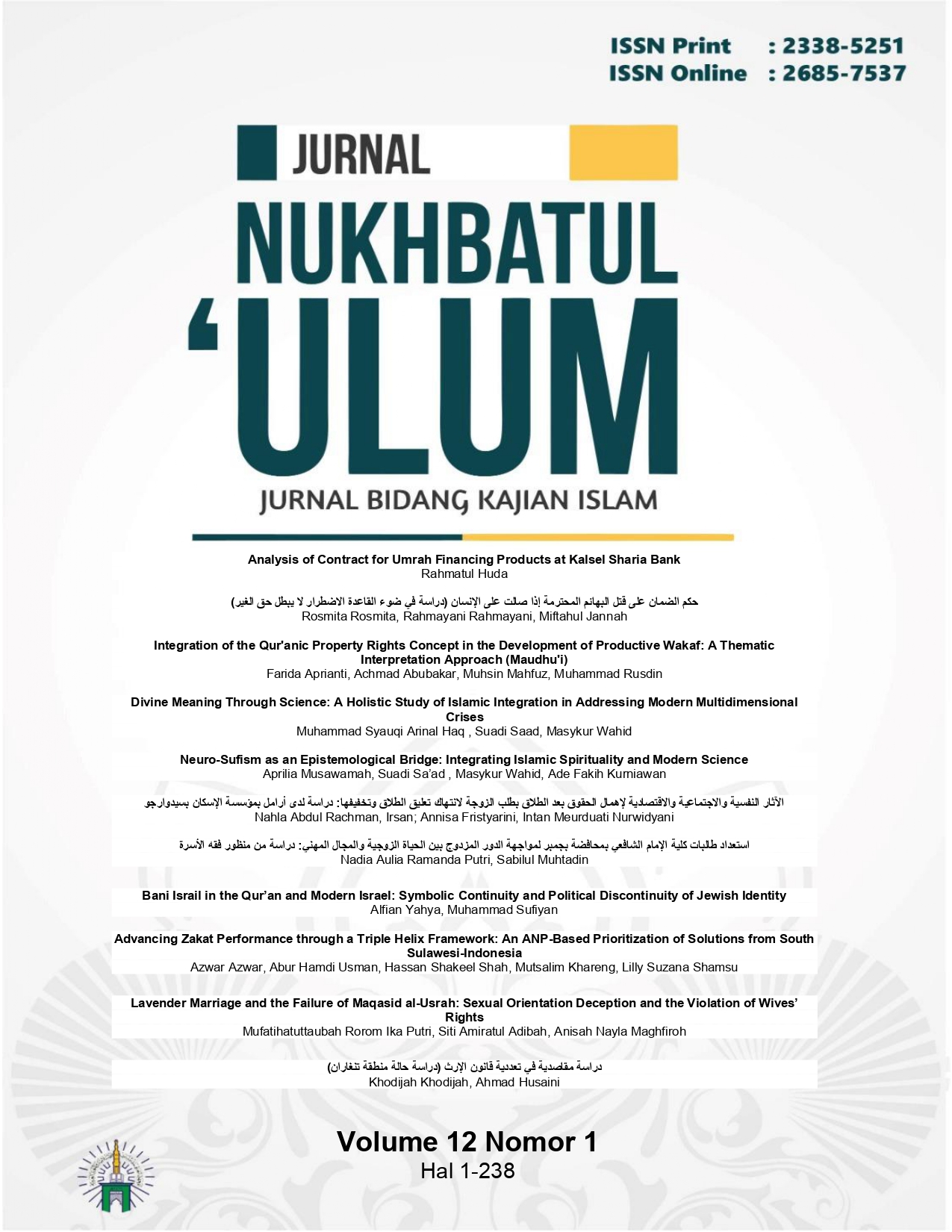
Advancing Zakat Performance through a Triple Helix Framework: An ANP-Based Prioritization of Solutions from South Sulawesi-Indonesia
DOI:
https://doi.org/10.36701/nukhbah.v12i1.2998Keywords:
zakat, zakat performance, Triple Helix, ANP, South SulawesiAbstract
As an essential component of Islamic social finance, zakat possesses considerable potential to reduce poverty and promote inclusive socio-economic development. However, the performance of zakat management remains suboptimal in many regions due to persistent governance challenges involving multiple stakeholders. This study aims to identify and prioritize strategic solutions for improving zakat performance in South Sulawesi, Indonesia, using the Analytic Network Process (ANP) within a Triple Helix governance framework. An exploratory sequential mixed-methods design was employed, in which qualitative findings were used to identify and validate governance determinants before being incorporated into the ANP model for priority analysis. The findings indicate that government-based solutions constitute the highest strategic priority, particularly strengthening regulatory certainty and policy support. Institutional reforms, including improvements in transparency, accountability, governance, and service quality, rank second, while community-based initiatives focusing on zakat literacy and public engagement serve as complementary priorities for sustainable zakat development. These results demonstrate that improving zakat performance requires coordinated and synergistic collaboration among government, zakat institutions, and society rather than isolated interventions by individual stakeholders. Methodologically, this study contributes by integrating the Triple Helix governance framework with the ANP approach to generate evidence-based strategic priorities for zakat governance. The proposed framework provides practical guidance for policymakers and zakat management organizations in designing integrated governance strategies to maximize the socio-economic impact of zakat.
Downloads
References
Ansoriyah, Faizatul, Kushandajani Kushandajani, Hartuti Purnaweni, Retno S Astuti, and Son Haji. “Identifying Public Value of Zakat Management Organizations: A Review of Muzaki’s Perception.” Dinika Academic Journal of Islamic Studies 8, no. 1 (2023): 1–21. https://doi.org/10.22515/dinika.v8i1.6664.
Anuar, Fatimah Sakeenah, Norhayati Mohd Alwi, and Noraini Mohd Ariffin. “Financial Management Practices and Performance of Zakat Institutions in Malaysia.” Ipn Journal of Research and Practice in Public Sector Accounting and Management 9, no. 01 (2019): 1–26. https://doi.org/10.58458/ipnj.v09.01.01.0056.
Bakri, Nur A, Wan A Endut, Suraya Ismail, and Roshaiza Taha. “Financial Report of Zakat Institutions: Guidelines and Accounting Standard.” International Journal of Academic Research in Business and Social Sciences 12, no. 1 (2022). https://doi.org/10.6007/ijarbss/v12-i1/11468.
Cai, Yuzhuo, and Annina Lattu. “Triple Helix or Quadruple Helix: Which Model of Innovation to Choose for Empirical Studies?” Minerva 60, no. 2 (2022): 257–80.
Chen, Zhenhua, and Junmei Cheng. “Economic Impact of Smart City Investment: Evidence From the Smart Columbus Projects.” Journal of Planning Education and Research 44, no. 3 (2022): 1881–97. https://doi.org/10.1177/0739456x221129173.
Creswell, John W, and J David Creswell. Research Design Qualitative, Quantitative, and Mixed Methods Approaches. 5th ed. New York, NY: SAGE Publications, Inc, 2017. http://www.ceil-conicet.gov.ar/wp-content/uploads/2015/10/Creswell-Cap-10.pdf.
Damanhur, Damanhur, Ahmad Fauzul Hakim Hasibuan, and Ichsan Ichsan. “Analisis Problematika Pendistribusian Zakat Terhadap Masyarakat Miskin Di Provinsi Aceh.” E-Mabis Jurnal Ekonomi Manajemen Dan Bisnis 23, no. 1 (2022): 168–75. https://doi.org/10.29103/e-mabis.v23i1.800.
Danlami, Muhammad R, Muhamad Abduh, and Lutfi A Razak. “Social Finance, Institutional Quality and Stability of Islamic Banks: Evidence From Four Countries.” International Journal of Social Economics 50, no. 8 (2023): 1186–1216. https://doi.org/10.1108/ijse-06-2022-0441.
Hamzah, Hamzah, and Fifi Fata’tiatul Hidayah. “The Empowerment of Productive Zakat Influence on Independence of the Community.” International Journal of Nusantara Islam 7, no. 2 (2020): 203–18. https://doi.org/10.15575/ijni.v7i2.10000.
Hasbi, M Zidny Nafi’. “The Relevance of the Human Development Index From an Islamic Perspective to Macroeconomics and Zakat: A Measure of the Development of the World’s Muslim Community.” Muslim Business and Economic Review 2, no. 2 (2023): 251–68. https://doi.org/10.56529/mber.v2i2.189.
Hassan, M K, M Z H Khan, M A Miah, and M K Islam. “The National-Level Potential of Zakat and Its Integration into the Fiscal Framework: Sector-Specific Insights from the Economy of Bangladesh.” International Journal of Islamic and Middle Eastern Finance and Management 17, no. 1 (2024): 146–69. https://doi.org/10.1108/IMEFM-09-2023-0313.
Hendar, Jejen, Neni Ruhaeni, and Asep H Zakiran. “The Concept of Safe Zakat Management According to the Provisions of the Prevailing Laws and Regulations in Indonesia.” Kne Social Sciences, 2023. https://doi.org/10.18502/kss.v8i18.14266.
Herianingrum, S, I Supriani, R Sukmana, E Effendie, T Widiastuti, Q Fauzi, and A Shofawati. “Zakat as an Instrument of Poverty Reduction in Indonesia.” Journal of Islamic Accounting and Business Research 15, no. 4 (2024): 643–60. https://doi.org/10.1108/JIABR-11-2021-0307.
Herlina, Sri, Dana Syahputra Barus, and Muhammad Syahbudi. “The Triple Helix Model of Islamic Social Financial Institutions Achieves SDGs 2030 Finance in North Sumatra.” Electronic Journal of Education Social Economics and Technology 6, no. 2 (2025): 1228. https://doi.org/10.33122/ejeset.v6i2.1228.
Hidayatullah, A, and A Priantina. “Toward Zakat Management Integration in Indonesia: Problems and Solution.” Ahkam: Jurnal Ilmu Syariah 18, no. 2 (2018): 321–46. https://doi.org/10.15408/ajis.v18i2.6319.
Imsar, Imsar, Febriandi Akbar Sitompul, and Juliana Nasution. “Pengaruh Dana Zakat, Pembiayaan Syariah, Anggaran Penerimaan Dan Belanja Negara (APBN) Terhadap Tingkat Kemiskinan Dengan Indeks Pembangunan Manusia Sebagai Variabel Intervening.” Oikonomika Jurnal Kajian Ekonomi Dan Keuangan Syariah 4, no. 1 (2023): 1–13. https://doi.org/10.53491/oikonomika.v4i1.557.
Judijanto, Loso. “Implementation of Zakat Law in Empowering the Islamic Community’s Economy in Indonesia.” The Easta Journal Law and Human Rights 2, no. 03 (2024): 136–46. https://doi.org/10.58812/eslhr.v2i03.281.
Kato, T. “Islamic and Capitalist Economies: Comparison Using Econophysics Models of Wealth Exchange and Redistribution.” PLoS ONE 17, no. 9 September (2022). https://doi.org/10.1371/journal.pone.0275113.
Khalidin, Bismi, Armiadi Musa, Mertisa Fardesi, and Nur Ulfia. “Islamic Economics Towards the Sustainability of Economic Development.” International Journal of Social Science Humanity & Management Research 03, no. 11 (2024). https://doi.org/10.58806/ijsshmr.2024.v3i11n16.
Khamis, Fauz M. “Constructing Indicators for Islamic Financial Inclusion.” International Journal of Islamic Economics 3, no. 2 (2021): 101. https://doi.org/10.32332/ijie.v3i2.3720.
Kismawadi, E R. “Islamic Fintech: Navigating the Regulatory Framework and Promoting Financial Inclusion in Gulf Cooperation Council (GCC) Countries.” Journal of Islamic Marketing, 2024. https://doi.org/10.1108/JIMA-02-2023-0061.
Kumkit, Tidarat, Dao Le Trang Anh, Christopher Gan, and Baiding Hu. “Members’ Perspectives of Good Governance Practice of Thailand’s Credit Union Cooperatives.” Journal of Asian Business and Economic Studies 31, no. 1 (2023): 55–73. https://doi.org/10.1108/jabes-06-2022-0154.
Mohamad, Shamsher, and Zulkarnain Muhamad Sori. “Governance Issues in Managing Zakat Funds.” I-Iecons E-Proceedings, 2023, 960–65. https://doi.org/10.33102/iiecons.v10i1.116.
Mulindra, Mega A, Ira Novianty, and Iwan Setiawan. “Muzakki’s Perception Regarding Implementation Good Corporate Governance (GCG) Against Muzakki’s Trust in OPZ.” Indonesian Journal of Economics and Management 3, no. 3 (2023): 582–91. https://doi.org/10.35313/ijem.v3i3.4876.
Nasution, A A, S A Kesuma, J Agustrisna, M H B Rangkuti, and N M A Aziz. “The Implementation of the Islamic Accounting Standard for Zakah, Infaq, and Shadaqah (ZIS) in Indonesia.” In Lecture Notes in Networks and Systems, edited by Alareeni B. and Hamdan A., 1083 LNNS:444–56. Universitas Sumatera Utara, Medan, 20155, Indonesia: Springer Science and Business Media Deutschland GmbH, 2024. https://doi.org/10.1007/978-3-031-67431-0_43.
Pan, Ssu-Chi, Peilei Fan, Tai-Shan Hu, Hanyu Li, and Wen-Shin Liu. “An Anticipatory Practice for the Future of Science Parks: Understanding the Indices and Mechanisms on Different Spatial Scales of Regional Innovation Systems.” Sustainability 16, no. 11 (2024): 4600. https://doi.org/10.3390/su16114600.
Pusat Kajian Strategis – Badan Amil Zakat Nasional. “Indeks Zakat Nasional 2020 Sulawesi Utara, Sulawesi Tengah, Sulawesi Selatan, Sulawesi Tenggara, Gorontalo, Sulawesi Barat Maluku, Maluku Utara.” Jakarta, 2020.
Pusat Kajian Strategis – Badan Amil Zakat Nasional (Puskas BAZNAS). “Potensi Zakat BAZNAS RI,” 2022. https://www.puskasbaznas.com/publications/published/officialnews/1703-potensi-zakat-baznas-ri.
Qutaiba, Mohammad, Mohd Owais, and Abdus S Muharam. “The Current Issue of Reporting Zakat in Indonesia: A Critical Analysis.” Journal of Islamic Economic and Business Research 4, no. 1 (2024): 1–23. https://doi.org/10.18196/jiebr.v4i1.227.
Saaty, Thomas L. “Decision Making with the Analytic Hierarchy Process.” International Journal of Services Sciences 1, no. 1 (2008): 83–98. https://doi.org/https://doi.org/10.1504/IJSSCI.2008.017590.
———. Theory and Applications of the Analytic Network Process: Decision Making with Benefits, Opportunities, Costs, and Risks. RWS publications, 2005.
Saaty, Thomas L, and Luis G Vargas. The Analytic Network Process. Springer, 2013.
Sahban, Aishat Abubakar, and Fuadah Joharı. “Intention to Patronise Zakat Institution at Kwara State, Nigeria: An Application of the Decompose Theory of Planned Behaviour.” Falah Jurnal Ekonomi Syariah 6, no. 1 (2021): 1–16. https://doi.org/10.22219/jes.v6i1.15234.
Sawmar, Abdulsalam Ahmed, and Mustafa Omar Mohammad. “Governance of Formal Zakat Institution in Saudi Arabia.” International Journal of Zakat 4, no. 2 (2019): 23–40.
Setianingrum, Any, Nurul Huda, and Perdana Wahyu Santosa. “Prospects of Zakat as Tax Credit in a New Normal COVID-19 Period.” International Journal of Zakat 6, no. 1 (2021): 25–38. https://doi.org/10.37706/ijaz.v6i1.242.
Shamsuddin, Noraini, and Nor S Bakar. “Influence of the Internal Audit Function Towards Zakat Performance.” International Journal of Islamic Economics and Finance Research 4, no. 1 July (2021): 77–93. https://doi.org/10.53840/ijiefer50.
Sulsel.Baznas.Go.Id. “Penghimpunan Zakat, Infak, Dan Sedekah Januari-Desember 2024,” 2024. https://sulsel.baznas.go.id/.
Tajuddin, Teh S. “Trust in Zakat Authorities and Zakat Compliance: A Conceptual Analysis.” Almimbar, 2023, 115–28. https://doi.org/10.53840/almimbar.v3i2.82.
Thamrin, M H, F Eriza, M Faisal, I K Nasution, and M A Dalimunthe. “Religiosity in Paying Zakat and Tax Compliance in Medan City.” Pharos Journal of Theology 104, no. 3 (2023). https://doi.org/10.46222/pharosjot.104.330.
Wahyuni-TD, Ika S, Hasnah Haron, and Yudi Fernando. “The Effects of Good Governance and Fraud Prevention on Performance of the Zakat Institutions in Indonesia: A Sharīʿah Forensic Accounting Perspective.” International Journal of Islamic and Middle Eastern Finance and Management 14, no. 4 (2021): 692–712. https://doi.org/10.1108/imefm-03-2019-0089.
Wahyuningsi, Irmawati, Lince Bulutoding, and Suhartono Suhartono. “Pengelolaan Zakat Produktif Berbasis PSAK 109 Dalam Mewujudkan Good Zakat Governance.” Isafir Islamic Accounting and Finance Review 2, no. 1 (2021): 54–63. https://doi.org/10.24252/isafir.v2i1.19468.
Widiastuti, T, E F Cahyono, S Zulaikha, I Mawardi, and M U Al Mustofa. “Optimizing Zakat Governance in East Java Using Analytical Network Process (ANP): The Role of Zakat Technology (ZakaTech).” Journal of Islamic Accounting and Business Research 12, no. 3 (2021): 301–19. https://doi.org/10.1108/JIABR-09-2020-0307.
Yermakov, Oleksandr, and Iryna Kostetska. “Environmental Challenges of the Green Economy: Case of Ukraine.” Iop Conference Series Earth and Environmental Science 1111, no. 1 (2022): 12002. https://doi.org/10.1088/1755-1315/1111/1/012002.
Yusrawati, Yusrawati, Tatik Mariyanti, and Nanda Septiani. “The Effect of Commitment to Managerial Performance Intervening Variable at the National Baznas of Riau Province.” Aptisi Transactions on Technopreneurship (Att) 4, no. 2 (2022): 135–41. https://doi.org/10.34306/att.v4i2.249.
Downloads
Published
Issue
Section
License
Copyright (c) 2026 Azwar Azwar, Abur Hamdi Usman, Hassan Shakeel Shah, Mutsalim Khareng, Lilly Suzana Shamsu

This work is licensed under a Creative Commons Attribution-NonCommercial-ShareAlike 4.0 International License.