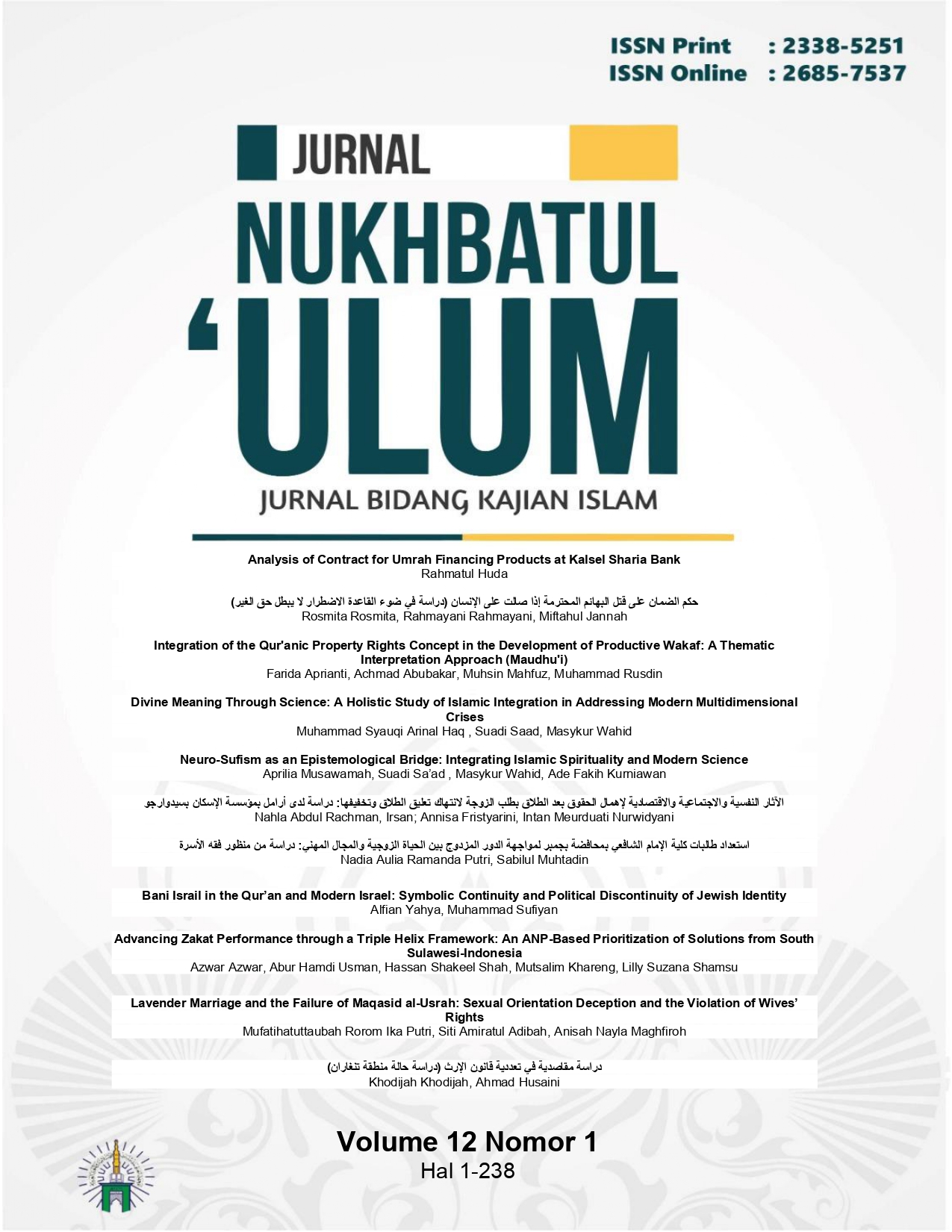
Divine Meaning Through Science: A Holistic Study of Islamic Integration in Addressing Modern Multidimensional Crises
DOI:
https://doi.org/10.36701/nukhbah.v12i1.2957Keywords:
Divine meaning in science, Islamic epistemology of science, Tauhid-based scientific paradigm, Science–spirituality integration, Modern multidimensional crisisAbstract
This article examines the search for divine meaning in science through a holistic integrative framework grounded in Islamic epistemology, particularly in response to the multidimensional crises characterizing modern society. Contemporary science, while technologically advanced, often operates within a reductionist and value-neutral paradigm that marginalizes ethical and spiritual dimensions. This study aims to analyze how the integration of Islamic spiritual principles can reorient scientific inquiry toward a more meaningful and ethically grounded paradigm. Employing a qualitative library-based research method, the study conducts a critical–descriptive analysis of classical and contemporary scholarly works on science–religion integration, holistic epistemology, and modern civilizational crises. The discussion demonstrates that positioning science within a tauhid-based worldview enables a reconceptualization of natural phenomena as both empirical realities and signs of divine order, thereby restoring ethical orientation, existential meaning, and epistemic coherence in scientific practice. The scholarly contribution of this article lies in its formulation of “divine meaning in science” as a conceptual epistemological framework that bridges empirical inquiry with spiritual consciousness, rather than merely advocating methodological dialogue between science and religion. This approach provides a specific conceptual alternative for addressing ecological, moral, and existential crises by repositioning science as a value-oriented and integrative human endeavor.
Downloads
References
Abror, Indal. “Refleksi tentang hubungan sains dan agama bagi umat islam.” Aplikasia: Jurnal Aplikasi Ilmu-ilmu agama 8, no. 1 (2007). http://digilib.uin-suka.ac.id/id/eprint/8326.
Afkarina, Miftahul, Wahyu Irawan, Abdul Haris, Abd. Malik Karim Amrullah, dan Agus Puspita W. “Konflik, Dialog, dan Integrasi: Sebuah Eksplorasi Filosofis tentang Hubungan Sains dan Agama.” Santhet: Jurnal sejarah, pendidikan, dan humaniora 8, no. 2 (2024): 2533–40. https://doi.org/10.36526/js.v3i2.
Afriandi, Budi, Tamrin Kamal, Rosniati Hakim, Halim Hanaf, Julhadi, dan Hengki Ras Bum. “Objek-Objek Kajian Filsafat Ilmu (Ontologi, Epistemologi, Aksiologi) dan Urgensinya Dalam Kajian Keislaman.” Jurnal Kajian dan Pengembangan Umat 7, no. 1 (2024). https://doi.org/10.31869/jkpu.v7i1.5524.
Ainina, Sefhia Qurrotu. “Integrating Science and Religion through Ontological and Historical Approaches in Islamic Education.” Averroes: Journal for Science and Religious Studies 1, no. 3 (2024). https://doi.org/10.62446/averroes.010302.
AK, Mukhopadhyay. “The Science of Divinity.” Archives in Neurology & Neuroscience 9, no. 3 (2020). https://doi.org/10.33552/ann.2020.09.000712.
Alfi, Lailah. “Konsep Ilmu Menurut Syed Muhammad Naquib Al-Attas(Analisis buku Islam dan Filsafat Sains).” TASFIYAH: Jurnal Pemikiran Islam 2, no. 2 (2018). https://doi.org/http://dx.doi.org/10.21111/tasfiyah.v2i2.2580.
Aljunied, Khairudin. “Osman Bakar and Epistemological Renewal in the Muslim World.” Al-Shajarah: ISTAC Journal Of Islamic Thought and Civilization 27, no. 1 (2022). https://doi.org/10.31436/shajarah.v27i1.1388.
Allen, Paul, dan Flavia Maracci. “Divined Explanations: The Theological and Philosophical Context for the Development of the Sciences (1600–2000).” The American Scientific Affiliation 77, no. 4 (2025). https://doi.org/10.56315/PSCF12-25Allen.
Amable, Bruno, dan Stefano Palombarini. “Multidimensional social conflict and institutional change.” New Political Economy 28, no. 6 (2023). https://doi.org/10.1080/13563467.2023.2215701.
Andi, Emerentiana Tulak, Muhammad Syukur, Ilmu Pengetahuan, dan Etika Moral. “Perkembangan Ilmu Pengetahuan Dan Teknologi Terhadap Etika Moral Manusia Sebagai Objek Filsafat Aksiologi” XIX, no. April (2024): 51–60.
Andreyev, Alexander. “Practices For Planning and Operating Multisite Network Environments Under Crisis Conditions.” The American Journal of Engineering and Technology 7, no. 9 (2025). https://doi.org/10.37547/tajet/Volume07Issue09-03.
Arroisi, Jarman, Hamid Fahmy Zarkasyi, dan Winda Roini. “The Relevance of Contemporary Epistemology on Existing Knowledge: A Critical Analysis of Western Scientific Worldview according to al-Attas Perspective.” Afkar: Jurnal Aqidan dan Pemikiran Islam 25, no. 2 (2023). https://doi.org/10.22452/afkar.vol25no2.7.
Barbour, Ian G. Juru Bicara Tuhan Antara Sains dan Agama, Terj. E.R. Muhammad. Bandung: Mizan, 2002.
Bergman, Annika, Thomas Gammelthoft, Mo Hamza, Jeff Hearn, Vasna Ramasar, dan Helle Rydstrom. “The case for Interdisciplinary Crisis Studies.” Global Discource: An interdisciplinary journal of current affairs 12, no. 3–4 (2020). https://doi.org/10.1332/204378920X15802967811683.
Bharucha, Bilkis. “Islam, Science, and the Environment: An Application of Ibrahim Kalin’s ‘Three Views of Science in the Islamic World.’” AJIS: American Journal Of Islam And Society 42, no. 3–4 (2025). https://doi.org/10.35632/ajis.v39i3--4.3724.
Brom, Luco J. van den. “Categorial differences between religious and scientific language: The agency of God.” HTS Theological Studies 79, no. 2 (2023). https://doi.org/10.4102/hts.v79i2.9012.
Buhagiar, Kristina, dan Amitabh Anand. “Synergistic triad of crisis management: leadership, knowledge management and organizational learning.” International Journal of Organizational Analysis 31, no. 2 (2023). https://doi.org/10.1108/IJOA-03-2021-2672.
Dahlan, Moh. “Relasi sains modern dan sains islam.” Jurnal Salam 12, no. 2 (2009): 65–83. https://ejournal.umm.ac.id/index.php/salam/article/view/444.
Darjee, Dilip Kumar, dan Dr. Neeru Sewa. “Divine Phenomena in India: A Study of Faith and Science Interpretations.” International Journal for Research in Applied Science and Engineering Technology 13, no. 8 (2025). https://doi.org/10.22214/ijraset.2025.72513.
Dr. Fathul Mu’in, dan Nurulia Febriati. Integrasi Islam Dan Sains Modern. Purbalingga: Eureka Media Aksara, 2021.
Fadhilah, Farah Nur. “Ironi Kemajuan Teknologi Vs Kerusakan Lingkungan.” Teknologi, 2025. https://teknologi.id/tekno/ironi-kemajuan-teknologi-vs-kerusakan-lingkungan.
Faizin. “Integrasi Agama Dan Sains Dalam Tafsir Ilmi Kementerian Agama Ri.” Jurnal Ushuluddin 25, no. 1 (2017): 19–33. https://doi.org/10.24014/jush.v25i1.2560.
Gusli, Ramadhoni Aulia, dan Ridha Ahida. “Konstruksi ilmu pengetahuan dalam pendidikan Islam aliran empirisme , rasionalisme , positivisme , dan idealisme di era kontemporer.” Idarah Tarbawiyah: Journal of Management in Islamic Education Vol. 6, no. 5 (2025): 481–502. https://doi.org/10.32832/itjmie.v6i5.21689.
Hochschild, Joshua. “Alasdair MacIntyre’s Service to Theology.” Church Life Journal, 2023. https://churchlifejournal.nd.edu/articles/alasdair-macintyre-philosophical-ethics-as-a-service-to-theology.
Humairoh, Ayu Savana, dan Ahmad Mustafidin. “Integrasi Ilmu Agama Dan Sains Dalam Pendidikan Islam Kontemporer.” NAAFI: Jurnal Ilmiah Mahasiswa 2, no. 3 (2025): 528–38. https://doi.org/10.62387/naafijurnalilmiahmahasiswa.v2i3.203.
Ika, Fani Az-Zahra, dan Silma Julfaika Silbi. “Integrasi Agama Dan Sains Dalam Kehidupan Modern.” JKIS: Jurnal Kajian Islam Dan Sosial Keagamaan 2, no. 1 (2024): 68–74. https://jurnal.ittc.web.id/index.php/jkis/index.
Iswanto, Amin Rais, dan Kholid Mawardi. “Relevansi Pemikiran Nurcholish Madjid tentang Integrasi Islam dan Sains dalam Era Modern.” JURNAL KEPENDIDIKAN 12, no. 1 (2024): 69–84. https://doi.org/10.24090/jk.v12i1.9802.
Jaeni, Muhamad, dan Putri Rahadian Dyah Kusumawati. “Integration of science and religion in general courses: Insights from Islamic teacher education.” Asatiza: Jurnal Pendidikan 6, no. 1 (2025). https://doi.org/10.46963/asatiza.v6i1.2557.
Jin, Yan, W. Timothy Coombs, Yijing Wang, Toni G.L.A. Van der Meer, dan Brittany N. Sivers. “‘READINESS’: A keystone concept beyond organizational crisis preparedness and resilience.” Journal of Contingencies and Crisis Management 32, no. 1 (2024). https://doi.org/10.1111/1468-5973.12546.
Jong, Jonathan. “A Scientist’s Perspective on Science-Engaged Theology.” Modern Theology 37, no. 2 (2021). https://doi.org/10.1111/moth.12694.
Kamil, Prof. Dr. Sukron. Islam Dan Sains Modern. Jakarta : Kencana, 2022.
Kesuma, Ulfa, dan Ahmad Wahyu Hidayat. “Pemikiran Thomas S. Kuhn Teori Revolusi Paradigma.” Islamadina: Jurnal Pemikiran Islam 21, no. 2 (2020). https://doi.org/10.30595/islamadina.v0i0.6043.
Komarudin. “Falsifikasi Karl Raimund Popper dan kemungkinan penerapannya dalam keilmuan Islam.” At-Taqadum 6, no. 2 (2014). https://doi.org/10.21580/at.v6i2.720.
Kuhn, Thomas S. The Structure of Scientific Revolutions. Chicago: University of Chicago Press, 1962.
Ludvig, Nandor. “A Cosmological Neuroscientific Definition of God.” Scientific Research Publishing 13, no. 2 (2023). https://doi.org/10.4236/ojpp.2023.132028.
Luke, Sean. “A Deepest Dearest Freshness: Special Divine Action and the Eschatological Transformation of the Cosmos.” Theology and Science 23, no. 1 (2024). https://doi.org/10.1080/14746700.2024.2436787.
Mansur, Ahmad Shalahuddin. “Merespons Jeritan Bumi: Titik Temu Ekoteologi Seyyed Hossein Nasr dan St. Fransiskus Assisi.” In Graduation Forum 2022 “Religion an Ecology in a Globalized Indonesia,” 2022.
Masruroh, Nunung, dan Amril M Amril M. “Philosophical and Sociological Background of the Integration of Religion and Science.” Belantika Pendidikan 8, no. 1 (2025). https://doi.org/10.47213/bp.v8i1.428.
Mbeo, Narwastuyati Petronela. “Analisa Charles Taylor Tentang Sekularisasi Dan Apa Yang Dapat Dipelajari Indonesia Daripadanya.” Sekolah Tinggi Filsafat Driyarkara, 2020.
Miao, Qing, Junaid Ahmad, dan Anders Ryom Villadsen. “Shaping the Crisis Management-Public Administration Nexus: A Systematic Review and Future Research Agenda.” Review of Policy Research 43, no. 2 (2026). https://doi.org/10.1111/ropr.70039.
Mubarok, Fahmi Ulum Al, Mohammad Zakki Azani, Hakimuddin Salim, Luqman Abdulhakim, dan Beni Kurniawan. “Divine Science: Ar-Razy’s Trailblazing Perspective on Al-Fatihah’s Scientific Secrets.” Syntax Literate: Jurnal Ilmiah Indonesia 9, no. 7 (2024). https://doi.org/http://dx.doi.org/10.36418/syntax-literate.v9i7.
Nasr, Seyyed Hossein. Pengetahuan dan Kesucian: Dialektika Ilmu, Filsafat, dan Spiritualitas Manusia, terj. M. Muhibuddin. Yogyakarta: IRCiSiD, 2025.
Nasr, Seyyed Hossein. Problematika Krisis Spiritual Manusia Kontemporer ter. M. Muhibbuddin. Yogyakarta: IRCiSiD, 2022.
Petersen, A. “Quantum Theology And ‘“We” And “They.”’” Zygon: Journal of Religion and Science 58, no. 1 (2023). https://doi.org/10.1111/zygo.12878.
Popper, Karl. The Logic of Scientific Discovery (Logika Penemuan Ilmiah), terj. Saut Pasaribu & Aji Sastrowardoyo. Yogyakarta : Pustaka Pelajar, 2008.
Robinson, Oliver C. “A Dialectical approach to understanding the relationship between science and spirituality: The MODI model.” Journal for the Study of Spirituality 10, no. 1 (2020). https://doi.org/10.1080/20440243.2020.1726045.
Rosa, Andi. Islam dan Sains dalam Kajian Epistemologi Tafsir Al-Qur’an: Al-Tafsir Al ilmi Al Kauni. Serang : A-Empat, 2021.
Sabilillah, Muhammad, dan Mulyo RizkyRamadhani. “An Epistemological Critique By Syed Naquid Al-Attas on The Relativism of Truth in Thomas Kuhn`sParadigm.” TATHO: International Journal of Islamic Thought and Sciences 2, no. 4 (2025). https://doi.org/10.70512/tatho.v2i4.145.
Sena, Marina Aline De Brito, Rodolfo Furlan Damiano, Giancarlo Lucchetti, dan Mario Peres. “Defining Spirituality in Healthcare: A Systematic Review and Conceptual Framework.” Frontiers in Psychology 12 (2021). https://doi.org/10.3389/fpsyg.2021.756080.
Soleh, Achmad Khudori. “Quantum Integration Model for Religion and Science.” Afkar: Jurnal Aqidan dan Pemikiran Islam 25, no. 2 (2023). https://doi.org/10.22452/afkar.vol25no2.8.
Suryati, Heti. “Epistemologi Ilmu : Landasan Filsafat dalam Pengembangan Pengetahuan.” Journal of Innovation in Teaching and Instructional Media 5, no. 2 (2025): 626–38. https://doi.org/10.52690/jitim.v5i2.987.
Syahrini, Rossa Audina, Siti Oktarina Afisyah, dan Heni Ani Nuraeni. “Melampaui Sekularisme : Harmoni Integrasi Islam dan Sains dalam Mengatasi Kerapuhan Sains Modern.” Jurnal Pendidikan Tambusai 8, no. 2 (2024): 17899–908. https://doi.org/10.31004/jptam.v8i2.14932.
Syed Muhammad Naquib Al-Attas. Islam dan Filsafat Sains, Terj. Saiful Muzani. Bandung: Mizan, 1995.
Taylor, Charles. A Secular Age. Cambridge: The Belknap Press of Harvard University Press, 2007.
Waluyo, Ts. Engku Shahrulerizal Bin Engku Ab Rahman, dan M. Nurkhafiq. “Reconstruction of the Integration of Religion and Modern Science.” Al-Hayat: Journal of Islamic Education 9, no. 4 (2025). https://doi.org/10.35723/ajie.v9i4.62.
Yang, Weichao, Xuebo Dun, Xuelian Jiang, Yadong Zhou, Bingtao Hou, Ruiqing Lang, Rong Zhuang, dan Qingling Meng. “An integrated risk assessment framework for multiple natural disasters based on multi-dimensional correlation analysis.” Springer Nature 119 (2023). https://doi.org/10.1007/s11069-023-06159-8.
Yusriyah, Akramun Nisa, dan Khaerunnisa. “Eksplorasi Ilmu Sains dalam Tafsir Al-Qur’an: Pemahaman Konsep Penciptaan dalam Al-Qur’an dan Ilmu Biologi.” Attractive : Innovative Education Journal 6, no. 3 (2024). https://www.attractivejournal.com/index.php/aj/.
Yusuf, Muhammad, dan Hasyim Haddade. “Islamic Epistemology: Solution To The Crisis Of Modern Science, Technology And The Impact Of Globalization.” Ar-Raniry: International Journal of Islamic Studies 8, no. 1 (2021). https://doi.org/10.22452/afkar.vol25no2.7.
Downloads
Published
Issue
Section
License
Copyright (c) 2026 Muhammad Syauqi Arinal Haq , Suadi Saad, Masykur Wahid

This work is licensed under a Creative Commons Attribution-NonCommercial-ShareAlike 4.0 International License.