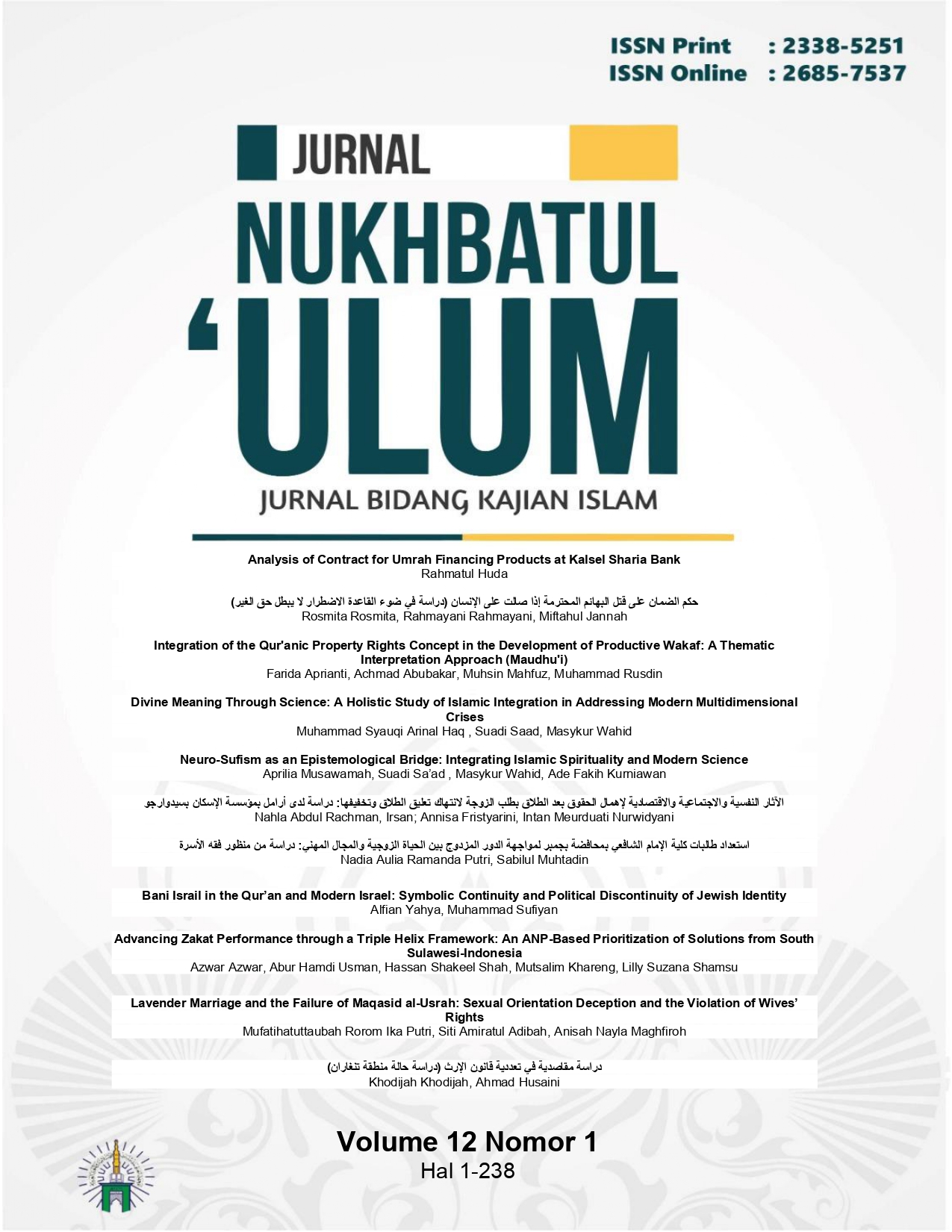
Neuro-Sufism as an Epistemological Bridge: Integrating Islamic Spirituality and Modern Science
DOI:
https://doi.org/10.36701/nukhbah.v12i1.2975Keywords:
Neuro-Sufism, Epistemology, Sufism, Neuroscience, ConsciousnessAbstract
This study examines the epistemological integration between Sufism and modern neuroscience in response to the persistent dichotomy between religious and scientific knowledge in contemporary Islamic thought. While previous studies have explored the psychological and functional dimensions of spirituality, few have systematically formulated an integrative epistemological framework connecting Sufi consciousness with neuroscientific theories of consciousness. This research aims to analyze the epistemology of consciousness in Sufism, examine neuroscientific perspectives on consciousness, and formulate Neuro-Sufism as an interdisciplinary epistemological paradigm. The study employs qualitative library research using a hermeneutic-philosophical approach to classical Sufi texts, particularly the works of Al-Ghazali and Ibn ‘Arabi, alongside neuroscientific theories proposed by Antonio Damasio and Andrew Newberg. The findings demonstrate that Al-Ghazali’s concept of qalb as the center of spiritual awareness corresponds to neuroscientific understandings of emotional-cognitive integration within the brain, particularly in relation to self-awareness and emotional regulation. Likewise, Ibn ‘Arabi’s notion of transcendent consciousness reflects dimensions of higher awareness that parallel contemporary discussions on altered states of consciousness and neuroplasticity. The study further finds that spiritual practices such as dhikr contribute not only to spiritual purification but also to measurable neurological changes associated with attention, emotional stability, and mental regulation. Based on these findings, this study formulates Neuro-Sufism as an integrative epistemological framework that unites revelation, reason, spiritual experience, and empirical neuroscience without reducing spirituality to biological mechanisms. This framework offers theoretical contributions to contemporary Islamic epistemology and practical implications for education, spirituality, and mental health.
Downloads
References
Abdillah, Syaik, Ris’an Rusli, Hossein Muttaqi, and Moh In’ami. “Rasulullah’s Sufism: The Principle of Balance of Islamic Esotericism And Exotericism.” Religia 28, no. 1 (April 29, 2025): 133–53. https://doi.org/10.28918/religia.v28i1.8517.
Acikgenc, Alparslan. Islamic Science: An Illustrated History. Kuala Lumpur: Islamic Book Trust, 2009. https://books.google.com/books/about/Islamic_Science.html?id=ADveAAAAMAAJ.
Ahmad, Mudasir, and Tariq Rafeeq Khan. “Integrating Cognitive Science with Islamic Philosophy: Emergence and Current Challenges.” Indonesian Journal of Interdisciplinary Islamic Studies 7, no. 2 (December 31, 2024): 109–49. https://doi.org/10.20885/ijiis.vol7.iss2.art1.
Al-Ghazali, A H. Ihya Ulum Al-Din [The Revival of Religious Sciences] TRAN - Karim, F. New Delhi: Islamic Book Service, 2001.
Al-Kaisi, Meis. “Rethinking Conceptual Sufism: A Synthesis of Islamic Spirituality, Asceticism, and Mysticism.” Teosofi: Jurnal Tasawuf Dan Pemikiran Islam 11, no. 2 (October 27, 2021): 169–93. https://doi.org/10.15642/teosofi.2021.11.2.169-193.
Andrabi, Abroo. “Human Psychology and Spiritual Development: An Islamic Perspective.” International Journal For Multidisciplinary Research 7, no. 3 (June 11, 2025): 291–302. https://doi.org/10.36948/ijfmr.2025.v07i03.47906.
Austin, James H. Zen and the Brain: Toward an Understanding of Meditation and Consciousness. Cambridge, MA: MIT Press, 1998. https://books.google.com/books/about/Zen_and_the_Brain.html?id=90MZAQAAIAAJ.
Barbour, I G. When Science Meets Religion: Enemies, Strangers, or Partners? New York: HarperCollins, 2000.
Brewer, Judson A., Patrick D. Worhunsky, Jeremy R. Gray, Yi-Yuan Tang, Jochen Weber, and Hedy Kober. “Meditation Experience Is Associated with Differences in Default Mode Network Activity and Connectivity.” Proceedings of the National Academy of Sciences 108, no. 50 (December 13, 2011): 20254–59. https://doi.org/10.1073/pnas.1112029108.
Calderone, Andrea, Desirée Latella, Federica Impellizzeri, Paolo de Pasquale, Fausto Famà, Angelo Quartarone, and Rocco Salvatore Calabrò. “Neurobiological Changes Induced by Mindfulness and Meditation: A Systematic Review.” Biomedicines 12, no. 11 (November 15, 2024): 2613-2630. https://doi.org/10.3390/biomedicines12112613.
Clayton, P. Mind and Emergence: From Quantum to Consciousness. Oxford: Oxford University Press, 2006.
Damasio, Antonio, and Hanna Damasio. “Sensing, Feeling and Consciousness.” Philosophical Transactions of the Royal Society B: Biological Sciences 379, no. 1908 (August 26, 2024): 1–3. https://doi.org/10.1098/rstb.2023.0243.
Doufesh, Hazem, Tarig Faisal, Kheng-Seang Lim, and Fatimah Ibrahim. “EEG Spectral Analysis on Muslim Prayers.” Applied Psychophysiology and Biofeedback 37, no. 1 (March 1, 2012): 11–18. https://doi.org/10.1007/s10484-011-9170-1.
Doufesh, Hazem, Fatimah Ibrahim, Noor Azina Ismail, and Wan Azman Wan Ahmad. “Effect of Muslim Prayer ( Salat ) on α Electroencephalography and Its Relationship with Autonomic Nervous System Activity.” The Journal of Alternative and Complementary Medicine 20, no. 7 (July 2014): 558–62. https://doi.org/10.1089/acm.2013.0426.
Ema Fitriya, Nur Hani’ah, and Hanifatul Khofifah. “Tasawuf Dalam Perspektif Psikologi: Harmoni Spiritual Dan Kesehatan Mental.” AJMIE: Alhikam Journal of Multidisciplinary Islamic Education 5, no. 2 (January 9, 2025): 291-306. https://doi.org/10.32478/8zv7ag68.
Faruque, Muhammad U. “Attention, Consciousness, and Self-Cultivation in Sufi-Philosophical Thought.” Üsküdar Üniversitesi Tasavvuf Araştırmaları Enstitüsü Dergisi 2, no. 2 (November 2023): 300–316. https://doi.org/10.32739/ustad.2023.4.56.
Firdaus, Firdaus, Hendri Hendri, Ahmad Lahmi, Dasrizal Dahlan, and Rosniati Hakim. “Neuroembriologi Dan Perkembangan Otak.” Journal of Innovative and Creativity (Joecy) 5, no. 2 (2025): 11296–306. https://doi.org/10.31004/joecy.v5i2.1828.
Fuad, Muskinul, and Lutfi Faishol. “Epistemological Reason of Islamic Psychology: Discourse Analysis of the Development of Islamic Psychology Studies in Indonesia.” Ijtimā Iyya Journal of Muslim Society Research 7, no. 2 (March 31, 2023): 182–206. https://doi.org/10.24090/ijtimaiyya.v7i2.7798.
Guessoum, Nidhal. Islam’s Quantum Question: Reconciling Muslim Tradition and Modern Science. London: I.B. Tauris, 2011. https://books.google.com/books/about/Islam_s_Quantum_Question.html?id=5nXmAAAAMAAJ.
Hayat, Teten Jalaludin, Nasihun Amin, and Nizar Nizar. “The Epistemology of Sufi Healing in the Book Miftāḥ Al-Ṣudūr by Pangersa Abah Anom.” Teosofia: Indonesian Journal of Islamic Mysticism 13, no. 2 (December 9, 2024): 239–68. https://doi.org/10.21580/tos.v13i2.21941.
Huda, Muhammad Najihul, and Khoirul Huda. “Harmonisasi Agama Dan Kemajuan: Manfaat Integrasi Keilmuan Islam Dalam Era Kontemporer.” Journal of Islamic Education 10, no. 1 (January 30, 2024): 146–62. https://doi.org/10.18860/jie.v11i1.24012.
Ihsan, Nur Hadi, Wan Mohd Azam Mohd Amin, Muhammad Ammar Tsaqib, and Jusmidar Jusmidar. “BRIDGING THE EPISTEMOLOGICAL DIVIDE: ARSYAD AL-BANJARI’S MA’RIFAH AS A RESPONSE TO WESTERN EPISTEMOLOGICAL DILEMMAS.” Al-Qalam 31, no. 1 (June 16, 2025): 71–84. https://doi.org/10.31969/alq.v31i1.1596.
Indra Purnamanita, Eka Ismaya. “Kajian Tasawuf Falsafi Mengenai Wahdat Al-Wujud Ibn Arabi (1165-1243 M).” TIN: Terapan Informatika Nusantara 4, no. 6 (November 29, 2023): 345–49. https://doi.org/10.47065/tin.v4i6.4629.
Irham, M. Iqbal. “Sufism Psychotherapy: Hudur Al-Qalb Method For Mental Health.” Journal of Asian Wisdom and Islamic Behavior 1, no. 2 (September 30, 2023): 95–103. https://doi.org/10.59371/jawab.v1i2.58.
Jailani, Mohammad. “Exploring The Development Of Neuroscience In The Light Of Islamic Perspectives: A Qualitative Literature Review.” Jurnal Studi Islam 12, no. 1 (August 25, 2023): 99–118. https://doi.org/10.33477/jsi.v12i1.3489.
Jenuri, Achmad Faqihuddin, Edi Suresman, and Mulyana Abdullah. “Overcoming the Spiritual Emptiness of Students in the Modern Era through the Integration of Al-Ghazali’s Human Concepts in the Islamic Religious Education Learning Model.” Cogent Education 12, no. 1 (December 31, 2025): 1–18. https://doi.org/10.1080/2331186X.2025.2497147.
Kaharu, Ninin Riska Syahfitri, and Indo Santalia. “The Concept of Mahabbah and Makrifah in the Sufism Thought of Rabiah Al-Adawiyah and Al-Ghazali: Relevance for Contemporary Islamic Spirituality.” IJoIS: Indonesian Journal of Islamic Studies 5, no. 2 (December 27, 2024): 19–24. https://doi.org/10.59525/ijois.v5i2.551.
Kaya, Emrah. “Knowledge In The Main Sources Of The Philosophy Of Sufism In The Pre-Ghazzālī Period.” Dinbilimleri Akademik Araştırma Dergisi 20, no. 2 (September 30, 2020): 1403–27. https://doi.org/10.33415/daad.743757.
Keshavarzi, Hooman, and Amber Haque. “Outlining a Psychotherapy Model for Enhancing Muslim Mental Health Within an Islamic Context.” International Journal for the Psychology of Religion 23, no. 3 (July 2013): 230–49. https://doi.org/10.1080/10508619.2012.712000.
Kizi, Yarashova. “Ibn Arabi’s Epistemological Views In The Context of Sufism and Islamic Philosophy.” Buletin Antropologi Indonesia 2, no. 1 (January 20, 2025): 1-8. https://doi.org/10.47134/bai.v2i1.3616.
Kusumo, Aditya Aryo Nur, Sukron Kamil, and M. Atho Mudzhar. “Development of Islamic Psychology Interdisciplinary Approaches in the Era of Contemporary Science.” Millati: Journal of Islamic Studies and Humanities 8, no. 2 (February 16, 2024): 213–35. https://doi.org/10.18326/millati.v8i2.545.
Lagunov, Aleksey A., and Svetlana Yu. Ivanova. “Philosophical and Methodological Problems of Modern Neurotheology.” RUDN Journal of Philosophy 27, no. 4 (December 15, 2023): 915–27. https://doi.org/10.22363/2313-2302-2023-27-4-915-927.
Lumingkewas, Priscilla E., Taufiq F. Pasiak, and Shane H.R. Ticoalu. “Indikator Yang Membedakan Gejala Psikotik Dengan Pengalaman Spiritual Dalam Perspektif Neurosains (Neuro-Anatomi).” Jurnal E-Biomedik 5, no. 2 (2017): 1-6. https://doi.org/10.35790/ebm.5.2.2017.18515.
Mirzarakhimov, Bakhtiyor. “The Essence of the Concept of Wahdat Al-Wujud in Muhyiddin Ibn Arabi’s Sufism: An Analysis Based on the ‘Risalat Al-Wujudiyya.’” Journal of Islamic Thought and Civilization 15, no. 1 (April 25, 2025): 99–112. https://doi.org/10.32350/jitc.151.06.
Nasr, Seyyed Hossein. Knowledge and the Sacred. Edinburgh: Edinburgh University Press, 1981. https://books.google.com/books/about/Knowledge_and_the_Sacred.html?id=fXwOAQAAIAAJ.
Nasruddin, Muhammad, and Abdul Muiz. “Tinjauan Kritis Neurosains Terhadap Konsep Qalb Menurut Al-Ghazali.” Syifa Al-Qulub 4, no. 2 (January 29, 2020): 70–87. https://doi.org/10.15575/saq.v4i2.7736.
Newberg, Andrew, and Eugene d’Aquili. Why God Won’t Go Away: Brain Science and the Biology of Belief. New York: Ballantine Books, 2001. https://books.google.com/books/about/Why_God_Won_t_Go_Away.html?id=76VvAAAAMAAJ.
Ngadiman, and Kholid Mawardi. “Integrasi Islam Dan Sains Model Tasawuf.” COMSERVA Indonesian Jurnal of Community Services and Development 1, no. 11 (March 28, 2022): 927–31. https://doi.org/10.36418/comserva.v1i11.93.
Pertel, Noémie Le, Jonathan Fisher, and Nick van Dam. “Neuroscience of Embodied Reflection: Somatic/Mindbody/Contemplative Practices, Health, and Transformative Learning.” Reflective Practice 21, no. 6 (November 1, 2020): 803–18. https://doi.org/10.1080/14623943.2020.1827492.
Putra, Akhmad Fitriansyah Mandala, and Suyadi Suyadi. “The Concept of Neuroscience-Based Inclusive Islamic Education for Millennial Generation: A Literature Review.” Jurnal Penelitian Pendidikan Islam 10, no. 1 (August 30, 2022): 41-50. https://doi.org/10.36667/jppi.v10i1.933.
Sholeh, Mohammad, and Ali Mudlofir. “Pendidikan Tasawuf Dalam Neurosains Dan Kontribusinya Terhadap Spiritualitas Masyarakat Modern.” Al Qalam: Jurnal Ilmiah Keagamaan Dan Kemasyarakatan 18, no. 5 (2024): 3767-3787. https://doi.org/10.35931/aq.v18i5.3047.
Sumaiya, Bushra, Noorain Anas, and Eram Aziz. “Spirituality and Mental Well-Being: Designing a Holistic Educational Framework for Psycho-Spiritual Resilience.” Asian Journal of Education and Social Studies 51, no. 7 (July 9, 2025): 1131–41. https://doi.org/10.9734/ajess/2025/v51i72198.
Suyadi, Suyadi. “Hybridization of Islamic Education and Neuroscience: Transdisciplinary Studies of ’Aql in the Quran and the Brain in Neuroscience.” Dinamika Ilmu, December 15, 2019, 237–49. https://doi.org/10.21093/di.v19i2.1601.
Suyadi, Suyadi. “Integrasi Pendidikan Islam Dan Neurosains Dan Implikasinya Bagi Pendidikan Dasar (PGMI).” Al-Bidayah : Jurnal Pendidikan Dasar Islam 4, no. 1 (September 14, 2024): 111-130. https://doi.org/10.14421/al-bidayah.v4i1.9003.
Syafii, Muhammad Hisyam, Rudyn Alaldaya, Halim Purnomo, and Husain Azhari. “Neurocognitive-Spiritual Based Psychopedagogy in Improving Working Memory and Emotional Intelligence in Muslim Students.” Journal of Islamic Education and Ethics 3, no. 2 (July 11, 2025): 151–66. https://doi.org/10.18196/jiee.v3i2.86.
Waliyuddin, Muhammad Naufal. “Spiritualitas Dalam Perspektif Tasawuf Dan Neurosains: Relasi Komplementer Atau Kompartemen?” Refleksi Jurnal Filsafat Dan Pemikiran Islam 21, no. 2 (February 25, 2022): 263–83. https://doi.org/10.14421/ref.v21i2.3239.
Zifamina, Ikhbar F. “Apologi Teologis Atas Ibn’Arabi : Analisis Kritis Kitab Al-Yawaqit Wa Al-Jawahir Fi ’Aqaid Al-Akabir Karya Imam Sya’rani.” Refleksi Jurnal Filsafat Dan Pemikiran Islam 21, no. 2 (2022): 241-259. https://doi.org/10.14421/ref.2021.2102-06.
Zubaidi, and Moh. In’ami. Pendidikan Islam 5.0: Integrasi Spiritualitas Dan Teknologi Di Era Disrupsi. Zahir Publishing, 2025.
Zulkifli, Zulkifli, Ahmad Lahmi, Dasrizal Dahlan, and Rosniati Hakim. “Mekanisme Kerja Otak Dan Sistem Saraf: Perspektif Neurosains Pendidikan Islam.” Menara Ilmu 19, no. 1 (January 15, 2025): 118–30. https://doi.org/10.31869/mi.v19i1.6138.
Downloads
Published
Issue
Section
License
Copyright (c) 2026 Aprilia Musawamah, Suadi Sa’ad , Masykur Wahid, Ade Fakih Kurniawan

This work is licensed under a Creative Commons Attribution-NonCommercial-ShareAlike 4.0 International License.